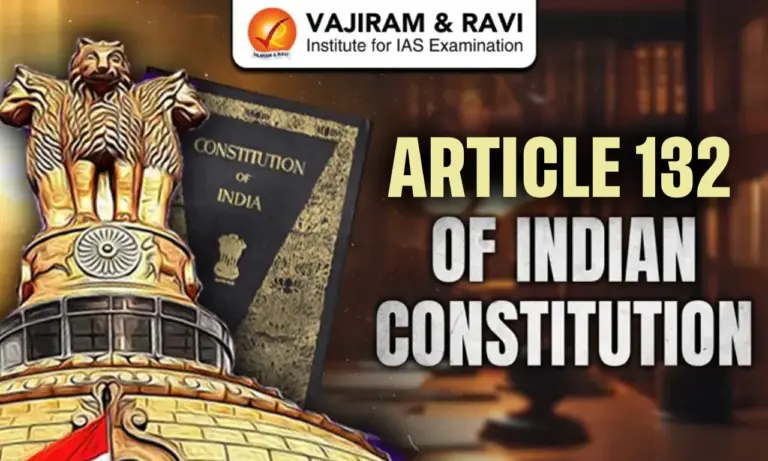
Article 132 of Indian Constitution provides appellate jurisdiction to the Supreme Court in cases involving substantial questions of law related to the interpretation of the Constitution. It ensures that important constitutional issues decided by High Courts can be reviewed by the highest court of the country. This provision creates a structured legal pathway for appeals in civil, criminal, or other proceedings where constitutional interpretation is involved. It plays a key role in maintaining uniformity, clarity and authority in constitutional law across India.
Article 132 of Indian Constitution Provisions
Article 132 of Indian Constitution defines conditions under which appeals from High Courts to the Supreme Court are allowed in cases involving constitutional interpretation.
- Right to Appeal to Supreme Court: Article 132(1) allows an appeal to the Supreme Court from any judgment, decree, or final order of a High Court if the case involves a substantial constitutional question.
- Applicability: This provision applies to civil, criminal, or any other type of proceeding, ensuring that constitutional issues across all legal matters can reach the Supreme Court.
- Requirement of High Court Certification: An appeal is permitted only when the High Court certifies that the case involves a substantial question of law related to interpretation of the Constitution.
- Power of Supreme Court to Grant Leave: Under clause (2), if the High Court refuses certification, the Supreme Court may still allow an appeal if it is satisfied that a substantial constitutional question exists.
- Appeal by Any Party: Article 132(3) allows any party involved in the case to appeal to the Supreme Court once certification or special leave is granted.
- Grounds of Appeal: The appeal can be filed on the ground that the constitutional question involved in the case has been wrongly decided by the High Court.
- Final Order: The explanation clarifies that a “final order” includes decisions on key issues that could completely dispose of the case if decided in favour of the appellant.
Article 132 of Indian Constitution Case Laws
Important judicial decisions highlight the scope of Article 132 of Indian Constitution and clarify its role in constitutional interpretation and appellate jurisdiction.
- Kesavananda Bharati v. State of Kerala (1973): This landmark case used Article 132 jurisdiction and led to the Basic Structure Doctrine, limiting Parliament’s power to amend the Constitution.
- Minerva Mills Ltd. v. Union of India (1980): The Supreme Court reaffirmed that constitutional amendments must preserve the basic structure, reinforcing its appellate role in constitutional matters.
- L. Chandra Kumar v. Union of India (1997): The Court emphasized judicial review as a fundamental feature of the Constitution, showing the importance of Supreme Court appeals in constitutional interpretation.
- State of West Bengal v. Committee for Protection of Land Rights (2006): The Court clarified that a substantial constitutional question must have wider public importance to qualify for appeal.
- M.C. Mehta v. Union of India (1987): The case demonstrated that even in environmental matters, constitutional interpretation can bring cases under Article 132 jurisdiction.






Article 132 of Indian Constitution Significance
Article 132 of Indian Constitution ensures constitutional consistency and provides a clear appellate mechanism for resolving important legal questions.
- Ensures Uniform Interpretation: By allowing appeals to the Supreme Court, Article 132 maintains consistency in interpretation of constitutional provisions across different High Courts.
- Strengthens Supreme Court Authority: It reinforces the role of the Supreme Court as the final interpreter and guardian of the Constitution in India.
- Filters Important Cases Only: The requirement of a substantial question of law ensures that only significant constitutional matters reach the Supreme Court.
- Protects Constitutional Supremacy: The provision ensures that any incorrect interpretation by High Courts can be corrected at the highest judicial level.
- Supports Rule of Law: It provides a structured legal process for resolving constitutional disputes, strengthening legal certainty and fairness.
- Balances Judicial Workload: By requiring certification or special leave, it prevents unnecessary appeals and ensures efficient functioning of the Supreme Court.
- Covers Wide Range of Cases: Since it applies to civil, criminal and other proceedings, it ensures that constitutional issues in all types of disputes are addressed.
- Clarifies Legal Framework: The concept of “final order” helps determine when an appeal can be made, reducing ambiguity in legal procedures.
- Reflects Constitutional Intent: The debates during its adoption show that the Article was designed to deal only with constitutional questions, not general legal issues.
- Ensures Access to Justice: It provides parties an opportunity to challenge incorrect constitutional interpretation, ensuring fairness and justice at the highest level.

 Last updated on April, 2026
→ UPSC Final Result 2025 is now out.
→ UPSC has released UPSC Toppers List 2025 with the Civil Services final result on its official website.
→ Anuj Agnihotri secured AIR 1 in the UPSC Civil Services Examination 2025.
→ UPSC Marksheet 2025 is now out.
→ UPSC Notification 2026 & UPSC IFoS Notification 2026 is now out on the official website at upsconline.nic.in.
→ UPSC Calendar 2026 has been released.
→ Check out the latest UPSC Syllabus 2026 here.
→ UPSC Prelims 2026 will be conducted on 24th May, 2026 & UPSC Mains 2026 will be conducted on 21st August 2026.
→ The UPSC Selection Process is of 3 stages-Prelims, Mains and Interview.
→ Prepare effectively with Vajiram & Ravi’s UPSC Prelims Test Series 2026 featuring full-length mock tests, detailed solutions, and performance analysis.
→ Enroll in Vajiram & Ravi’s UPSC Mains Test Series 2026 for structured answer writing practice, expert evaluation, and exam-oriented feedback.
→ Join Vajiram & Ravi’s Best UPSC Mentorship Program for personalized guidance, strategy planning, and one-to-one support from experienced mentors.
→ Shakti Dubey secures AIR 1 in UPSC CSE Exam 2024.
→ Also check Best UPSC Coaching in India
Article 132 of Indian Constitution FAQs
Q1. What does Article 132 of Indian Constitution deal with? +
Q2. When can an appeal be made under Article 132? +
Q3. Can the Supreme Court allow appeal without High Court certification? +
Q4. What is meant by a “Final Order” under Article 132? +
Q5. What is the need of Article 132 of Indian Constitution? +
Tags: article 132 of indian constitution