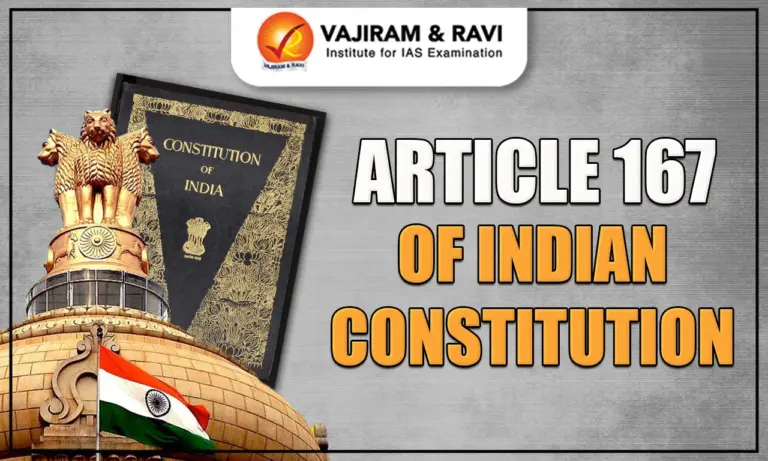
Article 167 of Indian Constitution, contained in Part VI, defines the duties of the Chief Minister in ensuring effective communication between the Governor and the Council of Ministers. This provision serves as a key element in the functioning of state governments, facilitating the smooth flow of information and reinforcing the Governor’s constitutional position as the head of the state. By mandating that the Chief Minister keep the Governor informed of decisions, it strengthens transparency, accountability, and administrative coordination in governance.
Article 167 of Indian Constitution
It shall be the duty of the Chief Minister of each State-
(a) to communicate to the Governor of the State all decisions of the Council of Ministers relating to the administration of the affairs of the State and proposals for legislation;
(b) to furnish such information relating to the administration of the affairs of the State and proposals for legislation as the Governor may call for; and
(c) if the Governor so requires, to submit for the consideration of the Council of Ministers any matter on which a decision has been taken by a Minister but which has not been considered by the Council.
Article 167 of Indian Constitution Interpretation
Under Article 167 of Indian Constitution, the Chief Minister is trusted with the duty of keeping the Governor informed of all decisions and proposals made by the Council of Ministers relating to the administration of the state and matters of legislation. The Chief Minister must also furnish the Governor with detailed information on any administrative or legislative matter whenever requested.
Where a decision has been taken by an individual Minister without review by the Council of Ministers, the Governor may direct that the matter be placed before the Council for consideration. This arrangement ensures that the Governor, as the constitutional head of the state, remains fully apprised of executive actions, thereby promoting transparency and accountability in governance.
Article 167 also underscores the Chief Minister’s role as the principal channel of communication between the Governor and the Council of Ministers, facilitating the discharge of the Governor’s constitutional functions and strengthening the coordination between the executive and the state’s constitutional head.





Who is Chief Minister?
-
Article 167 of the Indian Constitution is an important provision under Part VI.
-
It outlines the duties of the Chief Minister in maintaining communication between the Governor and the Council of Ministers.
-
The provision acts as a cornerstone for the operation of state governments.
-
It guarantees a smooth flow of information.
-
It upholds the constitutional role of the Governor as the head of the state.
-
It bolsters the principles of transparency, accountability, and administrative coordination in governance.
-
It requires the Chief Minister to inform the Governor of decisions.

 Last updated on March, 2026
→ UPSC Final Result 2025 is now out.
→ UPSC has released UPSC Toppers List 2025 with the Civil Services final result on its official website.
→ Anuj Agnihotri secured AIR 1 in the UPSC Civil Services Examination 2025.
→ UPSC Marksheet 2025 is now out.
→ UPSC Notification 2026 & UPSC IFoS Notification 2026 is now out on the official website at upsconline.nic.in.
→ UPSC Calendar 2026 has been released.
→ Check out the latest UPSC Syllabus 2026 here.
→ UPSC Prelims 2026 will be conducted on 24th May, 2026 & UPSC Mains 2026 will be conducted on 21st August 2026.
→ The UPSC Selection Process is of 3 stages-Prelims, Mains and Interview.
→ Prepare effectively with Vajiram & Ravi’s UPSC Prelims Test Series 2026 featuring full-length mock tests, detailed solutions, and performance analysis.
→ Enroll in Vajiram & Ravi’s UPSC Mains Test Series 2026 for structured answer writing practice, expert evaluation, and exam-oriented feedback.
→ Join Vajiram & Ravi’s Best UPSC Mentorship Program for personalized guidance, strategy planning, and one-to-one support from experienced mentors.
→ Shakti Dubey secures AIR 1 in UPSC CSE Exam 2024.
→ Also check Best UPSC Coaching in India
Article 167 of Indian Constitution FAQs
Q1. What does Article 167 deal with?+
Q2. Which part of the Constitution contains Article 167?+
Q3. What are the main duties of the Chief Minister under Article 167?+
Q4. Why is Article 167 important?+
Q5. Does Article 167 give power to the Governor over the Chief Minister?+
Tags: article 167 of indian constitution