What’s in today’s article?
- Why in News?
- Diphu and its social profile
- What is Article 244(A) of the Constitution?
- Demand for autonomy
Why in News?
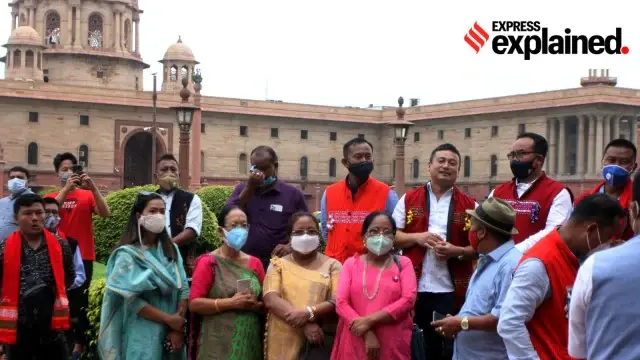
In the tribal-dominated Diphu Lok Sabha constituency in Assam candidates from all political parties have pledged to put into action Article 244(A) of the Constitution. Article 244(A) aims to establish an autonomous region, almost like a separate government within the state.





Diphu and its social profile
- Diphu is the most sparsely populated of Assam’s 14 Lok Sabha constituencies, with just 8.9 lakh voters.
- It is reserved for Scheduled Tribes (STs), and covers six legislative Assembly segments in three tribal-majority hill districts of Assam: Karbi Anglong, West Karbi Anglong, and Dima Hasao.
- These three districts are administered under the provisions of the Sixth Schedule of the Constitution.
- These areas come under two autonomous councils: the Karbi Anglong Autonomous Council (KAAC) and the North Cachar Hills Autonomous Council.
- Voters at the seat belong to various communities: Karbi (the third largest tribe in the state), Dimasa, Hmar, Kuki, Rengma Naga, Zeme Naga, Bodo, Garo, Assamese, Gorkha, etc.
What is Article 244(A) of the Constitution?
- 22nd amendment act of 1969
- The Constitution (Twenty-second Amendment) Act of 1969 introduced Article 244(A), allowing Parliament to create an autonomous region within Assam.
- This region could include certain tribal areas like Karbi Anglong.
- Key highlights
- In this autonomous region, there could be a separate governing body, like a Legislature or Council of Ministers, or both.
- This provision is more advanced than what’s currently in place under the Sixth Schedule for these areas.
- Difference from the Sixth Schedule of the Constitution
- Under the Sixth Schedule, there are already councils with elected representatives for decentralized governance in tribal areas.
- However, these councils have limited powers. They can’t control law enforcement, and their financial authority is also limited.
- On the other hand, Article 244(A) accounts for more autonomous powers to tribal areas. Among these the most important power is the control over law and order.
Demand for autonomy
- History of Autonomy Demand
- The quest for autonomy in the hill areas of undivided Assam dates back to the 1950s, with a movement seeking a separate hill state.
- This movement eventually led to the formation of Meghalaya as a full-fledged state in 1972.
- Despite this, leaders in the Karbi Anglong region chose to remain with Assam, influenced by the promise of autonomy under Article 244(A).
- Role of Autonomous State Demand Committee (ASDC)
- The Autonomous State Demand Committee (ASDC), established as a mass organization advocating for regional autonomy, played a pivotal role.
- In 1995, the ASDC, alongside local student bodies, reached a Memorandum of Settlement with state and central governments.
- This agreement aimed to bolster the powers of the two autonomous councils in the region by expanding their departmental authority from 10 to 30.
- Political Representation and Insurgency
- Frustrated by the elusive nature of autonomy, the demand for implementing Article 244(A) escalated into armed insurgency over the years.
- Both the Delhi and Guwahati governments have engaged in peace negotiations with militant groups, including the Karbi and Dimasa factions, signing several peace accords in the process.
- Peace settlement
- In 2021, a peace settlement was reached with five militant groups in Karbi Anglong.
- These groups included Karbi People’s Liberation Tigers, People’s Democratic Council of Karbi Longri, Karbi Longri NC Hills Liberation Front, Kuki Liberation Front, and United People’s Liberation Army.
- Under this settlement, greater autonomy and a special development package of Rs 1,000 crore over five years were promised.
- In 2023, an agreement was signed with the Dimasa National Liberation Army along the same lines.
- In 2021, a peace settlement was reached with five militant groups in Karbi Anglong.
Q.1. What is Sixth Schedule of the Indian Constitution?
The Sixth Schedule of the Indian Constitution protects tribal areas in Assam, Meghalaya, Tripura, and Mizoram. It was enacted in 1949 by the Constituent Assembly based on the recommendations of the Bordoloi Committee.
Q.2. What is Karbi Anglong Autonomous Council (KAAC)?
The Karbi Anglong Autonomous Council (KAAC) is an autonomous district council in the state of Assam, India. It is responsible for the development and protection of tribals living in the Karbi Anglong and West Karbi Anglong districts.

 Last updated on March, 2026
→ UPSC Final Result 2025 is now out.
→ UPSC has released UPSC Toppers List 2025 with the Civil Services final result on its official website.
→ Anuj Agnihotri secured AIR 1 in the UPSC Civil Services Examination 2025.
→ UPSC Marksheet 2025 is now out.
→ UPSC Notification 2026 & UPSC IFoS Notification 2026 is now out on the official website at upsconline.nic.in.
→ UPSC Calendar 2026 has been released.
→ Check out the latest UPSC Syllabus 2026 here.
→ UPSC Prelims 2026 will be conducted on 24th May, 2026 & UPSC Mains 2026 will be conducted on 21st August 2026.
→ The UPSC Selection Process is of 3 stages-Prelims, Mains and Interview.
→ Prepare effectively with Vajiram & Ravi’s UPSC Prelims Test Series 2026 featuring full-length mock tests, detailed solutions, and performance analysis.
→ Enroll in Vajiram & Ravi’s UPSC Mains Test Series 2026 for structured answer writing practice, expert evaluation, and exam-oriented feedback.
→ Join Vajiram & Ravi’s Best UPSC Mentorship Program for personalized guidance, strategy planning, and one-to-one support from experienced mentors.
→ Shakti Dubey secures AIR 1 in UPSC CSE Exam 2024.
→ Also check Best UPSC Coaching in India