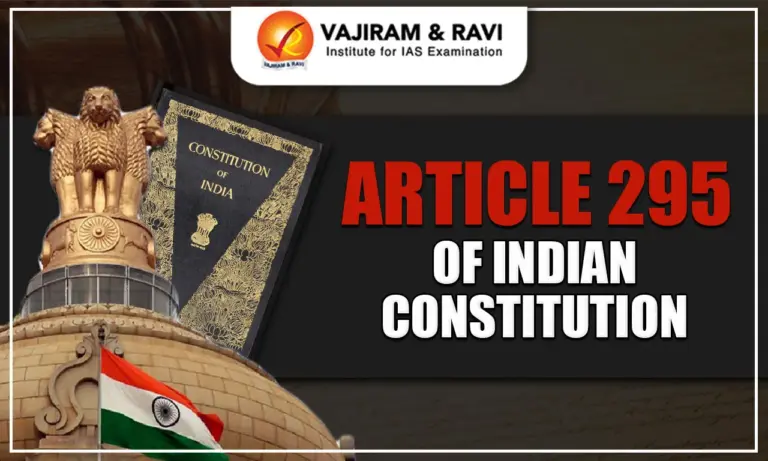
Article 295 of the Constitution of India covers the succession of property, rights, liabilities and obligations in cases. The article is extremely important as it helps in a transition of responsibilities from princely states to the Union and state government. In this article, we are going to cover Article 295, its importance, developments and amendments.
Article 295 of Constitution of India
Article 295 of the Constitution of India talks about the integration of princely states into the Indian Union after independence that needed guidelines for the transfer of assets and liabilities. The article covers all the guidelines that a princely state had to qualify in order to be succeeded by Union or state governments . These guidelines and rights and obligations help in setting legal clarity and governance.
Article 295 as Stated in the Indian Constitution
Succession to property, assets, rights, liabilities and obligations in other cases
(1) As from the commencement of this Constitution —
(a) all property and assets which immediately before such commencement were vested in any Indian State corresponding to a State specified in Part B of the First Schedule shall vest in the Union, if the purposes for which such property and assets were held immediately before such commencement will thereafter be purposes of the Union relating to any of the matters enumerated in the Union List; and
(b) all rights, liabilities, and obligations of the Government of any Indian State corresponding to a State specified in Part B of the First Schedule, whether arising out of any contract or otherwise, shall be the rights, liabilities, and obligations of the Government of India, if the purposes for which such rights were acquired or liabilities or obligations were incurred before such commencement will thereafter be purposes of the Government of India relating to any of the matters enumerated in the Union List, subject to any agreement entered into in that behalf by the Government of India with the Government of that State.
(2) Subject as aforesaid, the Government of each State specified in Part B of the First Schedule shall, as from the commencement of this Constitution, be the successor of the Government of the corresponding Indian State as regards all property and assets and all rights, liabilities, and obligations, whether arising out of any contract or otherwise, other than those referred to in clause (1).





Article 295 of Indian Constitution Landmark Cases
Although Article 295 has not been the centerpiece of numerous landmark Supreme Court judgments, its principles concerning the succession of assets and liabilities have been recognized and upheld in several important cases, especially in the context of the integration of princely states and the distribution of property between the Union and states. Key judgments include:
- State of Rajasthan v. Union of India (1977):
This case examined the scope of the Union’s powers over states and referred to the distribution of assets and liabilities during the integration process. The Supreme Court acknowledged the significance of constitutional provisions like Article 295 in maintaining the federal structure. - Madhav Rao Scindia v. Union of India (1971):
The abolition of privy purses and derecognition of princely rulers raised questions about property rights. The Court analyzed how such changes impacted asset succession, underlining the role of Article 295 in resolving disputes arising from constitutional transitions. - State of Seraikella & Others v. Union of India (1951):
This case involved merger agreements of princely states and the transfer of assets and liabilities to the Union. The judgment highlighted the practical relevance of Article 295 in legitimizing such transfers. - Bholanath J. Thakar v. State of Saurashtra (1954):
The Court addressed disputes stemming from pre-accession agreements of princely states. Article 295 was cited to determine the rights and obligations carried forward after integration.
These judgments reflect how Article 295 has been a constitutional anchor in settling legal issues linked to the succession of assets and liabilities post-independence, particularly in cases involving the merger of princely states into the Indian Union.
Article 295 of Constitution of India Importance
Article 295 in India’s Constitutional Framework has the following importance:
- Enabling Integration: Article 295 established the legal basis for transferring the assets and liabilities of princely states to the Indian Union, thereby smoothing their incorporation into the Republic.
- Guaranteeing Continuity: By prescribing how property and obligations would pass to the Union or the states, the provision ensured administrative stability throughout the post-independence transition.
- Defining Jurisdiction: It clearly allocated responsibility between the Union and the states for the estates of former princely rulers, averting jurisdictional disputes and ambiguity.
Collectively, Article 295 provided the legal architecture that underpinned the orderly consolidation of a newly independent India.

 Last updated on March, 2026
→ UPSC Final Result 2025 is now out.
→ UPSC has released UPSC Toppers List 2025 with the Civil Services final result on its official website.
→ Anuj Agnihotri secured AIR 1 in the UPSC Civil Services Examination 2025.
→ UPSC Marksheet 2025 is now out.
→ UPSC Notification 2026 & UPSC IFoS Notification 2026 is now out on the official website at upsconline.nic.in.
→ UPSC Calendar 2026 has been released.
→ Check out the latest UPSC Syllabus 2026 here.
→ UPSC Prelims 2026 will be conducted on 24th May, 2026 & UPSC Mains 2026 will be conducted on 21st August 2026.
→ The UPSC Selection Process is of 3 stages-Prelims, Mains and Interview.
→ Prepare effectively with Vajiram & Ravi’s UPSC Prelims Test Series 2026 featuring full-length mock tests, detailed solutions, and performance analysis.
→ Enroll in Vajiram & Ravi’s UPSC Mains Test Series 2026 for structured answer writing practice, expert evaluation, and exam-oriented feedback.
→ Join Vajiram & Ravi’s Best UPSC Mentorship Program for personalized guidance, strategy planning, and one-to-one support from experienced mentors.
→ Shakti Dubey secures AIR 1 in UPSC CSE Exam 2024.
→ Also check Best UPSC Coaching in India
Article 295 of Indian Constitution FAQs
Q1. What is Article 295 of the Indian Constitution?+
Q2. What is Article 296 of the Indian Constitution?+
Q3. What is Article 299 of the Indian Constitution?+
Q4. What are the Princely states that joined the Indian Union?+
Q5. What are the guidelines to join the Indian Union?+
Tags: article 295 of indian constitution