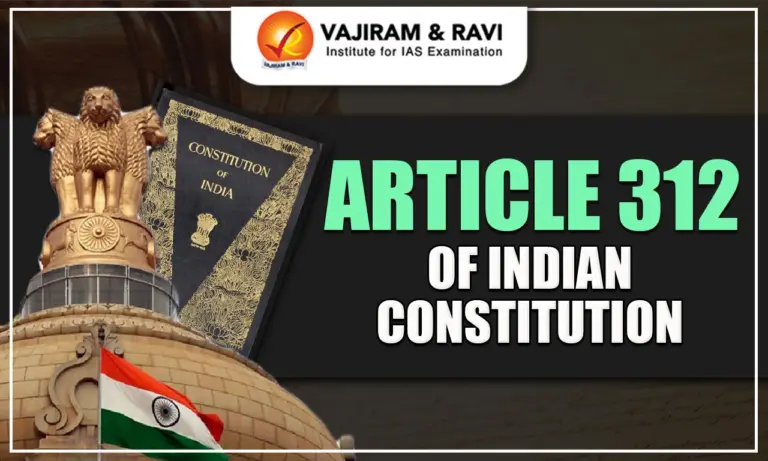
Article 312 of Indian Constitution is discussed in part of Part XIV which strengthens administrative unity and efficiency through the establishment of All-India Services (AIS). Officers serve both the Union and State governments, ensuring a uniform system of recruitment, training, and service conditions. The article empowers Parliament to create new AIS, such as the proposed All India Judicial Service (AIJS). Rajya Sabha requires a two-thirds majority resolution in the Council of States, declaring it necessary in the national interest.
Article 312 of Indian Constitution
- Notwithstanding anything in Chapter VI of Part VI or Part XI, if the Council of States has declared by resolution supported by not less than two-thirds of the members present and voting that it is necessary or expedient in the national interest so to do, Parliament may by law provide for the creation of one or more all-India services (including an all-India judicial service) common to the Union and the States, and, subject to the other provisions of this Chapter, regulate the recruitment, and the conditions of service of persons appointed, to any such service.
- The services known at the commencement of this Constitution as the Indian Administrative Service and the Indian Police Service shall be deemed to be services created by Parliament under this article.
- The all-India judicial service referred to in clause (1) shall not include any post inferior to that of a district judge as defined in article 236.
- The law providing for the creation of the all-India judicial service aforesaid may contain such provisions for the amendment of Chapter VI of Part VI as may be necessary for giving effect to the provisions of that law and no such law shall be deemed to be an amendment of this Constitution for the purposes of article 368.
Article 312 of Indian Constitution Interpretation
Article 312 of Indian Constitution found in Part XIV of the Constitution, which deals with Services under the Union and the States.
- Clause (1) – Parliament can create new All-India Services (AIS), including a judicial service, if the Rajya Sabha passes a resolution by a two-thirds majority declaring it necessary in the national interest.
- Clause (2) – The existing Indian Administrative Service (IAS) and Indian Police Service (IPS) are deemed to have been created under this Article.
- Clause (3) – An All-India Judicial Service (AIJS) would include only posts not below the rank of District Judge, as defined in Article 236.
- Clause (4) – Any law to create AIJS can amend Chapter VI of Part VI (subordinate courts), but it will not be treated as a constitutional amendment under Article 368.





Article 312 of Indian Constitution and AIJS Background
- 1958 – The 14th Law Commission Report first recommended creating AIJS to improve efficiency and uniformity in judicial appointments.
- 1976 – The 42nd Constitutional Amendment added Clauses (3) and (4) to Article 312, paving the way for AIJS.
- 1978 & 2006 – The Law Commission and Parliamentary Standing Committee revisited the proposal, stressing its relevance.
- 2008 – The 213th Law Commission Report reiterated the urgent need for AIJS to address judicial vacancies and delays.
- Recent Years – Support from both judiciary and executive has revived the debate, framing AIJS as a national interest measure to tackle pendency and strengthen judicial capacity.
All India Judicial Service Overview
- Objective-Create a centralised cadre of judicial officers selected through a common national examination.
- Level of Appointment-Primarily for District Judges, with possible extension to other subordinate judiciary roles.
- Recruitment Model-Modeled on UPSC-style recruitment for IAS/IPS, ensuring transparency and merit.
- Scope-Promote judicial diversity, speed up vacancy filling, and allow career mobility for judges.
Judicial and Executive Views
- Justice D.Y. Chandrachud (2024)-Called AIJS necessary to address 21% vacancies in the district judiciary.
- President Droupadi Murmu (2023)-Supported a system to recruit young, capable legal professionals to IAS/IPS selection.
Need for AIJS
- Vacancy Crisis-Over 5,400 vacancies and 2.78 crore pending cases require faster, streamlined recruitment.
- Standardization-A single merit-based exam ensures uniform national criteria.
- Diversity-Broad-based selection can improve representation in the judiciary.
- Judicial Independence-Helps limit political or local interference in appointments.
- Career Path-Provides structured promotion avenues.
Challenges in Implementation
- Lack of Consensus-Divergent opinions among states and High Courts on feasibility.
- Legislative Inaction-No concrete progress since 2022.
- Dual Accountability-Balancing administrative control between Centre and States is complex.
- Transition Issues-Integrating AIJS with existing judicial structures requires major logistical adjustments.
Article 312 of Indian Constitution Significance
- Sets consistent national standards for recruitment, training, and promotions.
- Enables judges from different regions to serve across states, promoting a pan-Indian judicial identity.
- Recruitment is centralised, but appointments are fulfilled to each state’s requirements, maintaining the federal balance.
- A national-level exam ensures selection of highly capable candidates for judicial posts.
Article 312 of Indian Constitution Important Case
Article 312 of Indian Constitution Important Case includes various landmark judgements out of which one of a notable case is All India Judge Association vs Union of India. During this case, the Supreme Court has set up the requirement for uniformity in appointment of the judicial system.

 Last updated on April, 2026
→ UPSC Final Result 2025 is now out.
→ UPSC has released UPSC Toppers List 2025 with the Civil Services final result on its official website.
→ Anuj Agnihotri secured AIR 1 in the UPSC Civil Services Examination 2025.
→ UPSC Marksheet 2025 is now out.
→ UPSC Notification 2026 & UPSC IFoS Notification 2026 is now out on the official website at upsconline.nic.in.
→ UPSC Calendar 2026 has been released.
→ Check out the latest UPSC Syllabus 2026 here.
→ UPSC Prelims 2026 will be conducted on 24th May, 2026 & UPSC Mains 2026 will be conducted on 21st August 2026.
→ The UPSC Selection Process is of 3 stages-Prelims, Mains and Interview.
→ Prepare effectively with Vajiram & Ravi’s UPSC Prelims Test Series 2026 featuring full-length mock tests, detailed solutions, and performance analysis.
→ Enroll in Vajiram & Ravi’s UPSC Mains Test Series 2026 for structured answer writing practice, expert evaluation, and exam-oriented feedback.
→ Join Vajiram & Ravi’s Best UPSC Mentorship Program for personalized guidance, strategy planning, and one-to-one support from experienced mentors.
→ Shakti Dubey secures AIR 1 in UPSC CSE Exam 2024.
→ Also check Best UPSC Coaching in India
Article 312 of Indian Constitution FAQs
Q1. What does Article 312 deal with?+
Q2. What are All-India Services?+
Q3. Who can create a new All-India Service under Article 312?+
Q4. Why is the Rajya Sabha’s role crucial in Article 312?+
Q5. Has Article 312 been used to create services after the Constitution came into force?+
Tags: article 312 of indian constitution