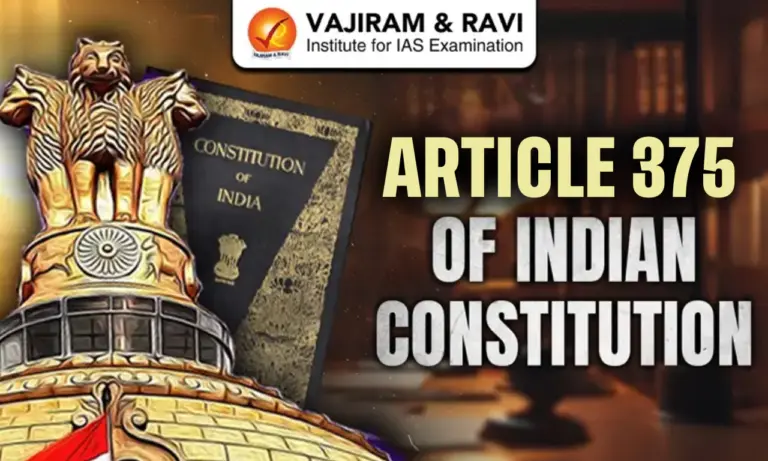
Article 375 of Indian Constitution is a provision that ensures smooth continuity in India’s judicial system after the Constitution came into force in 1950. It states that all courts, judges, and legal proceedings that were functioning before the Constitution would continue to operate until new arrangements were made under the Constitution.
Article 375 of Indian Constitution Key Aspects
- Article 375: All courts of civil, criminal and revenue jurisdiction, all authorities and all officers, judicial, executive and ministerial, throughout the territory of India, shall continue to exercise their respective functions subject to the provisions of this Constitution.
- It is part of Part XXI (Temporary, Transitional and Special Provisions) of the Constitution.
- It allowed courts, judges, police, and administrative officers to continue their work after 1950.
- It ensured that all these institutions would now function according to the Constitution.
- It acted as a bridge between the old British-era system and the new constitutional system.
Article 375 of Indian Constitution Scope
- Applies to all courts and judicial authorities that existed before the Constitution came into force.
- Covers judges, court officials, and ongoing cases, ensuring they continue without disruption.
- Validates the continuation of existing legal procedures and practices until new laws or structures are introduced.
- Operates until the new judicial system (such as High Courts and the Supreme Court) is fully functional under the Constitution.






Article 375 of Indian Constitution Significance
- Played a key role in ensuring a smooth transition from colonial to constitutional governance.
- Prevented delays and uncertainty in the administration of justice during the early years of independence.
- Maintained public confidence in the legal system by ensuring continuity and stability.
- Acted as a bridge between the old judicial system and the new constitutional framework.

 Last updated on April, 2026
→ UPSC Final Result 2025 is now out.
→ UPSC has released UPSC Toppers List 2025 with the Civil Services final result on its official website.
→ Anuj Agnihotri secured AIR 1 in the UPSC Civil Services Examination 2025.
→ UPSC Marksheet 2025 is now out.
→ UPSC Notification 2026 & UPSC IFoS Notification 2026 is now out on the official website at upsconline.nic.in.
→ UPSC Calendar 2026 has been released.
→ Check out the latest UPSC Syllabus 2026 here.
→ UPSC Prelims 2026 will be conducted on 24th May, 2026 & UPSC Mains 2026 will be conducted on 21st August 2026.
→ The UPSC Selection Process is of 3 stages-Prelims, Mains and Interview.
→ Prepare effectively with Vajiram & Ravi’s UPSC Prelims Test Series 2026 featuring full-length mock tests, detailed solutions, and performance analysis.
→ Enroll in Vajiram & Ravi’s UPSC Mains Test Series 2026 for structured answer writing practice, expert evaluation, and exam-oriented feedback.
→ Join Vajiram & Ravi’s Best UPSC Mentorship Program for personalized guidance, strategy planning, and one-to-one support from experienced mentors.
→ Shakti Dubey secures AIR 1 in UPSC CSE Exam 2024.
→ Also check Best UPSC Coaching in India
Article 375 of Indian Constitution FAQs
Q1. What is Article 375 of the Indian Constitution?+
Q2. Which part of the Constitution includes Article 375?+
Q3. What is the main objective of Article 375?+
Q4. What does Article 375 provide for?+
Q5. What is the scope of Article 375?+
Tags: Article 375 of Indian Constitution polity polity notes