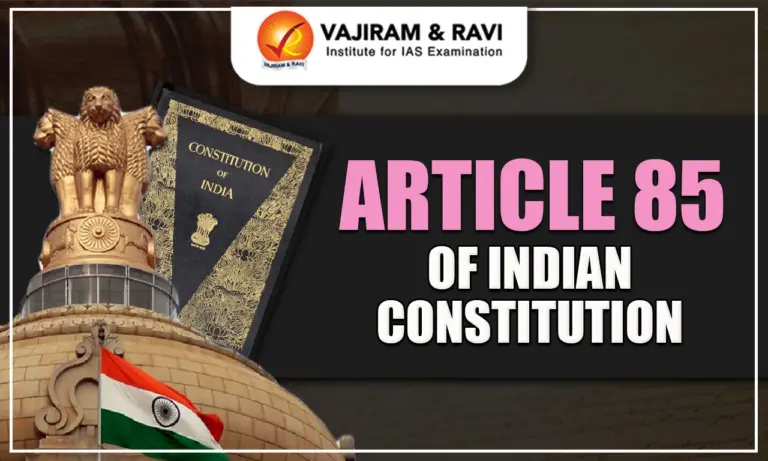
The Constitution of India lays down the framework that determines the structure and functioning of the government of the country. Article 85 of Indian Constitution discusses the sessions of the Parliament, Prorogation and Dissolution, it sets out the procedure for convening parliamentary sessions, the conditions under which they can be prorogued, and the circumstances in which they may be dissolved. This provision ensures Parliament works efficiently while keeping a balance of power between the legislature and the executive.
Article 85 of Indian Constitution Interpretation
Article 85 of Indian Constitution says that the President can summon each House of Parliament at times and places he thinks fit, but there can’t be more than six months between the last sitting of one session and the first sitting of the next. It also allows the President to:
- Prorogue either House or both Houses.
- Dissolve the Lok Sabha.
Parliament is required to meet at least twice a year, the Budget Session (February to May) and the Monsoon Session (July to September). A Winter Session is often held in November and December.
The President decides the timing of these sessions in consultation with the Lok Sabha Speaker and the Rajya Sabha Chairman.
- Article 85(2)(a) covers prorogation, ending a session without dissolving Parliament. It’s done by the President after consulting the presiding officers and is different from adjournment, which is just a temporary pause during a session.
- Article 85(2)(b) covers dissolution, ending the Lok Sabha entirely, either at the end of its five-year term or earlier on the Prime Minister’s advice. Dissolution leads to general elections. The Rajya Sabha is permanent and not subject to dissolution.






 Last updated on April, 2026
→ UPSC Final Result 2025 is now out.
→ UPSC has released UPSC Toppers List 2025 with the Civil Services final result on its official website.
→ Anuj Agnihotri secured AIR 1 in the UPSC Civil Services Examination 2025.
→ UPSC Marksheet 2025 is now out.
→ UPSC Notification 2026 & UPSC IFoS Notification 2026 is now out on the official website at upsconline.nic.in.
→ UPSC Calendar 2026 has been released.
→ Check out the latest UPSC Syllabus 2026 here.
→ UPSC Prelims 2026 will be conducted on 24th May, 2026 & UPSC Mains 2026 will be conducted on 21st August 2026.
→ The UPSC Selection Process is of 3 stages-Prelims, Mains and Interview.
→ Prepare effectively with Vajiram & Ravi’s UPSC Prelims Test Series 2026 featuring full-length mock tests, detailed solutions, and performance analysis.
→ Enroll in Vajiram & Ravi’s UPSC Mains Test Series 2026 for structured answer writing practice, expert evaluation, and exam-oriented feedback.
→ Join Vajiram & Ravi’s Best UPSC Mentorship Program for personalized guidance, strategy planning, and one-to-one support from experienced mentors.
→ Shakti Dubey secures AIR 1 in UPSC CSE Exam 2024.
→ Also check Best UPSC Coaching in India
Article 85 of Indian Constitution FAQs
Q1. What does Article 85 of the Indian Constitution deal with?+
Q2. What is the main provision regarding Parliamentary sessions in Article 85?+
Q3. Who has the authority to summon Parliament under Article 85?+
Q4. What does ‘prorogue’ mean in the context of Article 85?+
Q5. What is the difference between proroguing and dissolving the House?+
Tags: article 85 of indian constitution