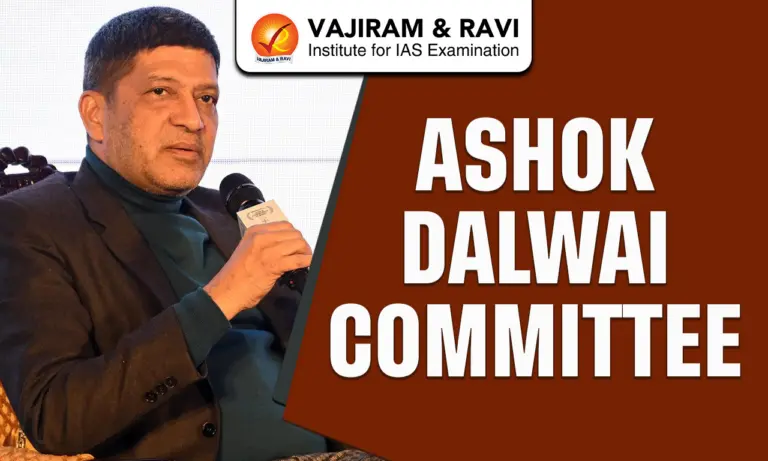
The Ashok Dalwai Committee was set up by the Government of India to improve the condition of farmers in the country. Its main aim was to find ways to double farmers’ income by 2022 and make agriculture more profitable and sustainable. The committee studied various problems faced by farmers, such as low income, high costs, and market challenges, and suggested practical solutions like better irrigation, improved technology, and stronger market support. It viewed agriculture as a complete economic activity, connected with markets, technology, industries, and services.
Ashok Dalwai Committee Background and Need
- Indian agriculture mainly focused on increasing production after the Green Revolution, which improved food supply but not farmers’ income.
- Even with higher production, farmers’ income did not increase much, creating a gap between output and earnings.
- Farmers faced problems like low prices for crops and high cost of farming, which reduced their profits.
- There was also poor market access and lack of proper facilities like storage and transport.
- Farming depended heavily on weather conditions, making it risky and uncertain.
- Therefore, the committee was formed to increase farmers’ income and make agriculture more profitable and sustainable.
Ashok Dalwai Committee Objectives
The main objective of the Ashok Dalwai Committee was to double farmers’ real income in a sustainable way.
- It aimed to reduce the gap between farm and non-farm income so that farmers can earn better and more stable incomes.
- The committee focused on making agriculture more efficient, productive, and profitable while reducing risks.
- It encouraged the use of modern technology and better farming practices to improve productivity and lower costs.
- It also aimed to strengthen farmers’ connection with markets so they can get better prices for their produce.





Important Focus Areas
The committee focused on five key areas to ensure long-term growth:
- Proper pricing and sale of agricultural produce.
- Sustainable farming practices to protect natural resources.
- Efficient use of water, soil, and other inputs.
- Strengthening agricultural extension services and spreading knowledge.
- Managing risks through insurance, forecasting, and planning.
Major Sources of Growth
The Ashok Dalwai Committee identified seven key ways to increase farmers’ income by improving both agricultural and non-agricultural activities.
- Within the Agriculture Sector
-
-
- Improving crop productivity through the use of better seeds, modern technology, and efficient irrigation methods, so that farmers can produce more from the same land.
- Increasing productivity in livestock, dairy, poultry, and fisheries, which provide additional and regular sources of income alongside crop farming.
- Reducing the cost of production by using inputs like water, fertilizers, and labour more efficiently, which helps in increasing net profit.
- Increasing cropping intensity by growing more than one crop in a year, making better use of land and resources.
- Diversifying towards high-value crops such as fruits, vegetables, flowers, and horticulture products, which give higher returns compared to traditional crops.
- Ensuring farmers receive better and fair prices for their produce through improved market systems, storage, and direct market linkages.
-
- Outside the Agriculture Sector
-
- Encouraging farmers to take up non-farm activities such as small businesses, food processing, rural industries, and services, so that they have multiple sources of income and are less dependent only on farming.
Ashok Dalwai Committee Major Recommendations
- The Ashok Dalwai Committee gave several important recommendations to increase farmers’ income and make agriculture more efficient and sustainable.
- Market and Supply Chain Reforms
- The committee suggested creating a strong and integrated agricultural market system so that farmers can sell their produce easily and at better prices.
- It recommended developing village-level and national-level markets connected through digital platforms to ensure wider market access.
- Improving storage, warehousing, transportation, and cold chain facilities was emphasized to reduce post-harvest losses.
- It also focused on providing better market information and price signals to farmers for informed decision-making.
- Sustainable Agriculture
- The committee stressed the need for eco-friendly and climate-resilient farming practices.
- It encouraged organic farming, conservation agriculture, and water management techniques.
- Use of scientific methods like soil testing, balanced fertilization, and efficient irrigation was recommended.
- The aim was to ensure long-term productivity while protecting natural resources.
- Increasing Productivity and Diversification
- It recommended increasing production by using modern technology and better farming methods.
- Farmers were encouraged to produce more with fewer resources to improve efficiency.
- The committee also promoted diversification into high-value crops like fruits, vegetables, and horticulture to increase income.
- Promoting Non-Farm Income
- The committee suggested developing rural industries, small enterprises, and services near farms.
- It encouraged activities like food processing, handicrafts, and agro-based industries.
- This would provide additional income sources and employment opportunities, reducing dependence only on farming.
- Risk Management
- It emphasized improving crop insurance and weather forecasting systems to protect farmers from losses.
- The committee also recommended better access to credit and financial support.
- Measures were suggested to prevent distress sale of crops and help farmers manage uncertainties.
- Strengthening Support Systems
- The committee highlighted the need to improve agricultural extension services and knowledge sharing.
- It also recommended better coordination between government institutions and use of digital systems for monitoring progress.
Five Pillars of Income Growth
- The Ashok Dalwai Committee identified five main pillars to increase and sustain farmers’ income in a simple and practical way:
- The first pillar is increasing productivity, which means growing more crops and producing more output from the same land by using better seeds, technology, and farming methods.
- The second pillar is reducing the cost of cultivation, so that farmers can save money by using resources like water, fertilizers, and labour more efficiently, leading to higher profits.
- The third pillar is ensuring better prices for produce, which focuses on helping farmers sell their crops at fair and profitable prices through better markets and direct linkages.
- The fourth pillar is promoting sustainable farming practices, which means using eco-friendly methods that protect soil, water, and the environment while maintaining long-term productivity.
- The fifth pillar is managing risks, which includes protecting farmers from losses caused by weather, price changes, and other uncertainties through insurance, planning, and support systems.
Structure and Implementation
- The Ashok Dalwai Committee prepared a detailed report in 14 volumes, covering various aspects of agriculture such as productivity, markets, sustainability, and risk management, to provide a complete roadmap for increasing farmers’ income.
- It recommended setting up an Empowered Body or authority to monitor progress, guide implementation, and ensure coordination among different ministries and departments.
- The committee suggested both short-term measures (up to 3 years) for quick improvements and long-term strategies for sustained growth in farmers’ income.
- It also emphasized the need for coordination between central and state governments, along with involvement of local institutions, to effectively implement its recommendations.
- The use of data, digital monitoring systems, and regular evaluation was suggested to track progress and improve policy decisions.
- Many of its important recommendations have already been adopted by the government and included in policies, schemes, and Union Budgets to support farmers.
Ashok Dalwai Committee Significance
- The Ashok Dalwai Committee is important because it shifted the focus of agriculture from only increasing production to increasing farmers’ income, which directly improves their standard of living.
- It provided a clear and practical roadmap for making farming more profitable, sustainable, and modern.
- The committee helped in promoting the idea of farmers as entrepreneurs, encouraging them to connect with markets and make better economic decisions.
- Its recommendations strengthened market systems, infrastructure, and supply chains, helping farmers get better prices for their produce.
- It also emphasized sustainable and climate-friendly farming, which is important for protecting natural resources and ensuring long-term growth.
- The focus on risk management, insurance, and diversification of income made farming more secure and less uncertain.

 Last updated on March, 2026
→ UPSC Final Result 2025 is now out.
→ UPSC has released UPSC Toppers List 2025 with the Civil Services final result on its official website.
→ Anuj Agnihotri secured AIR 1 in the UPSC Civil Services Examination 2025.
→ UPSC Marksheet 2025 is now out.
→ UPSC Notification 2026 & UPSC IFoS Notification 2026 is now out on the official website at upsconline.nic.in.
→ UPSC Calendar 2026 has been released.
→ Check out the latest UPSC Syllabus 2026 here.
→ UPSC Prelims 2026 will be conducted on 24th May, 2026 & UPSC Mains 2026 will be conducted on 21st August 2026.
→ The UPSC Selection Process is of 3 stages-Prelims, Mains and Interview.
→ Prepare effectively with Vajiram & Ravi’s UPSC Prelims Test Series 2026 featuring full-length mock tests, detailed solutions, and performance analysis.
→ Enroll in Vajiram & Ravi’s UPSC Mains Test Series 2026 for structured answer writing practice, expert evaluation, and exam-oriented feedback.
→ Join Vajiram & Ravi’s Best UPSC Mentorship Program for personalized guidance, strategy planning, and one-to-one support from experienced mentors.
→ Shakti Dubey secures AIR 1 in UPSC CSE Exam 2024.
→ Also check Best UPSC Coaching in India
Ashok Dalwai Committee FAQs
Q1. What is the Ashok Dalwai Committee?+
Q2. What was the main aim of the committee?+
Q3. Why was the committee formed?+
Q4. What was the major focus of the committee?+
Q5. What are the key sources of increasing farmers’ income?+
Tags: ashok dalwai committee governance governance notes