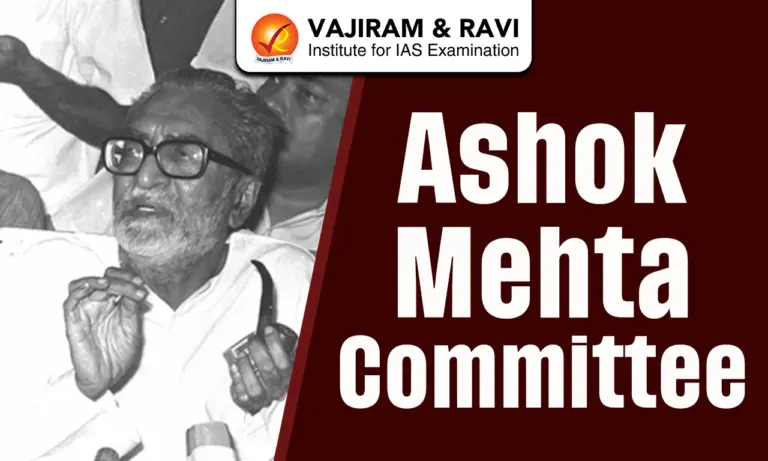
The Ashok Mehta Committee was set up by the Government of India to review and improve the system of local self-government in rural areas. At that time, it was felt that the existing Panchayati Raj system was not working effectively in many parts of the country. The committee was asked to suggest ways to make local governance stronger, more active, and more responsive to people’s needs. Its work helped in bringing attention to the importance of strengthening grassroots democracy and improving the functioning of local institutions.
Ashok Mehta Committee Historical Background
- The system of village panchayats started developing during the British period, mainly as a response to the growing demand for local self-governance and participation of people in administration.
- During this time, efforts were made to give people some control over local matters, which allowed citizens to access governance at the grassroots level, especially in rural areas.
- The Government of India Act, 1935 gave more powers to provinces (states) to make their own laws, which also encouraged the development of local self-government institutions.
- After independence, India focused more seriously on strengthening local governance, and an important step was taken when the Balwantrai Mehta Committee (1957) provided a proper framework for democratic decentralisation, which was later adopted by many states.
- These developments together helped in shaping the modern Panchayati Raj system, which aims to involve people directly in decision-making and rural development.
Ashok Mehta Committee Recommendations
- The committee suggested replacing the old three-tier Panchayati Raj system with a two-tier system, where there would be a Zila Parishad at the district level and a Mandal Panchayat at a lower level, which would include a group of villages with a population of about 15,000 to 20,000 people.
- It recommended that the district should be the main level of decentralisation, meaning that most planning and decision-making should start from the district under the supervision of elected representatives.
- The Zila Parishad should act as the main executive body, responsible for planning, implementing, and managing development programmes at the district level.
- The committee suggested that political parties should be allowed to take part in Panchayat elections, as this would make the system more organised, competitive, and accountable.
- It emphasized that Panchayati Raj institutions should have their own financial powers, including the authority to impose certain taxes, so that they can generate funds and work independently.
- The committee also recommended regular social audits, so that people can check how funds are being used and ensure transparency in local governance.
- It stated that if Panchayati Raj institutions are dissolved or suspended, then fresh elections should be held within six months to restore democratic functioning quickly.
- It suggested appointing a separate Minister for Panchayati Raj at the state level to give more importance and attention to local self-government.
- The committee supported reservation of seats for Scheduled Castes (SCs) and Scheduled Tribes (STs) to ensure representation of weaker sections in local governance.
- Finally, it strongly recommended giving constitutional status to Panchayati Raj institutions, so that they become more stable, secure, and protected from political interference.





Ashok Mehta Committee Significance
- The committee highlighted the weaknesses of the existing Panchayati Raj system and brought attention to the need for reforms.
- It strengthened the idea of democratic decentralisation by giving more importance to the district level in governance.
- It promoted political participation by allowing political parties in Panchayat elections, making the system more active and accountable.
- It emphasized financial independence of Panchayati Raj institutions for better functioning.
- It encouraged transparency and accountability through measures like social audits.
- Its recommendations influenced later reforms and contributed to the demand for constitutional status, which was finally achieved through the 73rd Constitutional Amendment Act (1992).

 Last updated on March, 2026
→ UPSC Final Result 2025 is now out.
→ UPSC has released UPSC Toppers List 2025 with the Civil Services final result on its official website.
→ Anuj Agnihotri secured AIR 1 in the UPSC Civil Services Examination 2025.
→ UPSC Marksheet 2025 is now out.
→ UPSC Notification 2026 & UPSC IFoS Notification 2026 is now out on the official website at upsconline.nic.in.
→ UPSC Calendar 2026 has been released.
→ Check out the latest UPSC Syllabus 2026 here.
→ UPSC Prelims 2026 will be conducted on 24th May, 2026 & UPSC Mains 2026 will be conducted on 21st August 2026.
→ The UPSC Selection Process is of 3 stages-Prelims, Mains and Interview.
→ Prepare effectively with Vajiram & Ravi’s UPSC Prelims Test Series 2026 featuring full-length mock tests, detailed solutions, and performance analysis.
→ Enroll in Vajiram & Ravi’s UPSC Mains Test Series 2026 for structured answer writing practice, expert evaluation, and exam-oriented feedback.
→ Join Vajiram & Ravi’s Best UPSC Mentorship Program for personalized guidance, strategy planning, and one-to-one support from experienced mentors.
→ Shakti Dubey secures AIR 1 in UPSC CSE Exam 2024.
→ Also check Best UPSC Coaching in India
Ashok Mehta Committee FAQs
Q1. What was the Ashok Mehta Committee?+
Q2. Why was the committee formed?+
Q3. What was the main recommendation of the committee?+
Q4. What role was given to the district level?+
Q5. What did the committee say about political participation?+
Tags: ashok mehta committee polity polity notes