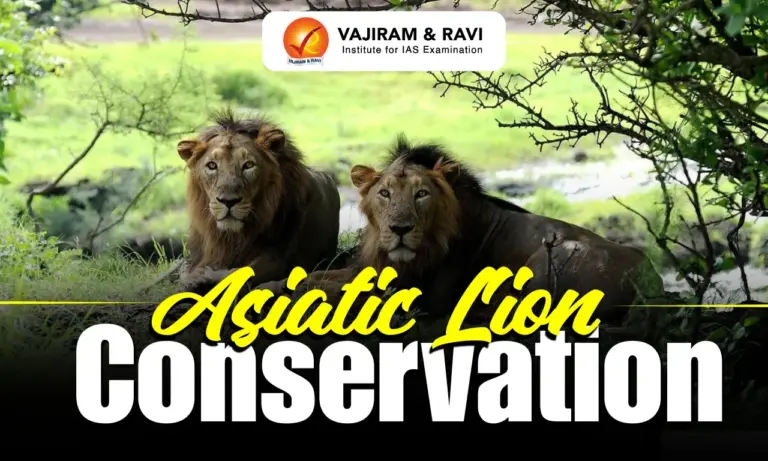
Asiatic Lion Conservation Latest News
- A recent analysis has highlighted that while the Asiatic lion population has crossed 1,000, its long-term survival depends on strengthening landscape-level conservation and addressing risks arising from its concentration in a single geographical region.
About Asiatic Lion
- The Asiatic lion (Panthera leo persica) is one of the world’s most endangered large cat species and is found only in India in the wild.
- Once distributed across West Asia and northern India, the species is now confined to the Gir landscape in Gujarat.
- Conservation Status
- IUCN Red List: Vulnerable
- Wildlife (Protection) Act, 1972: Schedule I
- CITES: Appendix I
- The Asiatic lion is slightly smaller than its African counterpart and is distinguished by a prominent fold of skin along its abdomen.


Recovery of the Asiatic Lion Population
- The recovery of the Asiatic lion is regarded as one of India’s major wildlife conservation successes.
- Around six decades ago, the wild population had declined to nearly 100-150 individuals. Continuous conservation efforts have resulted in the population increasing to more than 1,000 lions today.
- An equally significant development is that nearly half of the lion population now lives outside protected areas, indicating successful natural dispersal beyond Gir National Park and Sanctuary.
Landscape-Level Conservation
- Lion conservation has gradually evolved from a protected-area approach to a landscape-level conservation strategy.
- Instead of remaining confined to Gir National Park, lions now occupy a diverse range of habitats across the Saurashtra region, including:
- Gir National Park and Sanctuary
- Girnar hills
- Mitiyala forests
- Savarkundla-Liliya landscape
- Coastal tracts extending towards Bhavnagar
- The surrounding agricultural fields, grasslands, riverbeds, and hilly terrain function as ecological corridors that facilitate the natural dispersal of lions.
- A key factor behind this success has been the acceptance of dispersing lions by local communities, enabling coexistence between humans and wildlife.
- The success of lion conservation has been supported by four major pillars:
- Strong political commitment
- Efficient forest administration
- Sustained financial support
- Cooperation of local communities
Major Conservation Challenges
- Concentration in a Single Landscape
- The most significant challenge is that the entire wild population continues to remain concentrated within a single geographical landscape.
- Such concentration exposes the species to the risk of catastrophic events that could affect the entire population simultaneously.
- Disease Outbreaks
- The vulnerability became evident in 2018, when more than 20 Asiatic lions died due to an outbreak of Canine Distemper Virus (CDV).
- Although the Gujarat Forest Department responded through disease surveillance, veterinary interventions, and improved monitoring, the outbreak demonstrated the risks associated with maintaining a geographically concentrated population.
- Habitat Fragmentation
- As lions continue to expand outside protected areas, maintaining habitat connectivity has become increasingly important.
- Rapid infrastructure development, urbanisation, and changing land use patterns can fragment wildlife corridors, making dispersal more difficult and increasing the likelihood of human-wildlife conflict.
- Need for Long-Term Planning
- Conservation should not focus only on protecting Gir National Park but must also safeguard the wider network of habitats and movement corridors used by dispersing lions.
Need for a Second Free-Ranging Population
- One of the central arguments is the need to establish a second free-ranging population of Asiatic lions.
- At present, the species remains restricted to a single landscape despite repeated concerns expressed by wildlife scientists.
- Developing an alternative habitat would:
- Reduce the risk from disease outbreaks
- Protect the species against natural disasters
- Improve long-term genetic security
- Enhance the resilience of the wild population
- Resistance to creating such a second home continues despite growing scientific evidence supporting the need for geographical diversification.
Way Forward
- Future conservation efforts should focus on strengthening the gains achieved over the past six decades. Key priorities include:
- Conserving wildlife corridors across the Gir landscape
- Preventing habitat fragmentation due to infrastructure development
- Strengthening disease surveillance and veterinary preparedness
- Promoting continued coexistence between local communities and lions
- Establishing a second free-ranging population to reduce ecological risks
- Adopting a long-term landscape-based conservation strategy rather than limiting conservation to protected areas
Source: TH

 Last updated on Oct, 2026
→ UPSC 2027 Notification will be released on 13 January 2027 at upsconline.nic.in.
→ Asian Games 2026 are being held in Aichi-Nagoya, Japan, from 19 September to 4 October.
→ Check Nobel Prize 2026 Winners List here.
→ Download PIB PRiSM Monthly Magazine 2026 here.
→ Check UPSC Monthly Current Affairs Magazine The Recitals here.
→ Check out the latest UPSC Syllabus here.
→ Download UPSC Model Answers for Mains 2026
→ UPSC Mains Question Paper 2026 is out now for Essay & GS Paper 1, 2, 3 & 4.
→ UPSC Calendar 2027 has been released.
→ Enroll in Vajiram & Ravi’s UPSC Mains Test Series 2027 for structured answer writing practice, expert evaluation, and exam-oriented feedback.
→ Join Vajiram & Ravi’s UPSC Mentorship Program 2027 for personalized guidance, strategy planning, and one-to-one support from experienced mentors.
→ Go through the UPSC Mains Previous Year Papers to enhance your preparation.
→ UPSC has released UPSC Toppers List 2025 with the Civil Services final result on its official website.
→ Also check Best UPSC Coaching in India
Asiatic Lion Conservation FAQs
Q1. Where is the only free-ranging population of Asiatic lions found?+
Q2. What is the IUCN conservation status of the Asiatic lion?+
Q3. Which disease caused the death of more than 20 Asiatic lions in 2018?+
Q4. Why is the establishment of a second free-ranging lion population considered important?+
Q5. What has been the key approach behind the recovery of the Asiatic lion?+
Tags: asiatic lion conservation mains articles upsc current affairs upsc mains current affairs