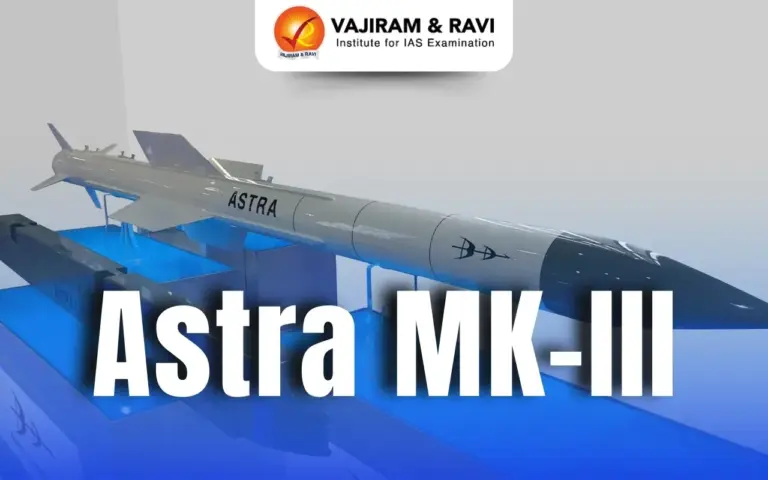
Astra MK-III Missile Latest News
India’s latest and most advanced air-to-air missile, the Astra MK-III, has now been officially renamed Gandiva, after the legendary bow of Arjuna from the Mahabharata.
About Astra MK-III Missile
- It is a beyond-visual-range (BVR) air-to-air missile designed to be mounted on fighter aircraft.
- Still under development by the Defence Research and Development Organisation (DRDO), this missile is expected to redefine the landscape of aerial warfare, especially in BVR combat.
- The missile will be deployed on the IAF’s Sukhoi Su-30MKI jetsand the Light Combat Aircraft Tejas.
- With the eventual induction of Gandiva, India will possess one of the longest-range BVR air-to-air missiles in the world.
- This missile is capable of targeting a variety of aerial threats, including enemy fighter jets, bombers, military transport aircraft, refueling planes, and Airborne Warning and Control System (AWACS) aircraft.





Astra MK-III Missile Features
- It has a range of 340 kilometers when the target is at an altitude of 20 kilometers, and 190 kilometers when the target is at a lower altitude of 8 kilometers.
- It is powered by a dual-fuel ducted ramjet engine, enabling it to be launched from an IAF jet at sea level or as high as 20 kilometers in altitude.
- The missile’s launch speed ranges from 0.8 to 2.2 Mach, with the capability to hit targets at a speed of 2.0 to 3.6 Mach.
- One of its most advanced features is its ability to engage highly maneuverable fighter aircraft, with an angle of attack of up to 20 degrees.
- Additionally, the Gandiva has a ±10 km snap-up/snap-down capability, allowing it to engage targets at varying altitudes—either higher or lower than the firing aircraft.
Astra MK-III Missile FAQs
Q1. Who developed the Astra missile?
Ans. The Astra missile was developed by the Defence Research and Development Organisation (DRDO).
Q2. What is the range of Astra Mark 3 missile?
Ans. Around 340 kilometres.
Q3. What is the speed of the Astra Mark 3 missile?
Ans. The missile’s launch speed ranges from 0.8 to 2.2 Mach, with the capability to hit targets at a speed of 2.0 to 3.6 Mach.
Source: ET

 Last updated on March, 2026
→ UPSC Final Result 2025 is now out.
→ UPSC has released UPSC Toppers List 2025 with the Civil Services final result on its official website.
→ Anuj Agnihotri secured AIR 1 in the UPSC Civil Services Examination 2025.
→ UPSC Marksheet 2025 is now out.
→ UPSC Notification 2026 & UPSC IFoS Notification 2026 is now out on the official website at upsconline.nic.in.
→ UPSC Calendar 2026 has been released.
→ Check out the latest UPSC Syllabus 2026 here.
→ UPSC Prelims 2026 will be conducted on 24th May, 2026 & UPSC Mains 2026 will be conducted on 21st August 2026.
→ The UPSC Selection Process is of 3 stages-Prelims, Mains and Interview.
→ Prepare effectively with Vajiram & Ravi’s UPSC Prelims Test Series 2026 featuring full-length mock tests, detailed solutions, and performance analysis.
→ Enroll in Vajiram & Ravi’s UPSC Mains Test Series 2026 for structured answer writing practice, expert evaluation, and exam-oriented feedback.
→ Join Vajiram & Ravi’s Best UPSC Mentorship Program for personalized guidance, strategy planning, and one-to-one support from experienced mentors.
→ Shakti Dubey secures AIR 1 in UPSC CSE Exam 2024.
→ Also check Best UPSC Coaching in India