Asymmetric Synthesis Latest News
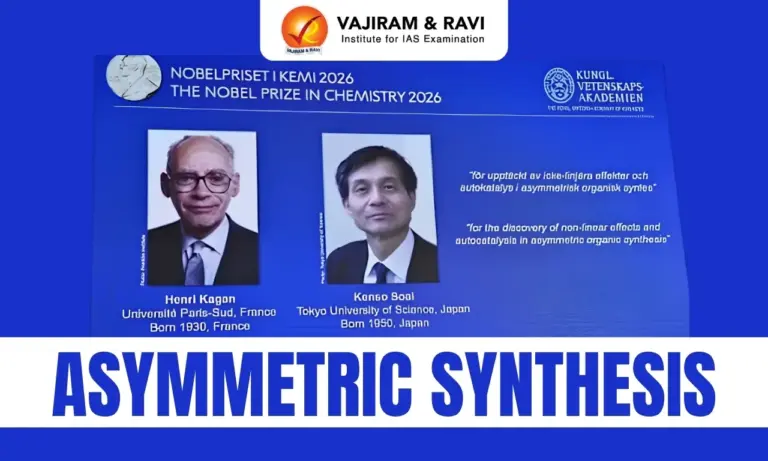
- The 2026 Nobel Prize in Chemistry has been awarded to Henri B. Kagan and Kenso Soai “for the discovery of non-linear effects and autocatalysis in asymmetric organic synthesis.”
- In simpler terms, their work created a way to produce more of one type of molecule and less of its mirror image in chemical reactions — solving one of chemistry’s most famous puzzles.
- Henri Kagan, 96, is Professor Emeritus at Université Paris-Sud, France. Kenso Soai, 76, is Professor Emeritus at Tokyo University of Science, Japan.
Understanding Chiral Molecules: The Lock and Key
- The Nobel Prize’s official press release explains chiral molecules using a lock-and-key analogy.
- Imagine manufacturing a key, only to discover the process produces two keys that are mirror images of each other. They look almost identical, but only one fits the lock — the other may do nothing, or in some cases, cause damage.
- This is essentially the problem chemists face with chiral molecules. Many molecules exist in two mirror-image forms, called enantiomers.
- They share the same chemical composition, but have different three-dimensional arrangements.


The Mystery of Life’s “One-Handed” Chemistry
- The story traces back to Louis Pasteur (also known for the rabies vaccine), who in the mid-19th century studied tartaric acid, found in grapes and wine.
- Pasteur discovered tartaric acid crystals existed in two mirror-image forms.
- But bacteria fermenting tartaric acid consumed only one enantiomer — the one found in grapes — leaving its mirror image untouched.
- This pointed to a much bigger mystery: life itself appeared to be one-handed.
- Further evidence: When scientists examined life’s building blocks, they found:
- Naturally occurring amino acids bend polarised light to the left.
- Sugars found in DNA bend it to the right.
- In other words, life overwhelmingly uses only one of the two possible mirror-image forms.
- Yet when chemists tried making chiral molecules in the laboratory, they generally got an equal mixture of both enantiomers.
- The puzzle: what happened at the dawn of life that made biological chemistry choose a side?
Building Toward an Answer: Three Key Steps
- Marckwald’s First Breakthrough (Early 1900s)
- German chemist Willy Marckwald carried out the first successful asymmetric reaction — one producing more of one enantiomer than the other.
- The imbalance was small, and didn’t explain how such an imbalance could grow much larger.
- Frank’s Theoretical Model (1953)
- Charles Frank, a theoretical physicist at the University of Bristol, proposed a mathematical model for how homochirality (life’s “one-handedness”) could arise.
- His model required three conditions:
- A chiral catalyst and an asymmetric reaction.
- Formation of one mirror image enhanced while the other is suppressed.
- The reaction must produce the catalyst itself — a condition called autocatalysis.
- Autocatalysis creates a chemical “snowball effect.” If a reaction produces a tiny excess of one molecular form, and that form helps make more of itself, the initial imbalance can grow rapidly.
- Frank’s model became a famous puzzle: could anyone actually build a reaction fulfilling all three conditions?
Kagan Finds the Missing Piece
- In the 1980s, Kagan was working on asymmetric reactions aimed at producing as pure an enantiomer as possible — a goal particularly critical for pharmaceutical manufacturing.
- The prevailing assumption: Chemists commonly used catalysts containing a metal atom plus a chiral substance, assuming that if the catalyst contained equal amounts of both mirror-image forms, the resulting product would also contain equal amounts of its two enantiomers.
- Kagan’s insight: He questioned this assumption, realising the metal atom might interact with at least two chiral molecules simultaneously. If both forms were present, this could create three kinds of catalyst:
- One containing two molecules of one handedness.
- One containing two of the other handedness.
- A mixed form.
- The crucial discovery: The mixed catalyst behaved differently — it drove the reaction much more slowly than the other two. This meant the relationship between the catalyst’s handedness and the final product’s handedness was not linear.
- In 1986, Kagan described three asymmetric reactions displaying these non-linear effects — supplying the second missing piece of Frank’s model: a way to amplify an initial asymmetry.
Soai Makes the Chemistry Self-Reinforcing
- The final step came from Kenso Soai at the Tokyo University of Science.
- Soai was studying an asymmetric reaction showing a strong non-linear effect. He noticed similarities between the catalyst and the product, and wondered whether he could design a reaction in which the catalyst actually produced itself.
- The 1995 Experiment: Starting with just a 2% excess of one enantiomer, the reaction ended with an 87% excess. The reaction was self-reinforcing — a slight initial advantage became a much larger one.
- The Ultimate Achievement — the Soai reaction (2003): Soai presented a reaction in which an excess of one enantiomer formed, and that enantiomer then helped produce copies of itself — fulfilling all three of Frank’s original conditions in a single, elegant experiment.
Why This Matters
- The non-linear effects that Kagan discovered have become an important tool for chemists when they design new reactions.
- Since a reaction being non-linear reveals information about how it occurs, chemists can use this to optimise reactions and obtain the purest possible enantiomers of a product.
- This is vital for every company manufacturing substances intended to interact with living beings — including pharmaceuticals, flavours, scents, and agricultural chemicals.
- Since only one enantiomer of a chiral drug may be therapeutically active (and the other potentially harmless or harmful, as with the lock-and-key analogy), producing the correct, pure form matters enormously for drug safety and efficacy.
Real-World Example
- Thalidomide was introduced in the late 1950s as a sedative, widely prescribed, including to pregnant women for morning sickness.
- By 1961, doctors linked the drug to severe birth defects. Thousands of babies across 46 countries were affected, many with phocomelia (severely shortened or absent limbs).
- Thalidomide exists as two enantiomers (mirror-image molecules). One enantiomer produced the desired sedative effect, while the other caused birth defects.
- It was later found that the two forms can interconvert inside the body — meaning even giving only the “safe” enantiomer wouldn’t have prevented harm, since the body could convert it into the harmful form.

 Last updated on Oct, 2026
→ UPSC 2027 Notification will be released on 13 January 2027 at upsconline.nic.in.
→ Asian Games 2026 are being held in Aichi-Nagoya, Japan, from 19 September to 4 October.
→ Check Nobel Prize 2026 Winners List here.
→ Download PIB PRiSM Monthly Magazine 2026 here.
→ Check UPSC Monthly Current Affairs Magazine The Recitals here.
→ Check out the latest UPSC Syllabus here.
→ Download UPSC Model Answers for Mains 2026
→ UPSC Mains Question Paper 2026 is out now for Essay & GS Paper 1, 2, 3 & 4.
→ UPSC Calendar 2027 has been released.
→ Enroll in Vajiram & Ravi’s UPSC Mains Test Series 2027 for structured answer writing practice, expert evaluation, and exam-oriented feedback.
→ Join Vajiram & Ravi’s UPSC Mentorship Program 2027 for personalized guidance, strategy planning, and one-to-one support from experienced mentors.
→ Go through the UPSC Mains Previous Year Papers to enhance your preparation.
→ UPSC has released UPSC Toppers List 2025 with the Civil Services final result on its official website.
→ Also check Best UPSC Coaching in India
Asymmetric synthesis FAQs
Q1. What is asymmetric synthesis? +
Q2. What did Henri Kagan contribute to asymmetric synthesis?+
Q3. How did Kenso Soai advance the understanding of asymmetric synthesis?+
Q4. Why is asymmetric synthesis important for pharmaceuticals? +
Q5. How does autocatalysis explain life's molecular handedness? +
Tags: Asymmetric synthesis mains articles upsc current affairs upsc mains current affairs