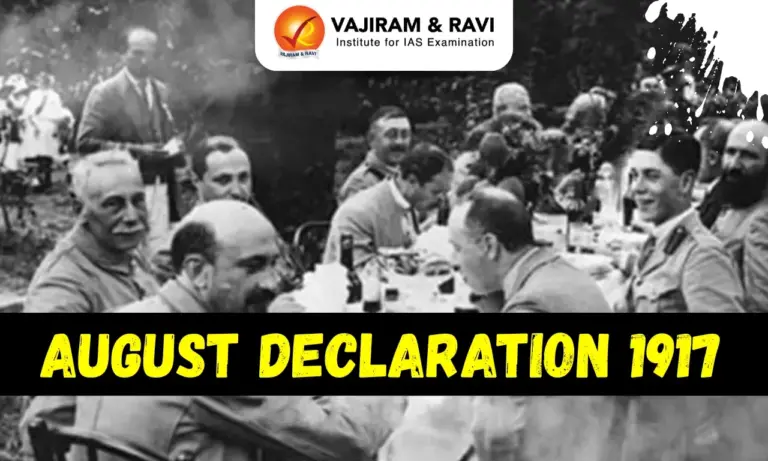
The August Declaration of 1917 marks a historic turning point in the constitutional development of British India. It was announced by Edwin Samuel Montagu, the then Secretary of State for India, this declaration for the first time officially acknowledged self-governance as the long-term goal of British rule in India. It laid the foundation for future constitutional reforms and directly influenced the Government of India Act, 1919.
August Declaration 1917
The August Declaration, also known as the Montagu Declaration, was announced on 20 August 1917 in the British Parliament. It came at a time when India’s political consciousness was rising rapidly, fueled by the Home Rule Movement, growing nationalism, and India’s contribution to World War I.
For the first time, the British government publicly accepted that Indians should gradually be associated with the governance of their own country, marking a shift from colonial absolutism to constitutional gradualism.
August Declaration 1917 Objectives
The British government issued the August Declaration 1917 with multiple political and strategic objectives:
- To secure Indian support during World War I
- To pacify rising nationalist sentiments and growing demand for self-rule
- To provide a constitutional roadmap for gradual political reform
- To strengthen British control while appearing progressive
- To counter the influence of extremists and revolutionary activities
- To maintain imperial unity while introducing limited self-governance





Provisions of the August Declaration 1917
The August Declaration 1917 laid down the broad principles for constitutional development in India by promising gradual political advancement and greater Indian participation in governance, while retaining British control over key powers.
- Declared progressive realization of responsible government in India as the long-term objective of British policy.
- Promised gradual development of self-governing institutions, not immediate self-rule.
- Emphasized increasing association of Indians in every branch of administration.
- Proposed expansion of legislative councils at the central and provincial levels.
- Assured that reforms would be introduced step by step, based on India’s political maturity.
- Maintained British supremacy, especially in defence, finance, and administration.
- Clarified that reforms would be framed under British parliamentary control.
- Did not define a fixed timeline for self-government.
- Focused on constitutional methods rather than mass political movements.
- Became the basis for the Montagu-Chelmsford Reforms and Government of India Act, 1919.
August Declaration 1917 Outcomes
The demand for self-government or Home Rule could no longer be treated as seditious, as the British government itself had now officially accepted self-government as a future goal, marking a sharp departure from Morley’s 1909 assertion that reforms were not intended to lead India toward self-rule.
The use of the term “responsible government” implied that the executive should be accountable to elected representatives rather than solely to the British Parliament in London. However, it was equally evident that the British were unwilling to transfer real power to legislatures dominated by Indian representatives.
To resolve this contradiction and to make the executive appear more accountable while retaining control, the British introduced the concept of dyarchy, under which certain subjects were transferred to Indian ministers while key areas remained under British authority.
August Declaration 1917 Criticism
The August Declaration 1917 faced widespread criticism from Indian nationalists who felt that it failed to meet their legitimate political aspirations. Although it appeared progressive in intent, its limitations soon became evident.
- Absence of a Clear Time Frame: One of the major objections was the lack of any definite timeline for the introduction of self-government. Nationalist leaders demanded a clear and time-bound roadmap toward responsible government, but the declaration remained vague, creating uncertainty and dissatisfaction.
- Disappointment with the Montagu Reforms: Prominent nationalist leader Bal Gangadhar Tilak criticised the reforms derived from the declaration, describing them as “unworthy and disappointing – a sunless dawn.” His remark reflected the widespread belief that the reforms failed to provide meaningful political power to Indians.
- Unilateral British Decision-Making: Indian leaders strongly opposed the fact that the nature and pace of constitutional reforms would be decided solely by the British government. They argued that Indians themselves should have a decisive role in determining their political future, rather than being passive recipients of British policies.
- Criticism by Annie Besant: Annie Besant, a leading Home Rule advocate, condemned the declaration as “unworthy of England to offer and India to accept.” Her criticism highlighted the gap between Indian expectations and British intentions, emphasizing that the declaration fell far short of genuine self-governance.

 Last updated on March, 2026
→ UPSC Final Result 2025 is now out.
→ UPSC has released UPSC Toppers List 2025 with the Civil Services final result on its official website.
→ Anuj Agnihotri secured AIR 1 in the UPSC Civil Services Examination 2025.
→ UPSC Marksheet 2025 is now out.
→ UPSC Notification 2026 & UPSC IFoS Notification 2026 is now out on the official website at upsconline.nic.in.
→ UPSC Calendar 2026 has been released.
→ Check out the latest UPSC Syllabus 2026 here.
→ UPSC Prelims 2026 will be conducted on 24th May, 2026 & UPSC Mains 2026 will be conducted on 21st August 2026.
→ The UPSC Selection Process is of 3 stages-Prelims, Mains and Interview.
→ Prepare effectively with Vajiram & Ravi’s UPSC Prelims Test Series 2026 featuring full-length mock tests, detailed solutions, and performance analysis.
→ Enroll in Vajiram & Ravi’s UPSC Mains Test Series 2026 for structured answer writing practice, expert evaluation, and exam-oriented feedback.
→ Join Vajiram & Ravi’s Best UPSC Mentorship Program for personalized guidance, strategy planning, and one-to-one support from experienced mentors.
→ Shakti Dubey secures AIR 1 in UPSC CSE Exam 2024.
→ Also check Best UPSC Coaching in India
August Declaration 1917 FAQs
Q1. What was the August Declaration of 1917?+
Q2. Why was the August Declaration announced?+
Q3. Who announced the August Declaration?+
Q4. What was the main objective of the August Declaration?+
Q5. Did the August Declaration promise self-government?+
Tags: august declaration 1917