Avalanche Latest News
Three Army personnel, including two Agniveers, lost their lives recently in a major avalanche at the Siachen base camp in Ladakh.
About Avalanche
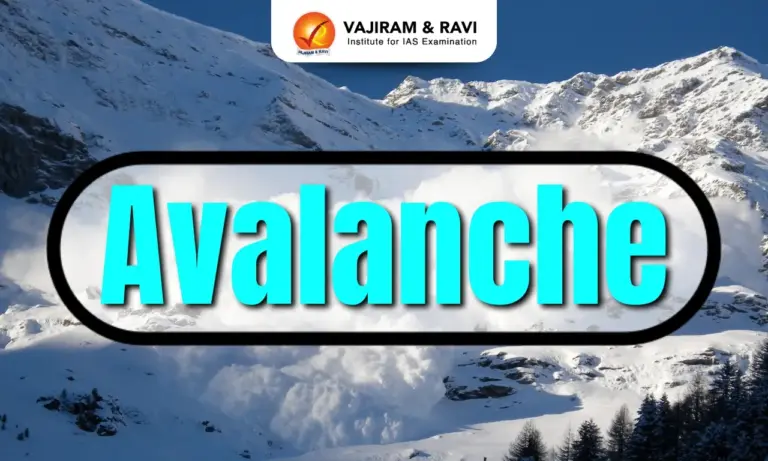
- An avalanche is a large amount of snow that quickly moves down a slope.
- An avalanche can be deadly because it will bury or sweep away anything in its path.
- Large amounts of sliding rocks, earth, or other materials may also be called avalanches. But these are often known as landslides.
- Many different conditions make an avalanche possible.
- An avalanche is more likely to happen on a slope without trees or large rocks. These things help to keep snow in place.
- A weak layer of snow also makes an avalanche likely.
- Once the conditions are right, several things can start an avalanche.
- Heavy snowfall, strong wind, and rising temperatures all can loosen snow on a slope.
- Falling rocks or ice also can cause snow to slide.
- Even the movement of a skier, a snowboarder, or a snowmobile can trigger an avalanche.
- There are two main types of snow avalanches—sluffs and slabs.
- Sluff avalanches occur when the weak layer of a snowpack is on the top.
- A sluff is a small slide of dry, powdery snow that moves as a formless mass.
- Sluffs are much less dangerous than slab avalanches.
- A slab avalanche occurs when the weak layer lies lower down in a snowpack.
- This layer is covered with other layers of compressed snow.
- When the avalanche is triggered, the weak layer breaks off, pulling all the layers on top of it down the slope.
- These layers tumble and fall in a giant block, or slab.
- Avalanches vary in destructive power from harmless to large enough to destroy mature forests or flatten villages.
- When an avalanche stops, the snow becomes solid like concrete, and people are unable to dig out.
- People caught in avalanches can die from suffocation, trauma, or hypothermia.
- People in mountainous areas protect themselves from avalanches in several ways.
- Special fences help to hold snow in place.
- Barriers help to stop sliding snow or change its direction.
- Explosives help to clear snow from places where avalanches are likely to occur.
Source: IT






 Last updated on March, 2026
→ UPSC Final Result 2025 is now out.
→ UPSC has released UPSC Toppers List 2025 with the Civil Services final result on its official website.
→ Anuj Agnihotri secured AIR 1 in the UPSC Civil Services Examination 2025.
→ UPSC Marksheet 2025 is now out.
→ UPSC Notification 2026 & UPSC IFoS Notification 2026 is now out on the official website at upsconline.nic.in.
→ UPSC Calendar 2026 has been released.
→ Check out the latest UPSC Syllabus 2026 here.
→ UPSC Prelims 2026 will be conducted on 24th May, 2026 & UPSC Mains 2026 will be conducted on 21st August 2026.
→ The UPSC Selection Process is of 3 stages-Prelims, Mains and Interview.
→ Prepare effectively with Vajiram & Ravi’s UPSC Prelims Test Series 2026 featuring full-length mock tests, detailed solutions, and performance analysis.
→ Enroll in Vajiram & Ravi’s UPSC Mains Test Series 2026 for structured answer writing practice, expert evaluation, and exam-oriented feedback.
→ Join Vajiram & Ravi’s Best UPSC Mentorship Program for personalized guidance, strategy planning, and one-to-one support from experienced mentors.
→ Shakti Dubey secures AIR 1 in UPSC CSE Exam 2024.
→ Also check Best UPSC Coaching in India
Avalanche FAQs
Q1. What is an avalanche?+
Q2. What are the two main types of snow avalanches?+
Q3. What happens during a slab avalanche?+
Tags: avalanche