About Atmospheric Waves Experiment (AWE)
- It is a first-of-its-kind NASA experimental attempt aimed at studying the interactions between terrestrial and Space weather.
- It is planned under NASA’s Heliophysics Explorers Program, this mission will study the links between how waves in the lower layers of the atmosphere impact the upper atmosphere, and thus, Space weather.
- It will be launched and mounted on the exterior of the Earth-orbiting International Space Station (ISS).
- From the vantage point, it will look down at the Earth and record the colourful light bands, commonly known as airglow.
- The new NASA mission will try to understand the combination of forces that drive the Space weather in the upper atmosphere.
- It will measure the airglow at mesopause (about 85 to 87 km above the Earth’s surface), where the atmospheric temperatures dip to minus 100 degrees Celsius.
- At this altitude, it is possible to capture the faint airglow in the infrared bandwidth, which appears the brightest enabling easy detection.
- It will be able to resolve waves at finer horizontal scales than what satellites can usually see at those altitudes, which is part of what makes the mission unique.
- The health of the ionosphere, whose lower layers sit at the edge of Space, is important for maintaining seamless communication.
What will NASA’S AWE do?
- It will perform focused mapping of the colourful airglows in the Earth’s atmosphere.
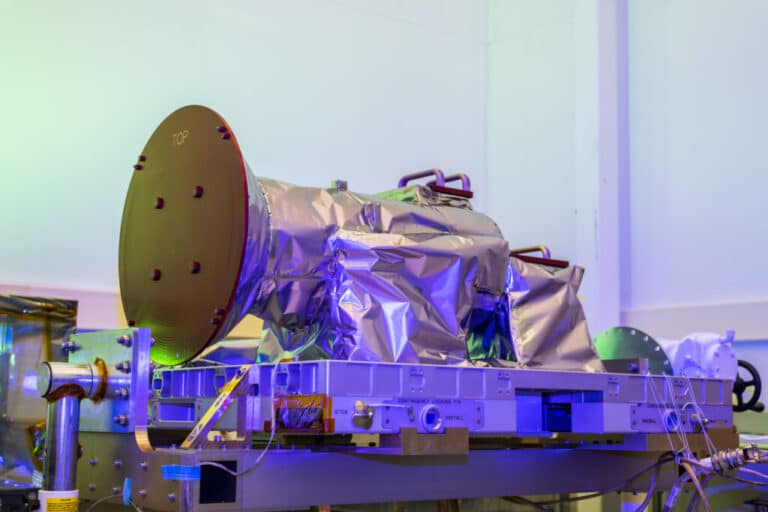
- Onboard AWE is an Advanced Mesospheric Temperature Mapper (ATMT), an instrument that will scan or map the mesopause (a region between the mesosphere and thermosphere).
- Using the four identical telescopes comprising an imaging radiometer, scientists hope to obtain the brightness of light at specific wavelengths.
- This information can then be converted into a temperature map, which could reveal the airglow movement and ultimately, give clues on their role in the upper atmosphere and Space weather.





What is air glow?
- It is a faint luminescence of Earth’s upper atmosphere that is caused by air molecules’ and atoms’ selective absorption of solar ultraviolet and X-radiation.
- Most of the airglow emanates from the region about 50 to 300 km above the surface of Earth, with the brightest area concentrated at altitudes around 97 km.
Q1) What Is mesopause?
The mesopause is the point of minimum temperature at the boundary between the mesosphere and the thermosphere atmospheric regions. Due to the lack of solar heating and very strong radiative cooling from carbon dioxide, the mesosphere is the coldest region on Earth with temperatures as low as -100 °C (-148 °F or 173 K).
Source: How a NASA experiment will study ‘airglow’ to understand Space weather and why it matters

 Last updated on March, 2026
→ UPSC Final Result 2025 is now out.
→ UPSC has released UPSC Toppers List 2025 with the Civil Services final result on its official website.
→ Anuj Agnihotri secured AIR 1 in the UPSC Civil Services Examination 2025.
→ UPSC Marksheet 2025 is now out.
→ UPSC Notification 2026 & UPSC IFoS Notification 2026 is now out on the official website at upsconline.nic.in.
→ UPSC Calendar 2026 has been released.
→ Check out the latest UPSC Syllabus 2026 here.
→ UPSC Prelims 2026 will be conducted on 24th May, 2026 & UPSC Mains 2026 will be conducted on 21st August 2026.
→ The UPSC Selection Process is of 3 stages-Prelims, Mains and Interview.
→ Prepare effectively with Vajiram & Ravi’s UPSC Prelims Test Series 2026 featuring full-length mock tests, detailed solutions, and performance analysis.
→ Enroll in Vajiram & Ravi’s UPSC Mains Test Series 2026 for structured answer writing practice, expert evaluation, and exam-oriented feedback.
→ Join Vajiram & Ravi’s Best UPSC Mentorship Program for personalized guidance, strategy planning, and one-to-one support from experienced mentors.
→ Shakti Dubey secures AIR 1 in UPSC CSE Exam 2024.
→ Also check Best UPSC Coaching in India