AYUSH Latest News
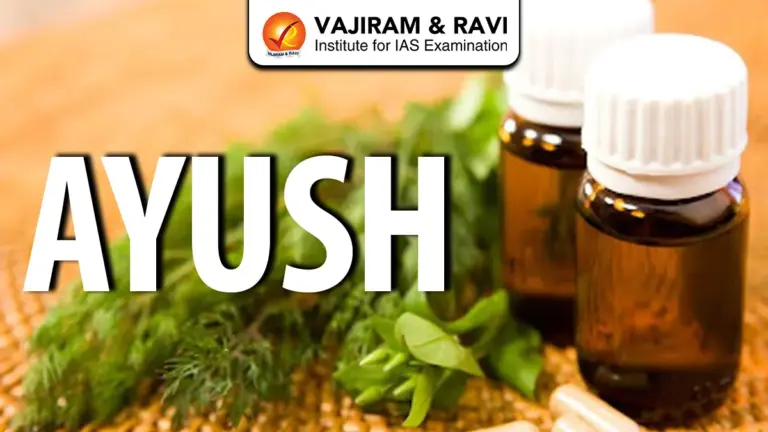
- The Union Budget 2026-27 significantly increased allocations for the AYUSH sector and announced major institutional and regulatory initiatives to expand its domestic and global footprint.
Understanding the AYUSH System in India
- AYUSH refers to Ayurveda, Yoga & Naturopathy, Unani, Siddha, and Homoeopathy, India’s traditional systems of medicine that coexist with modern allopathic healthcare.
- Over the last decade, the government has sought to integrate AYUSH into the public health system while also positioning it as a source of economic growth and soft power.
- Institutionally, AYUSH functions under the Ministry of AYUSH, established in 2014.
- The sector operates through a nationwide network of AYUSH hospitals, dispensaries, teaching institutions, research councils, and regulatory bodies.
- The National AYUSH Mission (NAM) is the primary vehicle for integrating AYUSH services into primary healthcare by co-locating AYUSH facilities in existing health centres.
- India also hosts Institutes of National Importance such as the All India Institute of Ayurveda, New Delhi, and the National Institute of Homoeopathy, Kolkata, along with research bodies like the Central Council for Research in Ayurvedic Sciences.
- Regulatory oversight is provided by the National Commission for Indian System of Medicine and the National Commission for Homoeopathy, while drug standards are set by the Pharmacopoeia Commission for Indian Medicine and Homoeopathy.





Budgetary Expansion of the AYUSH Sector
- The Union Budget 2026-27 marked a sharp increase in government spending on AYUSH.
- The total allocation rose to Rs. 4,408 crore, up from Rs. 3,992 crore in 2025-26 and Rs. 2,122 crore in 2020-21.
- This reflects a long-term policy shift to mainstream traditional medicine within India’s healthcare framework.
- A major announcement was the establishment of three new All-India Institutes of Ayurveda, envisioned as centres of excellence on the lines of AIIMS.
- These institutions will combine patient care, advanced research, and high-quality medical education, aiming to standardise Ayurvedic practice nationally.
- The Budget also proposed enhanced funding for upgrading the WHO Global Traditional Medicine Centre in Jamnagar, signalling India’s ambition to lead global standard-setting for traditional medicine practices.
Strengthening Infrastructure, Research, and Supply Chains
- The National AYUSH Mission received a 66% hike to Rs. 1,300 crore, focusing on modernising AYUSH hospitals and dispensaries, expanding preventive healthcare, and upgrading existing facilities.
- Additional funds were earmarked for improving AYUSH pharmacies and drug-testing laboratories to address long-standing quality and safety concerns.
- A notable innovation announced was Bharat-VISTAAR, a multilingual AI-based digital assistant designed to support farmers cultivating medicinal plants.
- It will provide real-time guidance on crop quality, market prices, and export certification, strengthening the medicinal plant supply chain.
India-EU Free Trade Agreement and Global Outreach
- A key driver behind the Budget push is the India-European Union Free Trade Agreement (FTA), which has opened new opportunities for AYUSH in European markets.
- In EU countries that do not specifically regulate traditional medicine, Indian AYUSH practitioners can now offer services based on qualifications obtained in India.
- The FTA also allows Indian companies to establish wellness centres and Ayurvedic clinics across the EU with legal certainty.
- Importantly, it enables mutual recognition of certain laboratory test results and safety certifications, easing the export of AYUSH products.
- The agreement also recognises India’s Traditional Knowledge Digital Library, helping prevent biopiracy and wrongful patent claims on Indian formulations.
Concerns Around Evidence, Safety, and Regulation
- Despite the expansion, the AYUSH sector faces persistent criticism.
- Medical bodies such as the Indian Medical Association argue that many AYUSH therapies lack rigorous empirical validation through randomised controlled trials.
- Safety concerns remain, particularly regarding the presence of heavy metals like lead and mercury in some Ayurvedic formulations, which have triggered international health advisories.
- Another contentious issue is “mixopathy”, the overlap between AYUSH and allopathic practices.
- Policy decisions allowing Ayurveda practitioners to perform certain surgical procedures and prescribe allopathic drugs have led to legal disputes and professional opposition, highlighting the need for clearer regulatory boundaries.
Source : TH

 Last updated on April, 2026
→ UPSC Final Result 2025 is now out.
→ UPSC has released UPSC Toppers List 2025 with the Civil Services final result on its official website.
→ Anuj Agnihotri secured AIR 1 in the UPSC Civil Services Examination 2025.
→ UPSC Marksheet 2025 is now out.
→ UPSC Notification 2026 & UPSC IFoS Notification 2026 is now out on the official website at upsconline.nic.in.
→ UPSC Calendar 2026 has been released.
→ Check out the latest UPSC Syllabus 2026 here.
→ UPSC Prelims 2026 will be conducted on 24th May, 2026 & UPSC Mains 2026 will be conducted on 21st August 2026.
→ The UPSC Selection Process is of 3 stages-Prelims, Mains and Interview.
→ Prepare effectively with Vajiram & Ravi’s UPSC Prelims Test Series 2026 featuring full-length mock tests, detailed solutions, and performance analysis.
→ Enroll in Vajiram & Ravi’s UPSC Mains Test Series 2026 for structured answer writing practice, expert evaluation, and exam-oriented feedback.
→ Join Vajiram & Ravi’s Best UPSC Mentorship Program for personalized guidance, strategy planning, and one-to-one support from experienced mentors.
→ Shakti Dubey secures AIR 1 in UPSC CSE Exam 2024.
→ Also check Best UPSC Coaching in India
AYUSH FAQs
Q1. What is AYUSH?+
Q2. How much allocation did AYUSH receive in Budget 2026–27?+
Q3. What new institutions were announced for AYUSH?+
Q4. How does the India-EU FTA benefit AYUSH?+
Q5. What are the key concerns related to AYUSH expansion?+
Tags: AYUSH mains articles upsc current affairs upsc mains current affairs