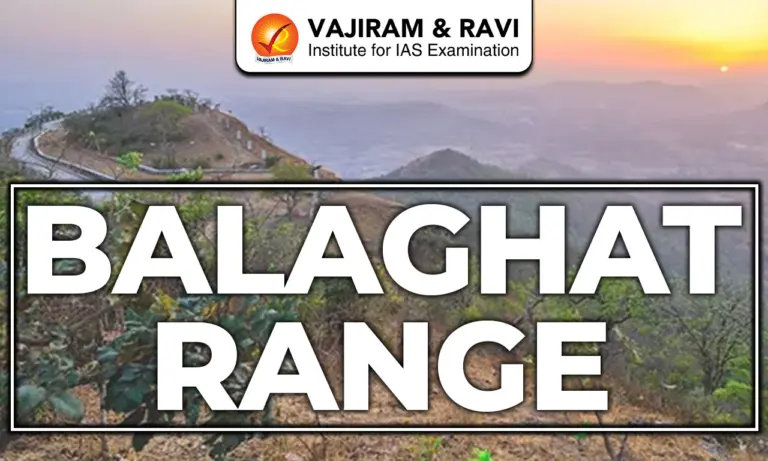
Balaghat Range is a series of low elevation hills forming an important geographical feature of the Deccan Plateau. It originates from the Harishchandra Range of the Western Ghats and extends southeastward up to the Maharashtra and Karnataka border. The range plays a crucial role as a watershed by separating the Godavari River basin in the north from the Bhima River basin in the south and consequently influencing regional drainage and landforms.
Balaghat Range Features
The Balaghat Range represents a compact hill system with distinct geomorphological and hydrological characteristics, forming an essential part of the western Deccan Plateau landscape.
- Location: It is located in the state of Maharashtra.
- Extent: The range begins in the Harishchandra Range of the Western Ghats and stretches southeastward for nearly 320 km across Ahmednagar, Beed, Latur, Osmanabad and Solapur districts, ending near the Karnataka border.
- Structure: It has a narrow width of about 5 to 9 kilometers, making it a compact hill system with continuous ridges and saddles that gradually widen towards the eastern side.
- Elevation Pattern: The western section peaks are higher with elevations between 550 to 825 meters, while the eastern part gradually slopes down towards the Bhima River valley, showing decreasing altitude.
- Topography: The hills are flat topped and separated by broad saddles, formed due to ancient lava flows of the Deccan Traps, giving a step like plateau structure.
- Watershed Function: The range acts as a major divide between the Godavari basin in the north and the Bhima basin in the south, controlling drainage and river flow patterns.
- Transport Connectivity: Important routes such as the Pune-Nashik Highway and the Dhond-Manmad Railway line pass through the range, enhancing regional connectivity across Maharashtra.
Balaghat Range Biodiversity
The Balaghat Range supports diverse ecological systems, with significant variation between the wetter western region and the drier eastern part.
- Vegetation: The western slopes receive higher rainfall and support dense vegetation, while the eastern areas are dry, stony and sparsely vegetated with scrub forests and grasslands.
- Floral Composition: The region hosts species like teak, bamboo and Terminalia, contributing to dry deciduous forest ecosystems.
- Grassland Ecosystem: The eastern part contains Savanna type grasslands dominated by drought resistant grasses and shrubs, which help in soil conservation and support grazing activities.
- Faunal Presence: The region supports animals such as Nilgai, Chital and small mammals along with reptiles and birds adapted to dry deciduous and grassland ecosystems.
- Ecological Adaptation: Vegetation in the region is adapted to semi arid conditions, seasonal droughts and monsoon variability, ensuring survival in fluctuating climatic conditions.





Balaghat Range Significance
The Balaghat Range holds geographical, ecological and economic importance in the Deccan Plateau region due to its natural and human related functions.
- Hydrological Importance: It acts as a major watershed dividing two important river basins, influencing groundwater recharge, surface runoff and irrigation systems in Maharashtra.
- Agricultural Support: Valleys with black cotton soil support crops like jowar, bajra, pulses and cotton under rain fed conditions, contributing to the regional agrarian economy.
- Pastoral Activities: The range supports shepherd communities, with sheep trails connecting villages and enabling livestock based livelihoods across the hilly terrain.
- Settlement and Culture: Small villages and hilltop temples are scattered across the range, reflecting traditional settlement patterns and cultural practices linked to the landscape.
- Environmental Role: The range helps in soil conservation, flood control and maintaining ecological balance by supporting forests, grasslands and biodiversity in a semi arid environment.
Balaghat Range Conservation Measures
Conservation of the Balaghat Range focuses on maintaining its ecological balance, forest cover and watershed functions amid increasing human pressures.
- Forest Protection: Parts of the range are designated as reserved forests under the Indian Forest Act 1927, ensuring regulation of deforestation, grazing and resource extraction.
- Afforestation Efforts: Plantation activities are undertaken to restore degraded lands, especially in areas affected by deforestation and soil erosion due to human activities.
- Control of Overgrazing: Measures are taken to manage livestock grazing, as excessive grazing leads to soil compaction, reduced water infiltration and vegetation loss.
- Regulation of Mining: Small scale basalt quarrying is monitored to reduce environmental damage, habitat fragmentation and dust pollution in the region.
- Invasive Species Management: Efforts are made to control invasive species like Lantana camara, which threaten native biodiversity and reduce the availability of forage.

 Last updated on March, 2026
→ UPSC Final Result 2025 is now out.
→ UPSC has released UPSC Toppers List 2025 with the Civil Services final result on its official website.
→ Anuj Agnihotri secured AIR 1 in the UPSC Civil Services Examination 2025.
→ UPSC Marksheet 2025 is now out.
→ UPSC Notification 2026 & UPSC IFoS Notification 2026 is now out on the official website at upsconline.nic.in.
→ UPSC Calendar 2026 has been released.
→ Check out the latest UPSC Syllabus 2026 here.
→ UPSC Prelims 2026 will be conducted on 24th May, 2026 & UPSC Mains 2026 will be conducted on 21st August 2026.
→ The UPSC Selection Process is of 3 stages-Prelims, Mains and Interview.
→ Prepare effectively with Vajiram & Ravi’s UPSC Prelims Test Series 2026 featuring full-length mock tests, detailed solutions, and performance analysis.
→ Enroll in Vajiram & Ravi’s UPSC Mains Test Series 2026 for structured answer writing practice, expert evaluation, and exam-oriented feedback.
→ Join Vajiram & Ravi’s Best UPSC Mentorship Program for personalized guidance, strategy planning, and one-to-one support from experienced mentors.
→ Shakti Dubey secures AIR 1 in UPSC CSE Exam 2024.
→ Also check Best UPSC Coaching in India
Balaghat Range FAQs
Q1. What is the Balaghat Range?+
Q2. Which rivers are separated by the Balaghat Range?+
Q3. Which districts does the Balaghat Range pass through?+
Q4. What type of vegetation is found in the Balaghat Range?+
Q5. What type of landforms are seen in the Balaghat Range?+
Tags: balaghat range geography geography notes