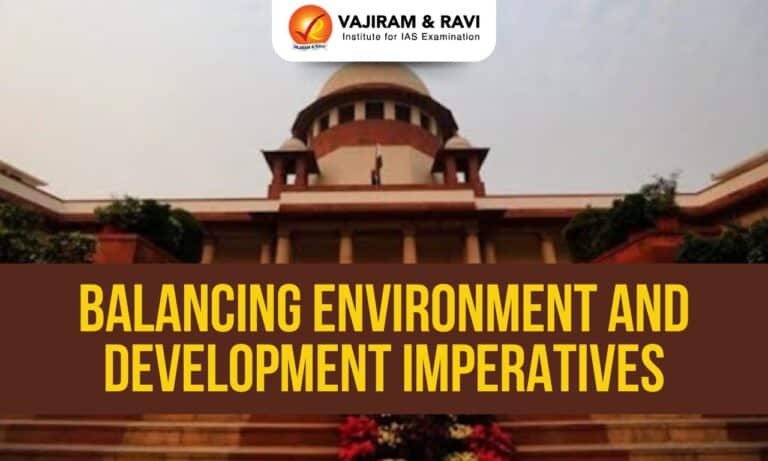
Balancing Environment and Development Imperatives Latest News
- The Supreme Court, by a 2–1 majority, recalled its (May 16, 2025) judgment that had declared retrospective (ex post facto) Environmental Clearances (ECs) as illegal and anathema to environmental law.
- The majority—CJI B.R. Gavai and Justice K. Vinod Chandran—held that the earlier ruling would cause massive economic losses and hinder critical public infrastructure.
- Justice Ujjal Bhuyan dissented strongly, calling the recall a “retrogression” and a violation of the precautionary principle.
Background
- A bench led by Justice A.S. Oka (now retired) and Justice Bhuyan held that ex post facto ECs are illegal.
- The court had struck down a 2017 notification and 2021 office memorandum (OM) of the Union government, which in effect recognised the grant of ex post facto ECs.
- The government was accused of “crafty drafting” to regularise illegal constructions.




Grounds for Recall (Majority Opinion)
- Public interest and economic costs:
- CJI Gavai emphasized devastating consequences if the earlier verdict continued.
- For example, 24 Central projects worth Rs. 8,293 crore and 29 State projects worth Rs. 11,168 crore were stuck.
- Major projects impacted – AIIMS Odisha (962-bed), Vijayanagar greenfield airport, SAIL investments, common effluent treatment plants.
- Demolition of such projects would mean wastage of nearly Rs. 20,000 crore and cause livelihood loss.
- Legal precedents ignored earlier:
- The earlier ruling overlooked co-equal bench decisions that allowed post facto ECs in exceptional circumstances. For example, Electrosteel Steels Ltd (2021), Pahwa Plastics (2022), D. Swamy (2022).
- As per judicial discipline:
- A coordinate bench must refer to a larger bench if it disagrees.
- The earlier verdict was therefore per incuriam (judicial error).
- Penalties as deterrence:
- 2017 and 2021 rules imposed heavy penalties, ensuring – polluter pays principle, deterrence against illegal constructions.
- The majority held that retrospective ECs plus penalties can achieve compliance without demolition.
- Pollution paradox:
- Demolishing large structures may cause more pollution – debris, reconstruction emissions
- Hence, recall is seen as protecting environmental interest indirectly.
Minority Opinion – Justice Ujjal Bhuyan’s Strongest Dissent
- Violation of environmental jurisprudence:
- Ex post facto ECs violate – precautionary principle (core of environmental jurisprudence), sustainable development.
- He termed retrospective ECs “anathema”, i.e., a thing devoted to evil.
- Per Incuriam logic reversed:
- Earlier cases Common Cause (2017) and Alembic Pharma (2020) held that ex post facto ECs are impermissible and contrary to law.
- Therefore, Electrosteel, Pahwa, and D. Swamy was per incuriam, not the earlier judgment.
- Critique of ‘false environment vs development’ narrative: He rejected the idea that environment and development are adversaries. Warned the Court is “backtracking on sound environmental jurisprudence”.
- Rule of law and accountability:
- Builders who violated EC norms should not be rewarded.
- Review petitions lacked details such as dates of construction, whether EC was originally required.
- Therefore, the review should have been dismissed.
- Delhi smog reminder: Highlighted Delhi air pollution as an example of environmental degradation, and the court has constitutional duty to protect the environment.
- Precautionary vs polluter pays principles: The precautionary principle cannot be diluted by relying on polluter-pays, which is only compensatory.
Challenges Highlighted in the Judgment
- Conflict between infrastructure development and environmental protection.
- Weak compliance culture among developers.
- Inconsistency in judicial precedents.
- Administrative lapses: Delayed EC processes.
- Environmental degradation: Air pollution and unsustainable practices.
- Risk of setting a lenient precedent encouraging violations.
Way Forward
- Establish clear, time-bound EC procedures: Avoid delays that prompt developers to proceed without ECs.
- Strengthen monitoring and penalties: Ensure real-time compliance, heavy penalties discouraging violations.
- Harmonise judicial precedents through a larger bench: To resolve contradictions on ex post facto EC validity, environmental principles.
- Promote sustainable infrastructure development: In line with precautionary principle, public interest, constitutional environmental duties.
- Strengthen EIA quality and transparency: Independent audits and public participation should be enhanced.
- Balance public interest with environmental safeguards: Critical public projects must comply with law while protecting ecology.
Conclusion
- The SC’s recall decision reflects a critical judicial balancing act between environmental protection and developmental imperatives.
- It underscores the need for robust EC processes, clear judicial guidance, and sustainable development that respects both environment and economic goals.
- The matter now being placed before the CJI may pave the way for a larger bench to finally settle the legal position on ex post facto environmental clearances.

 Last updated on March, 2026
→ UPSC Final Result 2025 is now out.
→ UPSC has released UPSC Toppers List 2025 with the Civil Services final result on its official website.
→ Anuj Agnihotri secured AIR 1 in the UPSC Civil Services Examination 2025.
→ UPSC Marksheet 2025 is now out.
→ UPSC Notification 2026 & UPSC IFoS Notification 2026 is now out on the official website at upsconline.nic.in.
→ UPSC Calendar 2026 has been released.
→ Check out the latest UPSC Syllabus 2026 here.
→ UPSC Prelims 2026 will be conducted on 24th May, 2026 & UPSC Mains 2026 will be conducted on 21st August 2026.
→ The UPSC Selection Process is of 3 stages-Prelims, Mains and Interview.
→ Prepare effectively with Vajiram & Ravi’s UPSC Prelims Test Series 2026 featuring full-length mock tests, detailed solutions, and performance analysis.
→ Enroll in Vajiram & Ravi’s UPSC Mains Test Series 2026 for structured answer writing practice, expert evaluation, and exam-oriented feedback.
→ Join Vajiram & Ravi’s Best UPSC Mentorship Program for personalized guidance, strategy planning, and one-to-one support from experienced mentors.
→ Shakti Dubey secures AIR 1 in UPSC CSE Exam 2024.
→ Also check Best UPSC Coaching in India
Balancing Environment and Development Imperatives FAQs
Q1. What concerns are associated with granting ex post facto Environmental Clearances (ECs) in India?+
Q2. What is the SC’s reasoning for recalling its earlier judgment on retrospective ECs?+
Q3. How the principle of judicial discipline influenced the SC’s decision to revisit its earlier judgment?+
Q4. What are the key concerns raised in Justice Ujjal Bhuyan’s dissent?+
Q5. Whether economic costs and public infrastructure considerations can justify retrospective environmental clearances?+
Tags: balancing environment and development imperatives