


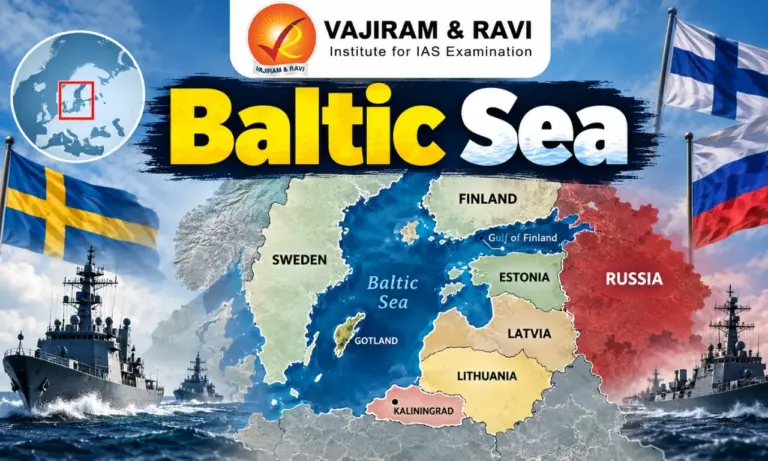
Baltic Sea Latest News
The Nordic Council Committee for a Sustainable Nordic Region announced a new initiative to combat pollution and to protect the marine environment of the Baltic Sea.
About Baltic Sea
- It is a semi-enclosed inland sea of the Atlantic Ocean, situated in Northern Europe.
- It is often cited as the world’s largest brackish inland water body.
- It is the youngest sea on our planet, emerging some 10,000-15,000 years ago as the glaciers retreated at the end of the last Ice Age.
- Surrounding Countries: It is bordered by Sweden, Poland, Lithuania, Latvia, Finland, Estonia, Germany, Denmark, and Russia.
- Key Branches and Basin
-
- It comprises several branches and basins, which include, from northeast to southwest, the Gulf of Bothnia, the Gulf of Finland, and the Gulf of Riga; the central-southern area known as the Baltic Proper; and the Danish straits of Kattegat and Skagerrak, which connect to the North Sea, an arm of the Atlantic Ocean.
- Its water salinity levels are lower than that of the world’s oceans due to the inflow of fresh water from the surrounding land and the sea’s shallowness.
- Islands: It is home to over 20 islands and archipelagos. Gotland, located off the coast of Sweden, is the largest island in the Baltic Sea.
- Issues: Algal Harmful Blooms are also one of the issues that affect the Baltic Sea.
Source: NC


 Last updated on Oct, 2026
→ UPSC 2027 Notification will be released on 13 January 2027 at upsconline.nic.in.
→ Check Nobel Prize 2026 Winners List here.
→ Download PIB PRiSM Monthly Magazine 2026 here.
→ Check UPSC Monthly Current Affairs Magazine The Recitals here.
→ Check out the latest UPSC Syllabus here.
→ Download UPSC Model Answers for Mains 2026
→ UPSC Mains Question Paper 2026 is out now for Essay & GS Paper 1, 2, 3 & 4.
→ UPSC Calendar 2027 has been released.
→ Enroll in Vajiram & Ravi’s UPSC Mains Test Series 2027 for structured answer writing practice, expert evaluation, and exam-oriented feedback.
→ Join Vajiram & Ravi’s UPSC Mentorship Program 2027 for personalized guidance, strategy planning, and one-to-one support from experienced mentors.
→ Go through the UPSC Mains Previous Year Papers to enhance your preparation.
→ UPSC has released UPSC Toppers List 2025 with the Civil Services final result on its official website.
→ Also check Best UPSC Coaching in India
Baltic Sea FAQs
Q1. How many countries shares border with Baltic Sea ?+
Q2. Where is Gotland Island is located?+
Tags: baltic sea prelims pointers upsc current affairs upsc prelims current affairs








