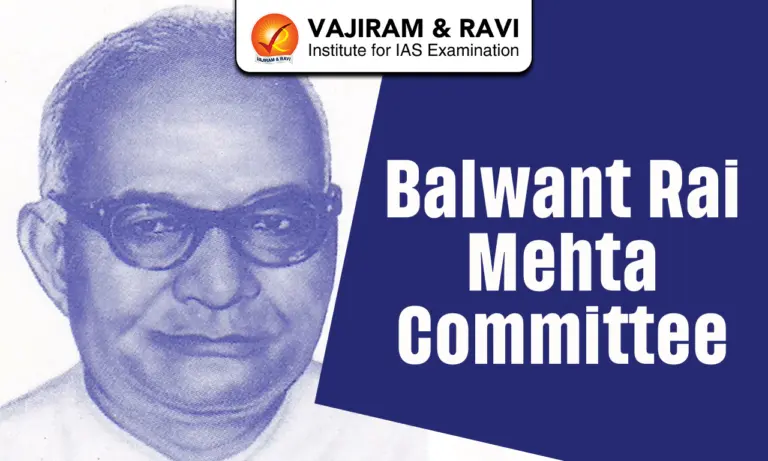
The Balwant Rai Mehta Committee was an important committee set up by the Government of India to improve local self-government in rural areas. It was formed in 1957 to study how development programs were working at the village level. The committee suggested strengthening democracy at the grassroots by giving more power to local bodies. Its recommendations led to the introduction of the Panchayati Raj system in India, which allows people in villages to take part in their own governance.
About Balwant Rai Mehta Committee
- The Balwantrai Mehta Committee was an important committee set up by the Government of India in 1957. Its main aim was to find ways to improve rural development and involve people more actively in local governance.
- The committee played a key role in shaping the Panchayati Raj system, which is the system of local self-government in villages. Its recommendations became the foundation of democratic decentralisation in India.
- The committee submitted its report in November 1957. It was considered very important because it suggested a proper system to bring democracy to the village level.
Balwant Rai Mehta Committee Background
- After independence in 1947, India focused strongly on rural development. To improve village conditions, the government started:
- Community Development Programme (1952)
- National Extension Service (1953)
- However, these programmes did not work as expected. By the mid-1950s, several problems were noticed:
- Too much control by government officials (bureaucracy)
- Very little involvement of local people
- Lack of coordination between departments
- Weak accountability
- Villagers had almost no role in planning development work
- Because of these issues, the government decided to review these programmes and find better ways to involve people at the grassroots level.
- So, on 16 January 1957, the Balwantrai Mehta Committee was formed under the leadership of Balwantrai G. Mehta, a Member of Parliament.





Balwant Rai Mehta Committee Objective
- To study how the Community Development Programme and National Extension Service were working
- To identify their weaknesses
- To suggest improvements
- To recommend ways to increase people’s participation
- To design a system for democratic decentralisation
Major Recommendations
- Three-Tier Panchayati Raj System: The committee recommended a three-tier Panchayati Raj system consisting of Zila Parishad at the district level, Panchayat Samiti at the block level, and Gram Panchayat at the village level, where the Gram Panchayat would act as the basic unit and all three levels would be properly connected to ensure smooth coordination and effective implementation of development programmes.
- Democratic Composition: It suggested that all members of Panchayati Raj institutions should be elected by the people either directly or indirectly, so that these bodies become democratic in nature, accountable to the public, and encourage active participation of citizens in governance.
- Devolution of Powers and Responsibilities: The committee emphasized devolution of real powers and responsibilities to local bodies, meaning that Panchayati Raj institutions should be given authority to plan, implement, and supervise development programmes along with sufficient administrative control and financial resources so that they can function effectively and independently.
- Importance of Panchayat Samiti: It identified the Panchayat Samiti at the block level as the most important unit, responsible for planning and development activities, as well as coordinating between the Gram Panchayats and the Zila Parishad to ensure that local needs are properly reflected in district-level plans.
- Role of Officials: The committee highlighted the need for close cooperation between government officials and elected representatives, where officials provide technical and administrative support while elected members represent the people’s interests, ensuring efficient governance and better execution of policies.
- Role of Zila Parishad: It recommended that the Zila Parishad should function as an advisory, coordinating, and supervisory body at the district level, overseeing the work of Panchayat Samitis and ensuring that development programmes are properly planned and implemented across the district.
- Financial Resources: The committee stressed that Panchayati Raj institutions should have adequate financial resources, including the power to raise local taxes and receive grants from the state government, so that they can operate independently without excessive dependence on higher authorities.
- Relationship with State Government: It suggested that the state government should play a supportive role by providing guidance, training, and supervision, but should avoid interfering in the daily functioning of Panchayati Raj institutions, thereby maintaining their autonomy and effectiveness.
- Training and Capacity Building: Finally, the committee emphasized the importance of training and capacity building for both elected representatives and officials, so that they can better understand planning, administration, and leadership, and perform their roles more efficiently in serving the community.
Implementation and Adoption of Panchayati Raj
- After the recommendations of the Balwantrai Mehta Committee were accepted by the National Development Council (NDC) in 1958, many states in India started taking steps to introduce the Panchayati Raj system in their regions in order to strengthen local self-government and improve rural development.
- Rajasthan became the first state to implement the Panchayati Raj system, and it was officially inaugurated on 2 October 1959 in Nagaur district, which was symbolically important as the day marks the birth anniversary of Mahatma Gandhi, who strongly supported village self-governance.
- Soon after Rajasthan, Andhra Pradesh became the second state to adopt the Panchayati Raj system, and gradually other states also began implementing similar structures according to their own administrative needs and political conditions.
- Different states adopted the system in slightly different ways, which led to variations in structure, powers, and functioning of Panchayati Raj institutions across the country.
- The introduction of Panchayati Raj marked an important step towards decentralisation of power, as it transferred decision-making authority from the central and state governments to local bodies at the grassroots level.
- It also increased people’s participation in governance, allowing villagers to take part in planning and implementing development programmes that directly affected their lives.
- Over time, Panchayati Raj institutions helped in improving rural development, local administration, and democratic awareness, although their success varied from state to state depending on implementation and support.
- This system strongly reflected the Gandhian idea of Gram Swaraj (village self-rule), where villages are empowered to govern themselves and manage their own affairs.
Evaluation and Criticism of the Balwantrai Mehta Committee
- Although the committee played an important role in introducing democratic decentralisation, its implementation faced several challenges across different states.
- There was uneven adoption, as states followed different structures and powers, leading to lack of uniformity.
- Bureaucratic dominance reduced the real authority of elected representatives and weakened local democracy.
- Insufficient financial powers made Panchayati Raj institutions dependent on state governments.
- Lack of training and awareness among representatives and people affected effective functioning.
- Political interference at the state level also limited their autonomy.
- Despite these issues, the committee’s recommendations laid the foundation of Panchayati Raj and influenced later reforms like the 73rd Constitutional Amendment.
Post-Committee Developments
- The Balwantrai Mehta Committee laid the foundation for Panchayati Raj in India and inspired many later committees and reforms to strengthen local self-government.
- The Ashok Mehta Committee (1977) suggested a two-tier system and emphasized greater political decentralisation and stronger local bodies.
- The G.V.K. Rao Committee (1985) and L.M. Singhvi Committee (1986) recommended giving constitutional status to Panchayati Raj institutions to make them more stable and effective.
- All these efforts finally led to the 73rd Constitutional Amendment Act (1992), which gave constitutional recognition to Panchayati Raj and made a uniform three-tier system compulsory across India.
Balwantrai Mehta Committee Significance
- The committee introduced the concept of democratic decentralisation, transferring power to local bodies at the grassroots level.
- It laid the foundation of the Panchayati Raj system through a clear three-tier structure of governance.
- It promoted people’s participation in decision-making and rural development.
- It improved local administration by involving Panchayats in planning and implementation of programmes.
- It supported the idea of Gram Swaraj (village self-rule).
- Its recommendations influenced later reforms, especially the 73rd Constitutional Amendment Act (1992).

 Last updated on March, 2026
→ UPSC Final Result 2025 is now out.
→ UPSC has released UPSC Toppers List 2025 with the Civil Services final result on its official website.
→ Anuj Agnihotri secured AIR 1 in the UPSC Civil Services Examination 2025.
→ UPSC Marksheet 2025 is now out.
→ UPSC Notification 2026 & UPSC IFoS Notification 2026 is now out on the official website at upsconline.nic.in.
→ UPSC Calendar 2026 has been released.
→ Check out the latest UPSC Syllabus 2026 here.
→ UPSC Prelims 2026 will be conducted on 24th May, 2026 & UPSC Mains 2026 will be conducted on 21st August 2026.
→ The UPSC Selection Process is of 3 stages-Prelims, Mains and Interview.
→ Prepare effectively with Vajiram & Ravi’s UPSC Prelims Test Series 2026 featuring full-length mock tests, detailed solutions, and performance analysis.
→ Enroll in Vajiram & Ravi’s UPSC Mains Test Series 2026 for structured answer writing practice, expert evaluation, and exam-oriented feedback.
→ Join Vajiram & Ravi’s Best UPSC Mentorship Program for personalized guidance, strategy planning, and one-to-one support from experienced mentors.
→ Shakti Dubey secures AIR 1 in UPSC CSE Exam 2024.
→ Also check Best UPSC Coaching in India
Balwant Rai Mehta Committee FAQs
Q1. What was the Balwant Rai Mehta Committee?+
Q2. Why was the committee formed?+
Q3. What was the main recommendation of the committee?+
Q4. What is democratic decentralisation according to the committee?+
Q5. Which state first implemented Panchayati Raj?+
Tags: balwant rai mehta committee polity polity notes