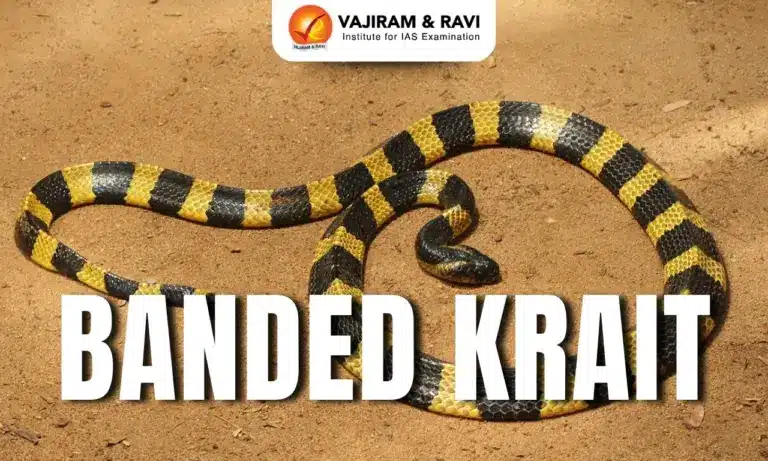
Banded Krait Latest News
An Indian Forest Service officer has drawn widespread attention on social media after sharing a striking video of a highly venomous Banded Krait encountered during a night patrol.
About Banded Krait
- It is a highly venomous snake native to South and Southeast Asia.
- Scientific Name: Bungarus fasciatus
- Part of the elapid family, which includes cobras and mambas, the Banded Krait is easily recognizable by its vibrant yellow and black crossbands, giving it a distinctive appearance.
- Distribution: These snakes have been recorded eastwards from central India through Bangladesh, Myanmar, Cambodia, Thailand, Laos, Vietnam, and southern China (including Hong Kong) to Malaysia and the main Indonesian islands of Borneo (Java and Sumatra), as well as Singapore.





Banded Krait Habitat
- It primarily inhabits wetlands, forests, and areas near water bodies.
- They inhabit termite mounds and rodent holes close to water and often live near human settlements, especially villages, because of their supply of rodents and water.
Banded Krait Features
- It is a large snake, typically growing between 5 to 7 feet.
- It has a slender, cylindrical body with smooth scales.
- The alternating bands of yellow and black encircle its body entirely, making it one of the most visually striking snakes in the region.
- The head is slightly broader than its neck, with a rounded snout and small eyes.
- Though its venom is highly potent, it is known to be shy and nonaggressive, often avoiding human contact unless provoked.
- Banded kraits are carnivores and feed mainly on other snakes.
Banded Krait Conservation Status
It is classified as ‘Least Concern’ under the IUCN Red List.
Source: HT

 Last updated on April, 2026
→ UPSC Final Result 2025 is now out.
→ UPSC has released UPSC Toppers List 2025 with the Civil Services final result on its official website.
→ Anuj Agnihotri secured AIR 1 in the UPSC Civil Services Examination 2025.
→ UPSC Marksheet 2025 is now out.
→ UPSC Notification 2026 & UPSC IFoS Notification 2026 is now out on the official website at upsconline.nic.in.
→ UPSC Calendar 2026 has been released.
→ Check out the latest UPSC Syllabus 2026 here.
→ UPSC Prelims 2026 will be conducted on 24th May, 2026 & UPSC Mains 2026 will be conducted on 21st August 2026.
→ The UPSC Selection Process is of 3 stages-Prelims, Mains and Interview.
→ Prepare effectively with Vajiram & Ravi’s UPSC Prelims Test Series 2026 featuring full-length mock tests, detailed solutions, and performance analysis.
→ Enroll in Vajiram & Ravi’s UPSC Mains Test Series 2026 for structured answer writing practice, expert evaluation, and exam-oriented feedback.
→ Join Vajiram & Ravi’s Best UPSC Mentorship Program for personalized guidance, strategy planning, and one-to-one support from experienced mentors.
→ Shakti Dubey secures AIR 1 in UPSC CSE Exam 2024.
→ Also check Best UPSC Coaching in India
Banded Krait FAQs
Q1. To which family does the Banded Krait belong?+
Q2. How can the Banded Krait be visually identified?+
Q3. Is the banded krait venomous?+
Q4. Banded Krait is native to which regions?+
Q5. What is the conservation status of the Banded Krait on the IUCN Red List?+
Tags: banded krait