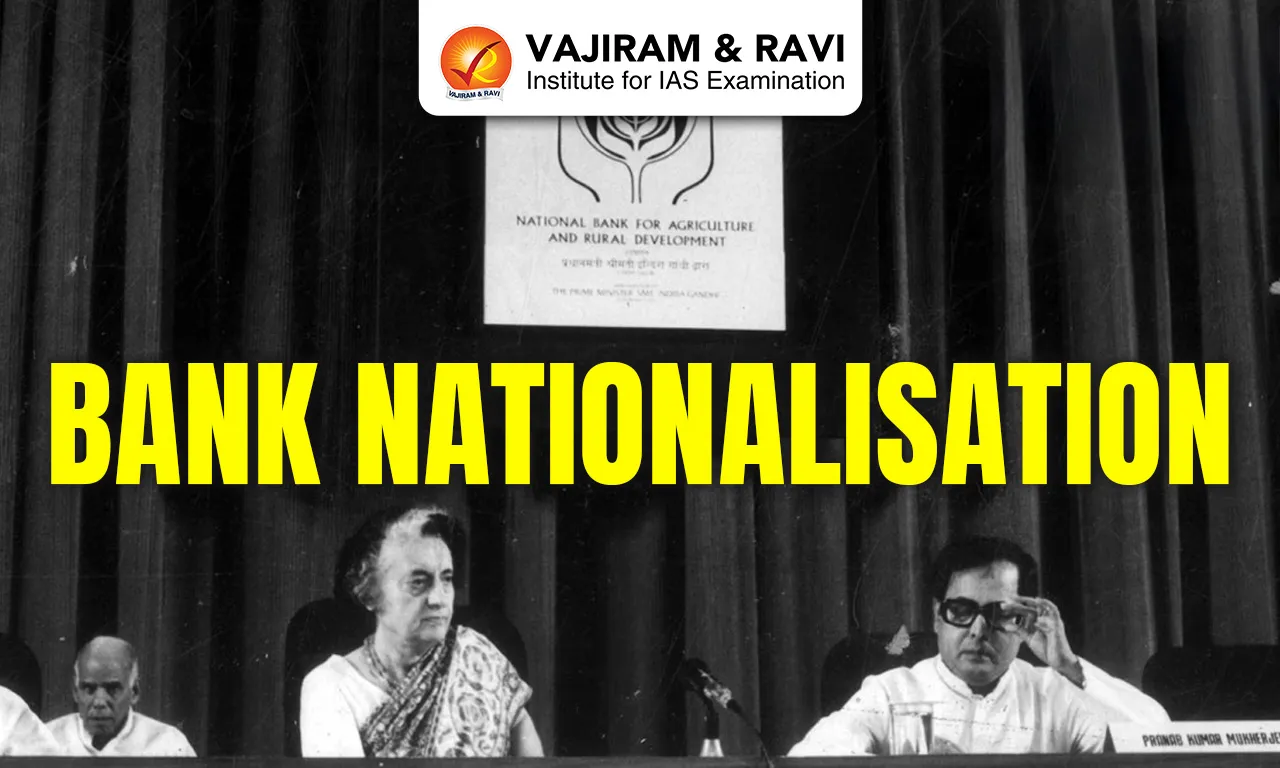
Bank Nationalisation Latest News
- The nationalisation of banks in 1969 is widely seen as one of the most transformative economic decisions in independent India.
- Led by the then PM Indira Gandhi, the government nationalised 14 major private banks on July 19, 1969, marking a decisive shift toward a socialist, state-led development model.
- The move aimed to align banking with broader social and economic goals, ensuring credit flowed to priority sectors and underserved regions. It built on earlier steps like the nationalisation of the State Bank of India in 1955.
- Its impact was far-reaching—reshaping India’s financial system for decades and influencing political and economic structures. Between 1951 and 1966, the number of fragile commercial banks had already been reduced, laying the groundwork for this major reform.
Rationale Behind Bank Nationalisation in India
- Limited Reach of Banking Services – Before the 1960s, banking expansion was largely confined to urban centres, leaving rural and semi-urban areas underserved. As a result, key sectors like agriculture, small-scale industries, and self-employed individuals lacked access to institutional credit.
- Inadequate Support for Priority Sectors – The absence of banking services in large parts of the country meant that developmental needs of the economy were not being met, particularly in sectors crucial for inclusive growth.
- Perception of Profit-Oriented Private Banks – There was a growing political belief that private banks prioritised profits over social responsibility. They were seen as reluctant to: Expand into less profitable rural areas; Lend to smaller borrowers; Diversify credit across sectors.
Need for Social Control Over Credit
- The political leadership felt that banking needed to align with national development goals. Nationalisation was seen as a way to:
- Ensure equitable distribution of credit
- Promote inclusive economic growth
- Make banks responsive to societal needs rather than just profits


Political Context Behind Bank Nationalisation
- Bank nationalisation was not just an economic reform but a strategic political move, consolidating power while embedding a long-term shift toward state-led economic governance.
- The concept of “social control” of banks emerged in 1967 as a compromise between opposing views—complete state control and continued private ownership.
- It reflected growing concern over aligning banking with public welfare.
Bank Nationalisation of 1969: Implementation and Immediate Reactions
- The nationalisation of banks was executed swiftly through an Ordinance, reflecting strong political resolve, while triggering debate over its economic rationale, procedural propriety, and long-term impact.
Criteria and Selection of Banks
- The process of nationalisation began with identifying banks based on deposit size.
- Initially, banks with deposits above ₹100 crore were considered, but the threshold was lowered to ₹50 crore to include more major institutions, in line with the RBI’s classification system.
- On July 19, 1969, the government issued an Ordinance to nationalise 14 major private banks with deposits exceeding ₹50 crore.
- In her national address, Indira Gandhi justified the move as essential for establishing a socialist economic framework, emphasising:
- Control over the “commanding heights” of the economy
- Mobilisation of resources for development
- Reduction of regional and social inequalities
Political and Public Reactions
- The decision sparked immediate debate:
- Jayaprakash Narayan criticised it as unwarranted, arguing it would increase bureaucratic power without solving economic issues.
- Atal Bihari Vajpayee questioned the use of an Ordinance for such a major reform when Parliament was about to convene.
- Within the Reserve Bank of India, discussions began shortly after the announcement, though records indicate only limited and cautious deliberation on the implications.

 Last updated on Sep, 2026
→ UPSC 2027 Notification will be released on 13 January 2027 at upsconline.nic.in.
→ Asian Games 2026 are being held in Aichi-Nagoya, Japan, from 19 September to 4 October.
→ Check out the latest UPSC Syllabus here.
→ Download UPSC Model Answers for Mains 2026
→ UPSC Mains Question Paper 2026 is out now for Essay & GS Paper 1, 2, 3 & 4.
→ UPSC Calendar 2027 has been released.
→ Enroll in Vajiram & Ravi’s UPSC Mains Test Series 2027 for structured answer writing practice, expert evaluation, and exam-oriented feedback.
→ Join Vajiram & Ravi’s UPSC Mentorship Program 2027 for personalized guidance, strategy planning, and one-to-one support from experienced mentors.
→ Go through the UPSC Mains Previous Year Papers to enhance your preparation.
→ UPSC has released UPSC Toppers List 2025 with the Civil Services final result on its official website.
→ Also check Best UPSC Coaching in India
Bank Nationalisation FAQs
Q1. What is bank nationalisation?+
Q2. Why was bank nationalisation introduced in 1969?+
Q3. How did bank nationalisation impact India’s economy?+
Q4. What was the political context behind bank nationalisation?+
Q5. What criticisms were raised against bank nationalisation?+
Tags: Bank nationalisation mains articles upsc current affairs upsc mains current affairs