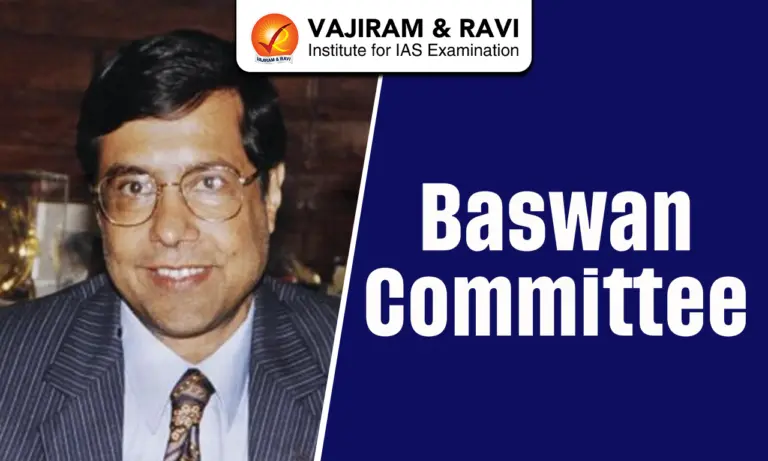
The Baswan Committee was set up by the Government of India to review and improve the civil services system in the country. It was formed to study how the overall functioning of civil services could be made more effective and better suited to the needs of modern governance. The committee was headed by B.S. Baswan, a former UPSC Chairman, focused on making the system more efficient, transparent, and responsive to people. Its suggestions aimed at bringing reforms so that government institutions can function better and serve the public more effectively.
Baswan Committee Background
- The committee was formed in August 2015 at a time when there were growing concerns that the Civil Services Examination had become lengthy, complex, and uneven, especially due to differences in optional subjects, high age limits, and multiple attempts, which created imbalance among candidates from different educational and social backgrounds.
- It carefully studied the entire examination process, including prelims, mains, and interview stages, and submitted its report in August 2016 to the government, after which it was sent to the Department of Personnel and Training (DoPT) for further consideration and possible reforms.
Baswan Committee Key Recommendations
-
- Age Limit Reduction: The committee recommended reducing the upper age limit (then 32 years for general category) so that candidates can enter civil services at a younger age, which would help in building a more energetic, long-serving, and adaptable administrative workforce.
- Removal of Optional Subject: It suggested removing the optional subject paper from the mains examination because different subjects created scoring differences and gave unfair advantages to some candidates, thereby affecting the principle of a level playing field.
- Changes in Exam Structure: The committee reviewed the structure of the exam, including the number of papers and evaluation methods, and suggested simplifying the pattern, improving transparency, and focusing more on testing practical knowledge, analytical ability, and problem-solving skills rather than rote learning.
- Fixing IAS Intake: It recommended that the number of IAS officers recruited each year should be kept around 180, as increasing the intake beyond this level could affect the quality of candidates and also put pressure on training capacity at institutions like the Lal Bahadur Shastri National Academy of Administration (LBSNAA).
- Additional Suggestions
-
- The committee emphasized the need to improve the overall quality of civil servants by focusing more on ethics, decision-making ability, leadership skills, and administrative aptitude so that selected candidates are better prepared for real-life governance challenges.
- It also highlighted the importance of better training, periodic performance evaluation, and continuous capacity building of civil servants even after recruitment, so that they remain efficient, accountable, and responsive to public needs.





Baswan Committee Significance
- The Baswan Committee is significant because it brought major attention to the need for reforms in the Civil Services Examination system and highlighted key issues like fairness, efficiency, and quality of selection.
- Its recommendations started an important debate on UPSC reforms, especially regarding optional subjects, age limits, and exam structure, and even though many suggestions have not been fully implemented, they continue to influence discussions on improving the recruitment system for civil services in India.

 Last updated on March, 2026
→ UPSC Final Result 2025 is now out.
→ UPSC has released UPSC Toppers List 2025 with the Civil Services final result on its official website.
→ Anuj Agnihotri secured AIR 1 in the UPSC Civil Services Examination 2025.
→ UPSC Marksheet 2025 is now out.
→ UPSC Notification 2026 & UPSC IFoS Notification 2026 is now out on the official website at upsconline.nic.in.
→ UPSC Calendar 2026 has been released.
→ Check out the latest UPSC Syllabus 2026 here.
→ UPSC Prelims 2026 will be conducted on 24th May, 2026 & UPSC Mains 2026 will be conducted on 21st August 2026.
→ The UPSC Selection Process is of 3 stages-Prelims, Mains and Interview.
→ Prepare effectively with Vajiram & Ravi’s UPSC Prelims Test Series 2026 featuring full-length mock tests, detailed solutions, and performance analysis.
→ Enroll in Vajiram & Ravi’s UPSC Mains Test Series 2026 for structured answer writing practice, expert evaluation, and exam-oriented feedback.
→ Join Vajiram & Ravi’s Best UPSC Mentorship Program for personalized guidance, strategy planning, and one-to-one support from experienced mentors.
→ Shakti Dubey secures AIR 1 in UPSC CSE Exam 2024.
→ Also check Best UPSC Coaching in India
Baswan Committee FAQs
Q1. What is the Baswan Committee?+
Q2. Who headed the Baswan Committee?+
Q3. Why was the Baswan Committee formed?+
Q4. What was the main recommendation of the committee?+
Q5. What did the committee suggest about the age limit?+
Tags: baswan committee polity polity notes