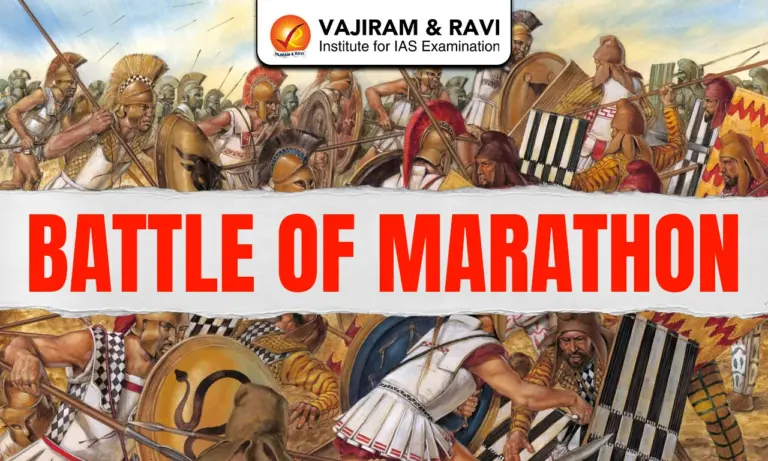
The battle of Marathon was fought in 490 BCE between the Greek city-state of Athens and the Persian Empire. It is considered historically significant because it demonstrated that a smaller, well-organised army could defeat a much larger imperial force through strategy and discipline.
Battle of Marathon Background
By the late 6th century BCE, the powerful Persian Empire under Darius I had conquered vast territories stretching from Asia Minor to parts of Europe. The Greek cities of Ionia (in present-day Turkey) were under Persian control. In 499 BCE, these Ionian cities revolted against Persian rule. Athens and Eretria sent ships and soldiers to support the revolt. Although the revolt was eventually crushed, Darius was angered by Athenian interference and decided to punish Athens.
In 490 BCE, the Persian army first attacked and destroyed Eretria and then landed at the Marathon plain, located about 40 kilometres from Athens. Marathon was strategically chosen because it provided suitable terrain for Persian cavalry and posed a direct threat to Athens.
Read about: Important Battles in Indian History
Course of the Battle
The Battle of Marathon was fought between the Persian army and the Athenian citizen army led by Athenian generals, especially Miltiades. The Greek army was smaller in number but was well organised and used superior battlefield tactics. The Greeks mainly relied on heavily armed infantry soldiers called hoplites, who fought in close formation. The Persian army had a larger force and strong cavalry units, but the Marathon plain limited the effectiveness of Persian cavalry movement. Miltiades adopted a surprise attack strategy by strengthening the Greek wings while keeping the centre slightly weaker. When the battle began, the Greek wings advanced and surrounded the Persian forces from both sides, creating a pincer-like attack. This tactical formation helped the Greeks defeat the Persian army despite numerical disadvantage, forcing the Persian forces to retreat from the battlefield.





Battle of Marathon Causes
- Persian Revenge: The Persian king Darius I was angry because Athens and Eretria had helped the Greek cities in Ionia (modern Turkey) revolt against Persia in 499 BCE. He wanted to punish Athens for interfering.
- Expansion of the Persian Empire: Persia wanted to extend its control into mainland Greece and make the Greek city-states part of its empire.
- Political Ambition: Darius wanted to restore Hippias, the former tyrant of Athens, to power. This would weaken Athenian democracy and bring Athens under Persian influence.
- Strategic Location: Controlling Athens and its surrounding region would give Persia control over important trade routes in the Aegean Sea and strengthen its western frontier.
- Support for the Ionian Revolt: The immediate spark was Athens sending help to the Ionian rebels, which Darius saw as a direct challenge to his authority.
Battle of Marathon Significance
- The victory helped protect Athens and prevented early Persian domination of mainland Greece.
- The defeat of Persia boosted confidence in the democratic political system of Athens.
- The battle showed that disciplined citizen soldiers could defeat a larger imperial army through strategy and organisation.
- The battle slowed Persian westward expansion into Greece.

 Last updated on March, 2026
→ UPSC Final Result 2025 is now out.
→ UPSC has released UPSC Toppers List 2025 with the Civil Services final result on its official website.
→ Anuj Agnihotri secured AIR 1 in the UPSC Civil Services Examination 2025.
→ UPSC Marksheet 2025 is now out.
→ UPSC Notification 2026 & UPSC IFoS Notification 2026 is now out on the official website at upsconline.nic.in.
→ UPSC Calendar 2026 has been released.
→ Check out the latest UPSC Syllabus 2026 here.
→ UPSC Prelims 2026 will be conducted on 24th May, 2026 & UPSC Mains 2026 will be conducted on 21st August 2026.
→ The UPSC Selection Process is of 3 stages-Prelims, Mains and Interview.
→ Prepare effectively with Vajiram & Ravi’s UPSC Prelims Test Series 2026 featuring full-length mock tests, detailed solutions, and performance analysis.
→ Enroll in Vajiram & Ravi’s UPSC Mains Test Series 2026 for structured answer writing practice, expert evaluation, and exam-oriented feedback.
→ Join Vajiram & Ravi’s Best UPSC Mentorship Program for personalized guidance, strategy planning, and one-to-one support from experienced mentors.
→ Shakti Dubey secures AIR 1 in UPSC CSE Exam 2024.
→ Also check Best UPSC Coaching in India
Battle of Marathon FAQs
Q1. When was the Battle of Marathon fought?+
Q2. Who led the Greek army in the Battle of Marathon?+
Q3. Why is the Battle of Marathon important in history?+
Q4. What was the main cause of the Battle of Marathon?+
Q5. What is the historical legacy of the Battle of Marathon?+
Tags: ancient history battle of marathon