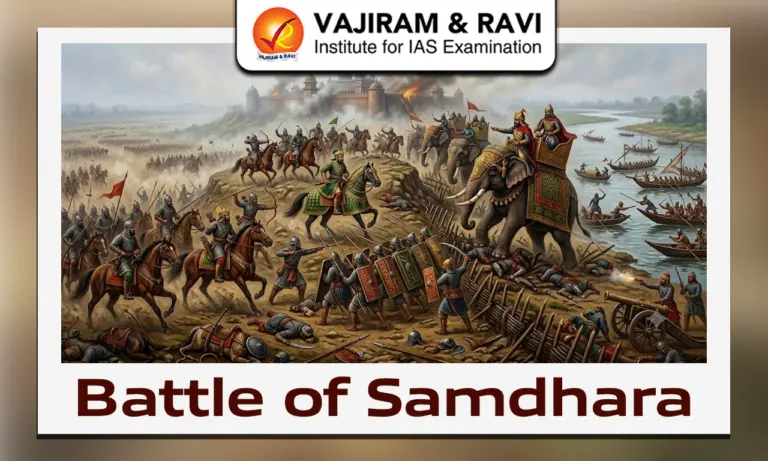
The Battle of Samdhara 1616 was the first major military victory of the Ahom Kingdom over the Mughal Empire. Fought at the confluence of the Bharali and Brahmaputra rivers in present-day Assam, the battle successfully stopped the early Mughal attempt to expand into Northeast India and strengthened Ahom control over the region.
Battle of Samdhara Background
The Battle of Samdhara emerged from growing political and military tensions between the Ahom Kingdom and the Mughal Empire over trade, territory, and border control in early 17th-century Assam.
- Rising Tensions: Relations between the Ahoms and Mughals deteriorated due to increasing border disputes.
- Illegal Trade: In 1615, the Ahoms intercepted and seized illegal Mughal trading vessels carrying contraband.
- Mughal Response: The incident prompted Bengal Governor Sheikh Qasim Khan to organize a military expedition against the Ahoms.
- Strategic Objective: The Mughals aimed to expand their influence into Assam and Northeast India.
- Ahom Preparedness: Under King Pratap Singha, the Ahoms strengthened their defenses to resist the expected invasion.
Battle of Samdhara Causes
The Battle of Samdhara was fought due to growing political, economic, and territorial tensions between the Ahom Kingdom and the Mughal Empire.
- Illegal Mughal Trade: The Ahoms seized Mughal trading vessels engaged in unauthorized trade and carrying contraband in 1615.
- Territorial Expansion: The Mughal Empire sought to extend its control over Assam and Northeast India.
- Border Disputes: Frequent conflicts along the Ahom–Mughal frontier increased hostility between the two kingdoms.
- Assertion of Authority: The Mughal administration aimed to re-establish its authority after the seizure of its trading vessels.
- Military Expedition: Bengal Governor Sheikh Qasim Khan dispatched an armed force to invade Ahom territory, triggering the battle.


Battle of Samdhara Outcome
The Battle of Samdhara ended in a decisive victory for the Ahom Kingdom, marking the first successful repulsion of a major Mughal invasion into Assam.
- Decisive Ahom Victory: The Ahom forces defeated the invading Mughal army.
- Death of Aba Bakr: Mughal commander Sayyid Aba Bakr was killed during the battle.
- Thousands Captured: A large number of Mughal soldiers were taken prisoner by the Ahoms.
- Mughal Advance Halted: The victory stopped the early Mughal expansion into Northeast India.
- Strengthened Ahom Rule: The success enhanced the military reputation and authority of King Pratap Singha.
- Foundation for Future Resistance: The battle paved the way for continued Ahom resistance against later Mughal campaigns in Assam.
Samdhara Rampart Inscription (1616)
The Ahom victory at Samdhara is commemorated through the 1616 Samdhara Rampart Inscription. This historical inscription records the triumph of King Pratap Singha and serves as valuable archaeological evidence of the battle and the Ahom Kingdom’s successful defence against Mughal aggression.

 Last updated on Oct, 2026
→ UPSC 2027 Notification will be released on 13 January 2027 at upsconline.nic.in.
→ Check Nobel Prize 2026 Winners List here.
→ Download PIB PRiSM Monthly Magazine 2026 here.
→ Check UPSC Monthly Current Affairs Magazine The Recitals here.
→ Check out the latest UPSC Syllabus here.
→ Download UPSC Model Answers for Mains 2026
→ UPSC Mains Question Paper 2026 is out now for Essay & GS Paper 1, 2, 3 & 4.
→ UPSC Calendar 2027 has been released.
→ Enroll in Vajiram & Ravi’s UPSC Mains Test Series 2027 for structured answer writing practice, expert evaluation, and exam-oriented feedback.
→ Join Vajiram & Ravi’s UPSC Mentorship Program 2027 for personalized guidance, strategy planning, and one-to-one support from experienced mentors.
→ Go through the UPSC Mains Previous Year Papers to enhance your preparation.
→ UPSC has released UPSC Toppers List 2025 with the Civil Services final result on its official website.
→ Also check Best UPSC Coaching in India
Battle of Samdhara FAQs
Q1. What was the Battle of Samdhara?+
Q2. Who ruled the Ahom Kingdom during the Battle of Samdhara?+
Q3. What caused the Battle of Samdhara?+
Q4. Why is the Battle of Samdhara important?+
Q5. What is the Samdhara Rampart Inscription?+
Tags: battle of samdhara Important Battles in Indian Important Battles in Indian History