About Bering Sea
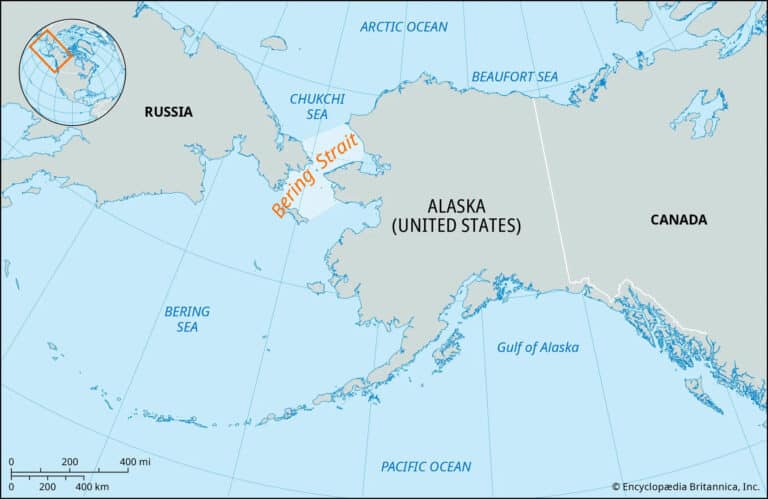
- It is a marginal sea in the northernmost part of the Pacific Ocean, separating the continents of Asia and North America.
- To the north, the Bering Sea connects with the Arctic Ocean through the Bering Strait, at the narrowest point of which the two continents are about 53 miles (85 kilometres) apart.
- It is bordered by the US state of Alaska to the east and northeast, the Kamchatka Peninsula and the Far Eastern region of Russia in the west, and the chain of the Aleutian Islands in the south.
- The boundary between the United States and Russia passes through the sea and the strait.
- The Bering Sea can be divided into two equal portions: a shallow area along the continental shelf in the northern and eastern parts of the sea, and a deeper area in its southwestern part.
- The Bering Strait is a relatively shallow passage, averaging 100 to 165 feet (30 to 50 metres) in depth.
- Canyons:
- There are about 16 submarine canyons in the Bering Sea.
- Situated in the sea’s center is a large underwater canyon known as the Zhemchug Canyon. It is also the world’s largest and deepest submarine canyon.
- Rivers: The two rivers that drain into the sea are the Anadyr and the Yukon Rivers.
- Islands:
- In addition to the Aleutian and Komandor groups, there are several other large islands in both the sea and strait.
- These include Nunivak, St. Lawrence, and Nelson islands in Alaskan waters and Karagin Island in Russian waters.
- Springtime in the Bering Strait brings one of the largest migrations in the world. Each year, millions of birds and hundreds of thousands of marine mammals follow retreating sea ice north through the Bering Strait.
Q1) What are submarine canyons?
Submarine canyons are any of a class of narrow steep-sided valleys that cut into continental slopes and continental rises of the oceans. Submarine canyons originate either within continental slopes or on a continental shelf. They are rare on continental margins that have extremely steep continental slopes or escarpments. Submarine canyons are so called because they resemble canyons made by rivers on land.
Source: Declining Bering Sea ice linked to increasing wildfire hazard in northeast China






 Last updated on April, 2026
→ UPSC Final Result 2025 is now out.
→ UPSC has released UPSC Toppers List 2025 with the Civil Services final result on its official website.
→ Anuj Agnihotri secured AIR 1 in the UPSC Civil Services Examination 2025.
→ UPSC Marksheet 2025 is now out.
→ UPSC Notification 2026 & UPSC IFoS Notification 2026 is now out on the official website at upsconline.nic.in.
→ UPSC Calendar 2026 has been released.
→ Check out the latest UPSC Syllabus 2026 here.
→ UPSC Prelims 2026 will be conducted on 24th May, 2026 & UPSC Mains 2026 will be conducted on 21st August 2026.
→ The UPSC Selection Process is of 3 stages-Prelims, Mains and Interview.
→ Prepare effectively with Vajiram & Ravi’s UPSC Prelims Test Series 2026 featuring full-length mock tests, detailed solutions, and performance analysis.
→ Enroll in Vajiram & Ravi’s UPSC Mains Test Series 2026 for structured answer writing practice, expert evaluation, and exam-oriented feedback.
→ Join Vajiram & Ravi’s Best UPSC Mentorship Program for personalized guidance, strategy planning, and one-to-one support from experienced mentors.
→ Shakti Dubey secures AIR 1 in UPSC CSE Exam 2024.
→ Also check Best UPSC Coaching in India