About Betelgeuse:
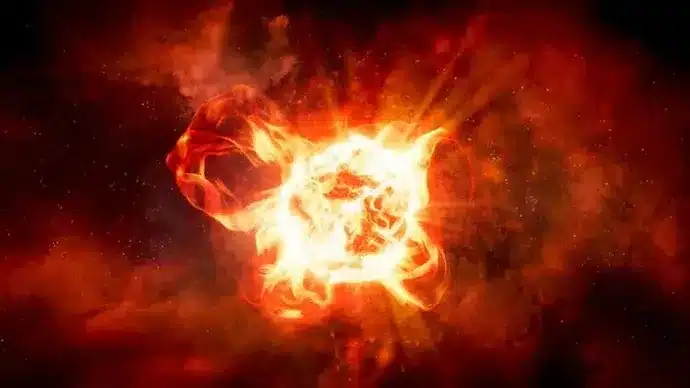
- It is a red supergiant star that forms the left shoulder of the constellation of Orion.
- It is one of the brightest stars in the night sky and one of the largest stars ever discovered.
- The star is approximately 650 light-years from Earth.
- The star is nearing the end of its life span, and when it dies, the resulting explosion will be bright enough to see during the day for weeks.
- It is one of the largest known stars, measuring more than 700 million miles (1.2 billion kilometers) in diameter.
- It is known for its periodic dimming and brightening up.
- It exhibits two distinct pulsation patterns: a short-term cycle of about a year and a longer six-year cycle.
- The researchers concluded that the longer cycle, known as a long secondary period, is likely caused by the Betelbuddy’s (companion star) orbital motion through Betelgeuse’s surrounding dust.
What is Red supergiant star?
- A red giant forms after a star has run out of hydrogen fuel for nuclear fusion, and has begun the process of dying.
- They are evolved stars with masses between 10 and 25 times that of the Sun.
- A star classed as a supergiant may have a diameter several hundred times that of the Sun and a luminosity nearly 1,000,000 times as great.
- Supergiants are tenuous stars, and their lifetimes are probably only a few million years, extremely short on the scale of stellar evolution.
- These stars have cool extended atmospheres.
Q1: What are Pulsars?
Pulsars are rapidly rotating neutron stars that blast out pulses of radiation at regular intervals ranging from seconds to milliseconds. Pulsars have very strong magnetic fields, which funnel jets of particles out along the two magnetic poles.
News: Betelgeuse, one of the brightest stars predicted to explode, hides a tiny sun






 Last updated on March, 2026
→ UPSC Final Result 2025 is now out.
→ UPSC has released UPSC Toppers List 2025 with the Civil Services final result on its official website.
→ Anuj Agnihotri secured AIR 1 in the UPSC Civil Services Examination 2025.
→ UPSC Marksheet 2025 is now out.
→ UPSC Notification 2026 & UPSC IFoS Notification 2026 is now out on the official website at upsconline.nic.in.
→ UPSC Calendar 2026 has been released.
→ Check out the latest UPSC Syllabus 2026 here.
→ UPSC Prelims 2026 will be conducted on 24th May, 2026 & UPSC Mains 2026 will be conducted on 21st August 2026.
→ The UPSC Selection Process is of 3 stages-Prelims, Mains and Interview.
→ Prepare effectively with Vajiram & Ravi’s UPSC Prelims Test Series 2026 featuring full-length mock tests, detailed solutions, and performance analysis.
→ Enroll in Vajiram & Ravi’s UPSC Mains Test Series 2026 for structured answer writing practice, expert evaluation, and exam-oriented feedback.
→ Join Vajiram & Ravi’s Best UPSC Mentorship Program for personalized guidance, strategy planning, and one-to-one support from experienced mentors.
→ Shakti Dubey secures AIR 1 in UPSC CSE Exam 2024.
→ Also check Best UPSC Coaching in India