About Bhargavastra:
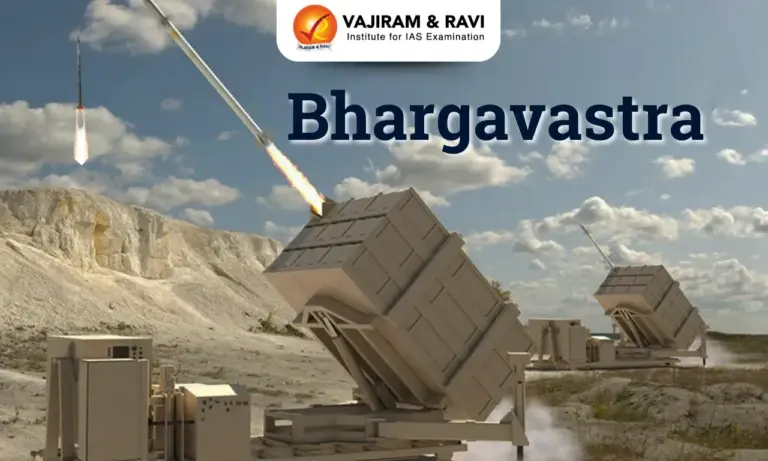
- It is India’s first indigenous micro-missile system designed to take on the threat of swarm drones.
- It was developed by the Economic Explosives Ltd.
- It can quickly deploy on a mobile platform and hit targets over 2.5 km.
- It is capable of detecting even small incoming flying machines at over 6 km and can take them down using micro munitions that can be guided towards the threat.
- The system can simultaneously fire more than 64 micro missiles.
- It is designed to operate in all terrains, including high-altitude areas, to meet specific requirements of the armed forces.
- Designed to meet the requirements of the Army Air Defence, this is the first counter-drone system that uses micro missiles.
What are Swarm Drones?
- SWARM stands for “Smart War-Fighting Array of Reconfigured Modules.”
- Drone swarm technologies coordinate at least three and up to thousands of drones to perform missions cooperatively with limited need for human attention and control.
- For example, an aerial drone swarm could potentially assist with controlling a wildfire, assessing damages, finding access points, and suppressing the fire by raining firefighting liquids on it—all with minimal human direction.
- Drone swarms may be more efficient and robust for certain applications than single drones because swarms cancomplete a variety of tasks in parallel without human supervision.
- And they can continue operating if individual drones become inoperable.
- Drone swarms integrate advanced computer algorithmswith local sensing and communication technologiesto synchronize multiple drones to achieve a goal.
- Drone swarms can use various methods of command and control, including preprogrammed missions with specific predefined flight paths, centralized control by a ground station or a single control drone, or distributed control where the drones communicate and collaborate based on shared information.
Q1: What are Ballistic Missiles?
Ballistic missiles are powered initially by a rocket or series of rockets in stages, but then follow an unpowered trajectory that arches upwards before descending to reach its intended target. Ballistic missiles can carry either nuclear or conventional warheads.
Source: ET






 Last updated on April, 2026
→ UPSC Final Result 2025 is now out.
→ UPSC has released UPSC Toppers List 2025 with the Civil Services final result on its official website.
→ Anuj Agnihotri secured AIR 1 in the UPSC Civil Services Examination 2025.
→ UPSC Marksheet 2025 is now out.
→ UPSC Notification 2026 & UPSC IFoS Notification 2026 is now out on the official website at upsconline.nic.in.
→ UPSC Calendar 2026 has been released.
→ Check out the latest UPSC Syllabus 2026 here.
→ UPSC Prelims 2026 will be conducted on 24th May, 2026 & UPSC Mains 2026 will be conducted on 21st August 2026.
→ The UPSC Selection Process is of 3 stages-Prelims, Mains and Interview.
→ Prepare effectively with Vajiram & Ravi’s UPSC Prelims Test Series 2026 featuring full-length mock tests, detailed solutions, and performance analysis.
→ Enroll in Vajiram & Ravi’s UPSC Mains Test Series 2026 for structured answer writing practice, expert evaluation, and exam-oriented feedback.
→ Join Vajiram & Ravi’s Best UPSC Mentorship Program for personalized guidance, strategy planning, and one-to-one support from experienced mentors.
→ Shakti Dubey secures AIR 1 in UPSC CSE Exam 2024.
→ Also check Best UPSC Coaching in India