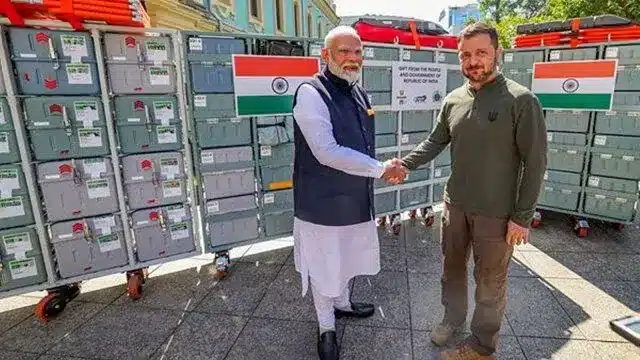
What is BHISHM?
- Full form: Bharat Health Initiative for Sahyog, Hita, and Maitri.
- Purpose: Provides compact, mobile medical units for emergency care, designed to deliver medical facilities swiftly and effectively.
Key features of BHISHM cubes:
- Compact and organised: Medical supplies and equipment are packed into 15-inch cubical boxes.
- These boxes are organized based on injury types and medical needs, making them efficient for quick deployment in emergencies.
- Transport flexibility: The cubes are mounted on an adjustable framework, allowing them to be transported via multiple modes, including air, sea, land, and drone.
- Each cube weighs up to 20 kg and is designed to be carried by an individual.
- Mother and BHISHM cubes:
- 36 mini cubes combine to form one mother cube.
- Two mother cubes combine to form one BHISHM Cube.
- One Mother Cube offers first-line care, shelter, and food for up to five people for 48 hours.
- The second mother cube is equipped for surgical care, handling 10-15 basic surgeries per day.
- Ease of use and management: Medicines and equipment are classified, with RFID inventory management and real-time stock updates.
- Additionally, a dedicated app and a tablet with support for 180 languages are provided for operational instructions.
- Capacity and Features:
- Each BHISHM Cube can handle around 200 emergency cases, including trauma, burns, fractures, and shock.
- The cubes are capable of supporting basic surgeries and can generate their power and oxygen for limited durations.
- Technological Integration: BHISHM cubes incorporate Artificial Intelligence (AI) and data analytics for effective coordination, real-time monitoring, and efficient management of medical services.
Project Aarogya Maitri:
- Objective: Part of India’s initiative to provide essential medical supplies to developing countries affected by disasters or humanitarian crises.
Importance: Highlights India’s commitment to international humanitarian assistance.
Q1. What is Pinaka?
Pinaka is a Multi-Barrel Rocket Launcher (MBRL) developed by the DRDO’s Armament Research and Development Establishment (ARDE). It delivers powerful fire against various targets, including enemy troops and vehicles, and was notably used during the Kargil War.






 Last updated on March, 2026
→ UPSC Final Result 2025 is now out.
→ UPSC has released UPSC Toppers List 2025 with the Civil Services final result on its official website.
→ Anuj Agnihotri secured AIR 1 in the UPSC Civil Services Examination 2025.
→ UPSC Marksheet 2025 is now out.
→ UPSC Notification 2026 & UPSC IFoS Notification 2026 is now out on the official website at upsconline.nic.in.
→ UPSC Calendar 2026 has been released.
→ Check out the latest UPSC Syllabus 2026 here.
→ UPSC Prelims 2026 will be conducted on 24th May, 2026 & UPSC Mains 2026 will be conducted on 21st August 2026.
→ The UPSC Selection Process is of 3 stages-Prelims, Mains and Interview.
→ Prepare effectively with Vajiram & Ravi’s UPSC Prelims Test Series 2026 featuring full-length mock tests, detailed solutions, and performance analysis.
→ Enroll in Vajiram & Ravi’s UPSC Mains Test Series 2026 for structured answer writing practice, expert evaluation, and exam-oriented feedback.
→ Join Vajiram & Ravi’s Best UPSC Mentorship Program for personalized guidance, strategy planning, and one-to-one support from experienced mentors.
→ Shakti Dubey secures AIR 1 in UPSC CSE Exam 2024.
→ Also check Best UPSC Coaching in India