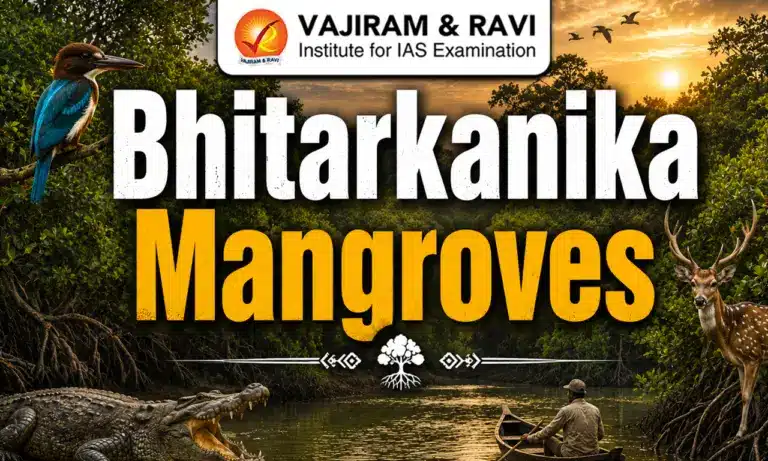
The Bhitarkanika Mangroves are one of India’s largest and most biodiverse mangrove ecosystems, located in the Kendrapara district of Odisha. Formed by the delta of the Brahmani, Baitarani, Dhamra, and Patasala rivers, these mangroves provide an ideal habitat for a wide range of wildlife, including the world’s largest population of saltwater crocodiles in India.
The region is also recognized as a Ramsar Site for its international importance as a wetland and plays a crucial role in coastal protection, biodiversity conservation, and climate change mitigation.
Bhitarkanika Mangroves Location
The Bhitarkanika Mangroves are situated in the Kendrapara district of Odisha along the eastern coast of India. They lie within the Brahmani-Baitarani river delta, where freshwater from rivers meets the saline waters of the Bay of Bengal.
Bhitarkanika Mangroves Flora
The Bhitarkanika Mangroves support a rich variety of salt-tolerant plant species that protect the coastline, stabilize the ecosystem, and provide habitat for diverse wildlife.
- Over 60 species of true mangroves and associated mangrove plants are found here.
- Dominated by Avicennia, Rhizophora, Sonneratia, Bruguiera, Ceriops, and Excoecaria species.
- Mangrove roots trap sediments, reduce coastal erosion, and improve shoreline stability.
- The forests act as a natural barrier against cyclones, storm surges, and tidal waves.
- Rich in halophytic (salt-tolerant) vegetation adapted to saline and waterlogged conditions.
- Supports nurseries for fish, crabs, and prawns, sustaining the coastal food chain.
- Plays a vital role in carbon sequestration (blue carbon), helping mitigate climate change.
- Maintains estuarine ecology by filtering pollutants and improving water quality.
- Provides habitat and nesting sites for birds, reptiles, and other wildlife.
- Helps maintain the ecological balance of the Brahmani-Baitarani delta.


Bhitarkanika Mangroves Fauna
The Bhitarkanika Mangroves are home to an exceptional diversity of reptiles, mammals, birds, amphibians, and aquatic species, making them one of India’s richest wetland ecosystems.
- Famous for India’s largest population of Saltwater Crocodiles (Crocodylus porosus).
- Home to the Indian Python and the King Cobra, two of India’s largest reptiles.
- Supports mammals such as the Fishing Cat, Spotted Deer, Wild Boar, Smooth-coated Otter, and Rhesus Macaque.
- Provides habitat for over 300 species of resident and migratory birds.
- Common birds include the Asian Openbill, Black-capped Kingfisher, Grey Heron, Little Egret, Oriental Darter, and Brahminy Kite.
- The nearby Gahirmatha Marine Sanctuary serves as the world’s largest nesting site for Olive Ridley Sea Turtles.
- Rich in fish, crabs, prawns, molluscs, and other estuarine aquatic species, supporting coastal fisheries.
- The mangroves act as an important breeding and nursery habitat for numerous marine and freshwater organisms.
- The ecosystem supports several threatened and protected species, contributing significantly to India’s biodiversity conservation.
Bhitarkanika National Park and Wildlife Sanctuary
The Bhitarkanika National Park and Wildlife Sanctuary is one of India’s most important protected mangrove ecosystems, known for its rich biodiversity, extensive tidal waterways, and successful conservation of the Saltwater Crocodile.
- Declared a Wildlife Sanctuary in 1975.
- Notified as a National Park in 1998.
- Recognized as a Ramsar Site (Wetland of International Importance) in 2002.
- Covers an area of approximately 145 sq. km as a National Park, while the Wildlife Sanctuary extends over 672 sq. km.
- Comprises mangrove forests, estuaries, creeks, mudflats, and tidal rivers.
- Famous for India’s largest population of Saltwater Crocodiles and a successful crocodile conservation and breeding programme.
- Supports diverse wildlife, including the Fishing Cat, King Cobra, Indian Python, Spotted Deer, and over 300 species of birds.
- Serves as a vital habitat for migratory birds and numerous aquatic species.
- Acts as a natural shield against cyclones, storm surges, and coastal erosion, while conserving the fragile coastal ecosystem.
Threats to the Bhitarkanika Mangroves
The Bhitarkanika Mangroves face several natural and human-induced threats that endanger their biodiversity, ecological balance, and ability to protect the coastline.
- Climate change and sea-level rise are increasing the risk of habitat loss and saline water intrusion.
- Frequent cyclones, storm surges, and coastal erosion damage mangrove vegetation and wildlife habitats.
- Illegal encroachment and deforestation reduce mangrove cover and fragment ecosystems.
- Expansion of aquaculture and shrimp farming leads to the clearing of mangrove forests.
- Industrial effluents, agricultural runoff, and plastic pollution degrade water quality and harm aquatic life.
- Siltation in rivers and creeks disrupts tidal flow and affects mangrove regeneration.
- Unsustainable fishing and overexploitation of natural resources threaten aquatic biodiversity.
- Human-wildlife conflict, especially involving Saltwater Crocodiles, poses challenges for both local communities and conservation efforts.
- Invasive plant species compete with native mangroves, affecting the natural ecosystem.
Government Initiatives for Mangrove Conservation
The Government of India and the Government of Odisha have launched several initiatives to conserve mangrove ecosystems, enhance coastal resilience, and protect biodiversity through restoration, sustainable management, and community participation.
- MISHTI (Mangrove Initiative for Shoreline Habitats & Tangible Incomes) promotes large-scale mangrove plantation and restoration along India’s coastline.
- National Coastal Mission under the National Action Plan on Climate Change (NAPCC) focuses on conserving coastal ecosystems and improving climate resilience.
- National Plan for Conservation of Aquatic Ecosystems (NPCA) supports the protection and management of wetlands and associated mangrove habitats.
- Integrated Coastal Zone Management (ICZM) Programme promotes sustainable development and conservation of coastal resources.
- Centrally Sponsored Scheme for Conservation and Management of Mangroves and Coral Reefs provides financial and technical assistance to States for mangrove protection and restoration.
- Ramsar Convention commitments encourage the conservation and wise use of wetlands, including the Bhitarkanika Ramsar Site.
- Mangrove afforestation and habitat restoration programmes are undertaken by the Odisha Forest Department to improve degraded mangrove areas.
- Saltwater Crocodile Conservation Programme helps protect one of India’s largest crocodile populations through habitat management and breeding initiatives.

 Last updated on Oct, 2026
→ UPSC 2027 Notification will be released on 13 January 2027 at upsconline.nic.in.
→ Asian Games 2026 are being held in Aichi-Nagoya, Japan, from 19 September to 4 October.
→ Check Nobel Prize 2026 Winners List here.
→ Download PIB PRiSM Monthly Magazine 2026 here.
→ Check UPSC Monthly Current Affairs Magazine The Recitals here.
→ Check out the latest UPSC Syllabus here.
→ Download UPSC Model Answers for Mains 2026
→ UPSC Mains Question Paper 2026 is out now for Essay & GS Paper 1, 2, 3 & 4.
→ UPSC Calendar 2027 has been released.
→ Enroll in Vajiram & Ravi’s UPSC Mains Test Series 2027 for structured answer writing practice, expert evaluation, and exam-oriented feedback.
→ Join Vajiram & Ravi’s UPSC Mentorship Program 2027 for personalized guidance, strategy planning, and one-to-one support from experienced mentors.
→ Go through the UPSC Mains Previous Year Papers to enhance your preparation.
→ UPSC has released UPSC Toppers List 2025 with the Civil Services final result on its official website.
→ Also check Best UPSC Coaching in India
Bhitarkanika Mangroves FAQs
Q1. Why are the Bhitarkanika Mangroves important?+
Q2. Where are the Bhitarkanika Mangroves located?+
Q3. Which animal is Bhitarkanika most famous for?+
Q4. Is Bhitarkanika a Ramsar Site?+
Q5. Which rivers form the Bhitarkanika delta?+
Tags: bhitarkanika mangroves