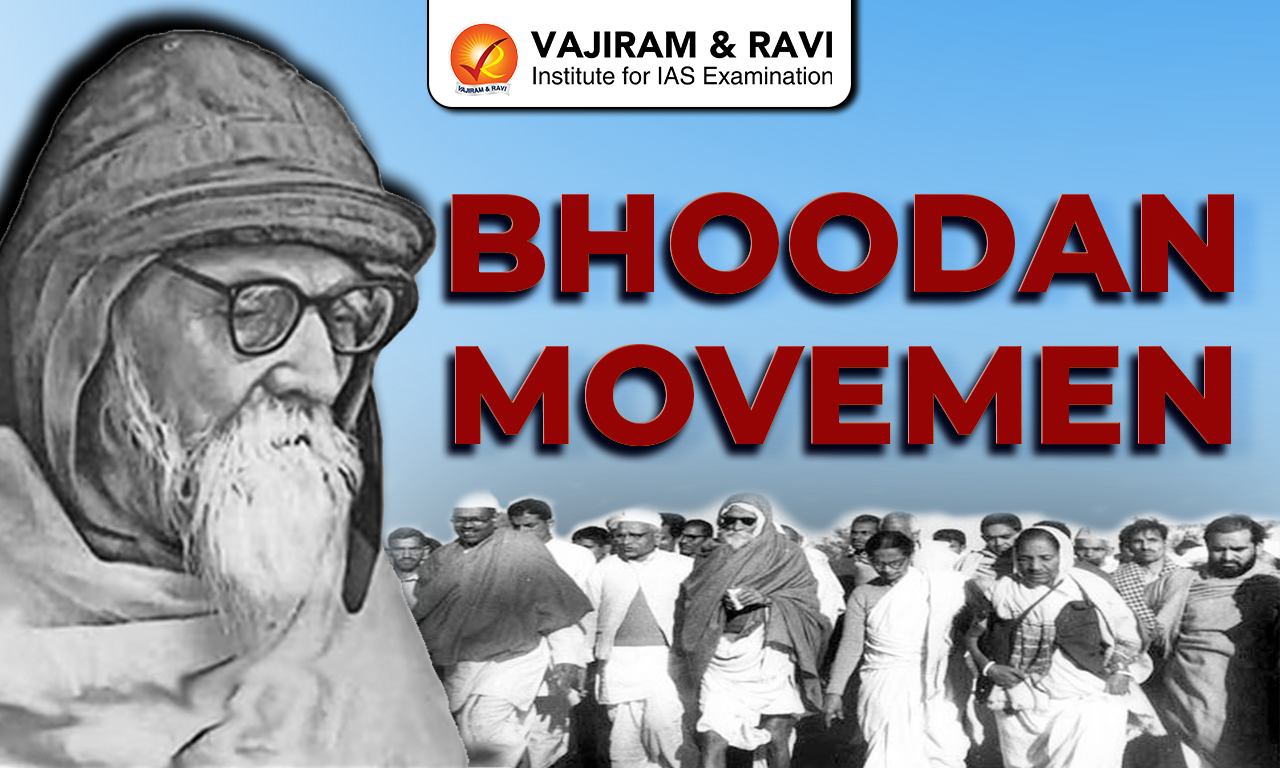
The Bhoodan Movement, also known as the Land Gift Movement, was a major socio-economic reform initiative in post-independence India. It was launched in 1951 by Vinoba Bhave, a prominent follower of Mahatma Gandhi.
The Bhoodan movement aimed to solve the problem of landlessness by encouraging landowners to voluntarily donate a portion of their land to the landless poor. It is often described as a “bloodless revolution” because it sought to bring social change without violence.
Bhoodan Movement Background
At the time of independence, India’s agrarian structure was marked by stark inequalities. Large landholdings were concentrated in the hands of a few, while millions of peasants remained landless or marginal farmers. Despite land reform laws, implementation remained weak due to administrative inefficiencies and political resistance. Recognizing this gap, Vinoba Bhave launched the Bhoodan Movement in 1951 from Pochampally village in Telangana.
His approach was deeply rooted in Gandhian principles of Sarvodaya (welfare of all) and Ahimsa (non-violence). Instead of demanding land redistribution through the state, he appealed directly to the conscience of landowners, urging them to voluntarily donate a portion of their land for the benefit of the landless.
Bhoodan Movement Objectives and Philosophy
The central objective of the Bhoodan Movement was simple yet transformative:
- To persuade wealthy landowners to donate land to landless peasants.
- To reduce rural inequality and promote social justice.
- To create a moral and cooperative framework for economic redistribution.
Vinoba Bhave undertook extensive padayatras (foot marches) across villages, engaging directly with rural communities. His moral authority and simplicity inspired many landowners to donate land. The movement was not merely economic in nature but also aimed at fostering compassion, social harmony, and ethical responsibility.


Gramdan Movement The Next Phase
The Bhoodan Movement later developed into the Gramdan Movement, which means “village gift movement.”
- In this system, instead of individuals donating small pieces of land, the entire village agreed to treat land as a common property.
- Villagers voluntarily gave up their ownership rights and allowed the land to be managed by the whole community.
- A village council looked after the land and ensured that it was shared fairly among all villagers, especially the landless.
- The main aim of Gramdan was to create villages that were self-sufficient, equal, and able to govern themselves, following Gandhian ideas of cooperation and rural development.
Gramdan Movement Key Features
- At least 75% of landowners must agree to surrender ownership.
- The surrendered land must constitute at least 60% of total village land.
- 5% of land is distributed to landless households for cultivation.
- Beneficiaries cannot transfer land without community approval.
- Donors retain usage rights but cannot sell land outside the village framework.
- All participating cultivators contribute 2.5% of their income to the community.
Bhoodan-Gramdan Movement Significance
The Bhoodan-Gramdan Movement holds great significance in India’s post-independence history as a unique attempt to bring about peaceful social and economic transformation based on justice, equality, and community participation.
- Addressing Landlessness: The movement succeeded in mobilizing significant land donations across India, helping many landless families gain access to agricultural land.
- Promoting Non-Violent Social Change: It demonstrated that structural socio-economic issues could be addressed through moral persuasion rather than coercion, reinforcing Gandhian methods in independent India.
- Strengthening Rural Communities: By encouraging cooperation and shared responsibility, the movement contributed to community empowerment and self-reliance.
- Influence on Policy and Thought: The ideas of equitable land distribution and decentralized governance influenced subsequent land reform policies and debates in India.
- Environmental and Resource Ethics: By promoting collective ownership, Gramdan encouraged a sense of shared responsibility towards natural resources, fostering sustainable practices.
Bhoodan Movement Limitations and Criticism
Despite its moral appeal, the movement faced several structural challenges:
- Poor Quality of Donated Land: Much of the land donated was infertile, uncultivable, or under legal disputes.
- Implementation Gaps: Although large tracts were collected, actual redistribution to beneficiaries remained limited.
- Regional Ineffectiveness: The movement struggled in areas with high land inequality and entrenched socio-economic hierarchies.
- Lack of Institutional Support: Absence of strong administrative backing reduced its long-term impact.
- Failure to Achieve Revolutionary Change: It could not fundamentally transform the agrarian structure as envisioned.

 Last updated on Oct, 2026
→ UPSC 2027 Notification will be released on 13 January 2027 at upsconline.nic.in.
→ Check Nobel Prize 2026 Winners List here.
→ Download PIB PRiSM Monthly Magazine 2026 here.
→ Check UPSC Monthly Current Affairs Magazine The Recitals here.
→ Check out the latest UPSC Syllabus here.
→ Download UPSC Model Answers for Mains 2026
→ UPSC Mains Question Paper 2026 is out now for Essay & GS Paper 1, 2, 3 & 4.
→ UPSC Calendar 2027 has been released.
→ Enroll in Vajiram & Ravi’s UPSC Mains Test Series 2027 for structured answer writing practice, expert evaluation, and exam-oriented feedback.
→ Join Vajiram & Ravi’s UPSC Mentorship Program 2027 for personalized guidance, strategy planning, and one-to-one support from experienced mentors.
→ Go through the UPSC Mains Previous Year Papers to enhance your preparation.
→ UPSC has released UPSC Toppers List 2025 with the Civil Services final result on its official website.
→ Also check Best UPSC Coaching in India
Bhoodan Movement FAQs
Q1. What is the Bhoodan Movement?+
Q2. What was the main objective of the Bhoodan Movement?+
Q3. Where did the Bhoodan Movement begin?+
Q4. What is the Gramdan Movement in relation to Bhoodan?+
Q5. Why did the Bhoodan Movement fail to achieve full success?+
Tags: bhoodan movement