Biennial Transparency Report Latest News
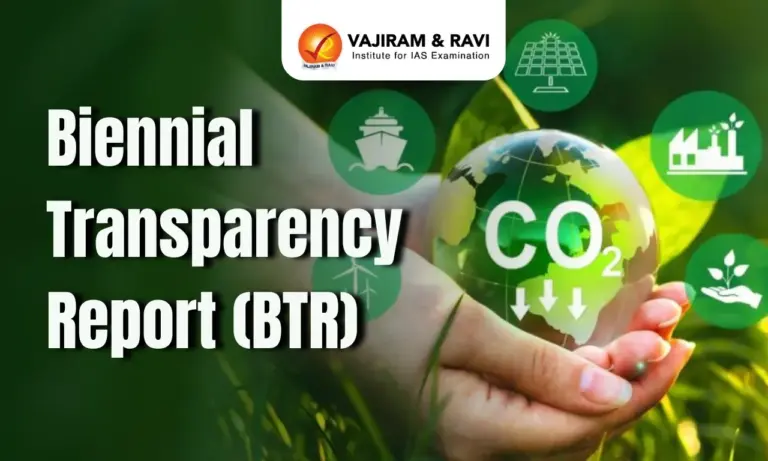
India is in the final stages of preparing its first ever Biennial Transparency Report (BTR), part of its commitment as a signatory to the 2015 Paris Agreement on climate change.
About Biennial Transparency Report
- The BTR is a report prepared and submitted by Parties to the Paris Agreement under the Enhanced Transparency Framework (ETF) that captures information on their progress in implementing the different aspects of the Agreement.
- The different aspects are covered in the five separate chapters of the BTR, some of which are mandatory and some of which are optional.
- Different chapters and components of the BTR:
- National Inventory Report of GHG Emissions: All Parties – Mandatory
- Progress made in implementing and achieving the NDC: All Parties – Mandatory
- Climate change impacts and adaptation: All Parties – Optional
- Financial, technology transfer, and capacity building support provided:
- Developed country Parties – Mandatory
- Other Parties that provide support – Optional
- Financial, technology transfer, and capacity-building support needed and received: Developing country Parties – Optional
- All Parties to the Paris Agreement, except for small island developing states (SIDS) and the least developed countries (LDCs), are required to provide country-specific information on the implementation of the Paris Agreement in the form of BTR every two years.
- Recognizing the capacity constraints faced by SIDS and LDCs, and the need to provide flexibility in light of their national circumstances, SIDS and LDCs may submit BTRs at their discretion.
- As the reporting instrument of the Paris Agreement, BTRs help facilitate mutual trust and confidence between countries and allow parties and non-party stakeholders to understand the state of climate action in each country.





Biennial Transparency Report FAQs
Q1. What is the Paris Agreement?
Ans. The Paris Agreement is a legally binding international treaty adopted in 2015, aiming to limit global warming to well below 2°C, preferably to 1.5°C, above pre-industrial levels.
Q2. What are Greenhouse Gas (GHG) Emissions?
Ans. GHG Emissions refer to the release of gases into Earth’s atmosphere that trap heat, contributing to the greenhouse effect and global warming.
Q3. What are small island developing states (SIDS)?
Ans. Small Island Developing States (SIDS) are a distinct group of 39 States and 18 Associate Members of United Nations regional commissions that face unique social, economic and environmental vulnerabilities.
Source: TH

 Last updated on March, 2026
→ UPSC Final Result 2025 is now out.
→ UPSC has released UPSC Toppers List 2025 with the Civil Services final result on its official website.
→ Anuj Agnihotri secured AIR 1 in the UPSC Civil Services Examination 2025.
→ UPSC Marksheet 2025 is now out.
→ UPSC Notification 2026 & UPSC IFoS Notification 2026 is now out on the official website at upsconline.nic.in.
→ UPSC Calendar 2026 has been released.
→ Check out the latest UPSC Syllabus 2026 here.
→ UPSC Prelims 2026 will be conducted on 24th May, 2026 & UPSC Mains 2026 will be conducted on 21st August 2026.
→ The UPSC Selection Process is of 3 stages-Prelims, Mains and Interview.
→ Prepare effectively with Vajiram & Ravi’s UPSC Prelims Test Series 2026 featuring full-length mock tests, detailed solutions, and performance analysis.
→ Enroll in Vajiram & Ravi’s UPSC Mains Test Series 2026 for structured answer writing practice, expert evaluation, and exam-oriented feedback.
→ Join Vajiram & Ravi’s Best UPSC Mentorship Program for personalized guidance, strategy planning, and one-to-one support from experienced mentors.
→ Shakti Dubey secures AIR 1 in UPSC CSE Exam 2024.
→ Also check Best UPSC Coaching in India