Biomaterials Latest News
- Biomaterials have gained attention as countries, including India, explore cleaner and low-carbon alternatives to fossil-based materials for manufacturing.
Understanding Biomaterials
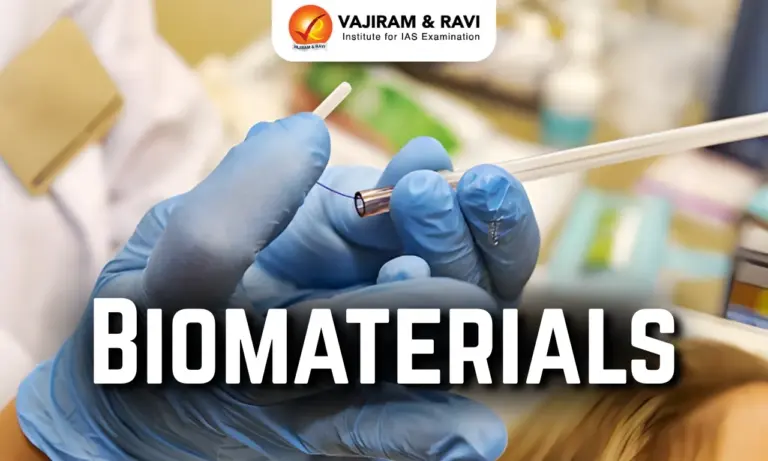
- Biomaterials refer to materials that are derived wholly or partly from biological sources or are engineered using biological processes to replace or interact with conventional materials.
- Unlike traditional petroleum-based materials, biomaterials are designed to reduce environmental impact while supporting sustainable production systems.
- They are increasingly used in sectors such as packaging, textiles, construction, and healthcare.
- Broadly, biomaterials are classified into three categories.
- Drop-in biomaterials are chemically identical to petroleum-based materials and can be used in existing manufacturing systems without major modifications. Examples include bio-PET used in packaging.
- Drop-out biomaterials are chemically different and require new processing or end-of-life systems, such as polylactic acid (PLA), which needs industrial composting.
- Novel biomaterials go a step further by offering entirely new properties, including self-healing materials, bioactive implants, and advanced composites with enhanced performance characteristics.
- The development of biomaterials is seen as the next frontier in materials engineering as industries attempt to reduce carbon footprints and comply with tightening environmental regulations.





Importance of Biomaterials for India
- For India, biomaterials serve multiple strategic objectives through a single development pathway.
- First, they contribute to environmental sustainability by reducing reliance on fossil fuels and lowering greenhouse gas emissions associated with conventional manufacturing.
- Second, they offer significant industrial and economic opportunities, enabling India to build domestic capacity in advanced materials and reduce dependence on imports.
- A key advantage for India lies in its large agricultural base. Biomaterials can be produced using agricultural feedstocks such as sugarcane, maize, and crop residues.
- This creates additional income streams for farmers, beyond traditional food markets, and supports rural livelihoods.
- Biomaterials also align well with India’s domestic policy priorities, including the ban on single-use plastics, waste reduction, and climate action commitments.
- From a trade perspective, as global consumer preferences shift toward low-carbon and circular products, biomaterials help Indian manufacturers remain competitive in export markets that are increasingly governed by sustainability standards.
Current Status of Biomaterials in India
- India’s biomaterials sector, encompassing bioplastics, biopolymers, and bio-derived materials, is at an early but rapidly emerging stage.
- The bioplastics market alone was valued at around $500 million in 2024 and is expected to grow steadily through the decade. Several domestic initiatives highlight this transition.
- Large-scale investments such as the planned PLA plant by Balrampur Chini Mills in Uttar Pradesh mark a significant step toward commercial-scale biomanufacturing.
- Indian start-ups are also playing a role, with enterprises converting agricultural and floral waste into value-added biomaterials.
- However, despite strong feedstock availability, India remains dependent on foreign technologies in certain segments, particularly in converting raw biomass into market-ready materials.
Global Developments in Biomaterials
- Globally, many regions are moving faster in adopting biomaterials.
- The European Union has introduced binding regulations under its Packaging and Packaging Waste Regulation, recognising the environmental benefits of compostable materials in specific applications.
- The United States supports biomaterials through government procurement policies, particularly under programmes that prioritise bio-based products.
- Meanwhile, countries like the UAE are positioning themselves as major manufacturing hubs through large-scale investments in PLA production.
- These global developments underscore the competitive urgency for India to scale up its biomaterials ecosystem.
Challenges and Way Forward
- Despite its potential, India’s biomaterials sector faces several challenges.
- Scaling up feedstock production without competing with food security remains a key concern.
- Intensive agricultural practices could also lead to water stress and soil degradation.
- Additionally, weak waste management and composting infrastructure may undermine the environmental benefits of certain biomaterials.
- Fragmented policy coordination across agriculture, environment, and industry further slows adoption.
- To address these issues, India needs to invest in biomanufacturing infrastructure, improve feedstock productivity using advanced technologies, and strengthen research and development.
- Clear regulatory definitions, labelling standards, and end-of-life pathways are essential to build industry and consumer confidence.
- Government procurement and time-bound incentives can also help de-risk early investments and accelerate adoption.
Source: TH

 Last updated on March, 2026
→ UPSC Final Result 2025 is now out.
→ UPSC has released UPSC Toppers List 2025 with the Civil Services final result on its official website.
→ Anuj Agnihotri secured AIR 1 in the UPSC Civil Services Examination 2025.
→ UPSC Marksheet 2025 is now out.
→ UPSC Notification 2026 & UPSC IFoS Notification 2026 is now out on the official website at upsconline.nic.in.
→ UPSC Calendar 2026 has been released.
→ Check out the latest UPSC Syllabus 2026 here.
→ UPSC Prelims 2026 will be conducted on 24th May, 2026 & UPSC Mains 2026 will be conducted on 21st August 2026.
→ The UPSC Selection Process is of 3 stages-Prelims, Mains and Interview.
→ Prepare effectively with Vajiram & Ravi’s UPSC Prelims Test Series 2026 featuring full-length mock tests, detailed solutions, and performance analysis.
→ Enroll in Vajiram & Ravi’s UPSC Mains Test Series 2026 for structured answer writing practice, expert evaluation, and exam-oriented feedback.
→ Join Vajiram & Ravi’s Best UPSC Mentorship Program for personalized guidance, strategy planning, and one-to-one support from experienced mentors.
→ Shakti Dubey secures AIR 1 in UPSC CSE Exam 2024.
→ Also check Best UPSC Coaching in India
Biomaterials FAQs
Q1. What are biomaterials?+
Q2. How are biomaterials different from petroleum-based materials?+
Q3. Why are biomaterials important for India?+
Q4. What is the current size of India’s bioplastics market?+
Q5. What are the main challenges in scaling biomaterials in India?+
Tags: biomaterials mains articles upsc current affairs upsc mains current affairs