Birhor Tribe Latest News
Around 550 residents, mostly belonging to the Birhor tribe, of Fulwariya hamlet in Koderma district would soon receive electricity supply, ending nearly eight decades of darkness.
About Birhor Tribe
- The Birhor are a forest-dependent semi-nomadic tribal community concentrated in the eastern central Indian state of Jharkhand.
- Some of them are also found in Chhattisgarh, Odisha, and West Bengal.
- The Birhor community is one of eight Particularly Vulnerable Tribal Groups (PVTGs) identified in Jharkhand.
- The term “Birhor” is derived from the words “Bi”, meaning “Jungle”, and “hor”, meaning “man”; thus, it means “the man living in Jungle” or “people of Jungle”.
- They belong to the Porto-Australoid stock.
- Religion: The Birhor follow a mixture of animism and Hinduism.


Birhor Tribe Language
- The Birhor tribes have their own language, known as Birhor, which belongs to the Munda group of languages of the Austroasiatic language family.
- Their language has similarities with the Santali, Mundari, and Ho languages.
- However, due to increased contact with other communities and the influence of mainstream languages, many Birhor people are bilingual or trilingual, with proficiency in Hindi, Bengali, or other regional languages.
Birhor Tribe Ethnology
- The Birhors are of short stature, with long heads, wavy hair, and broad nose.
- They claim they have descended from the Sun and believe that the Kharwars, who also trace their descent from the Sun, are their brothers.
- Ethnologically, they are akin to the Santals, Mundas, and Hos.
Birhor Tribe Society
- They typically live in small, close-knit communities, and their social organization is primarily based on kinship ties.
- The tribe is divided into several clans, and each clan has its own leader who plays a crucial role in resolving disputes and maintaining social harmony within the community.
- They live in small settlements in the forest or on the outskirts of villages.
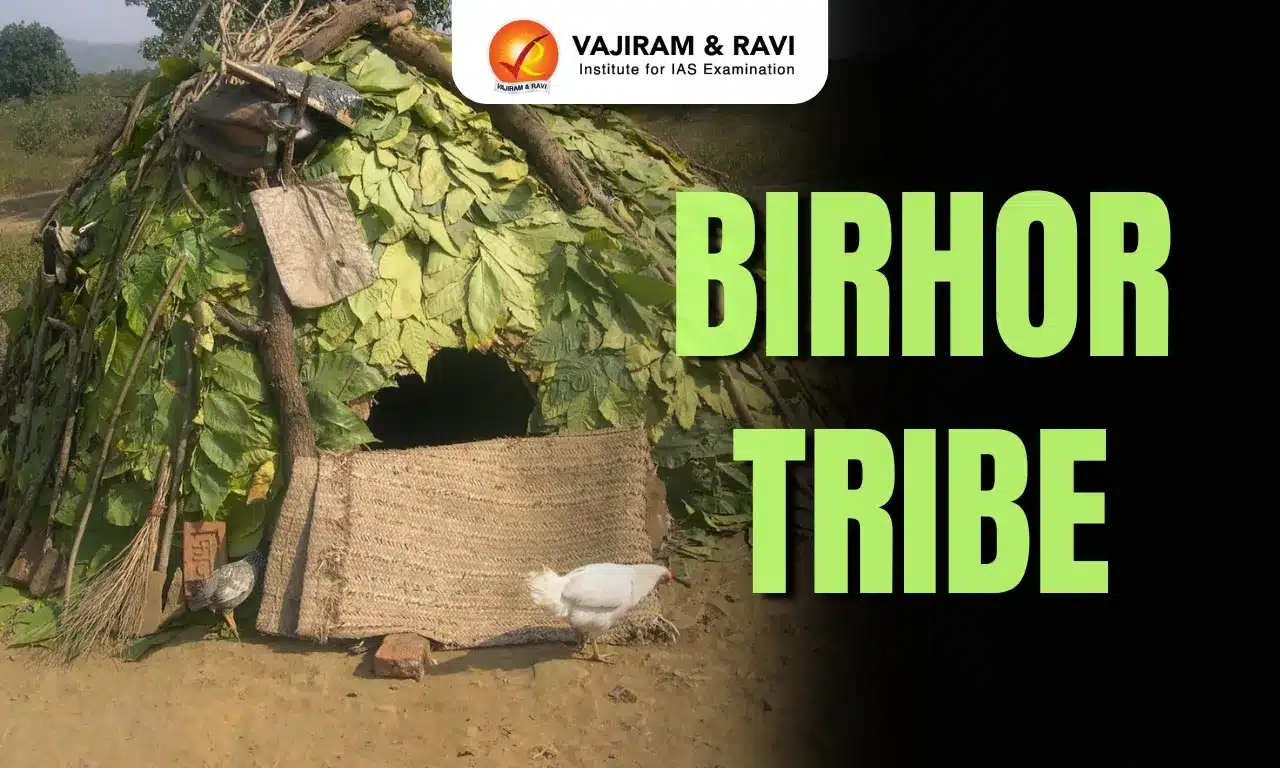
- The temporary Birhor settlements are known as tandas or bands.
- These consist of at least half a dozen huts of conical shape, erected with leaves and branches.
- Birhor society is characterized by a strong sense of community, cooperation, and mutual support.
Birhor Tribe Economy
- The “primitive subsistence economy” of the Birhors has been based on nomadic gathering and hunting, particularly for monkeys.
- They make ropes out of the fibres of a particular species of vine, which they sell in the markets of the nearby agricultural people.
- Some of them have settled into stable agriculture.
- According to socio-economic standing, the Birhors are classified into two groups. While the wandering Birhors are called Uthlus, the settled Birhors are called Janghis.
- The Birhor tribe has a rich knowledge of traditional medicine and uses various medicinal plants found in the forest for treating common ailments.
Source: TOI

 Last updated on Oct, 2026
→ UPSC 2027 Notification will be released on 13 January 2027 at upsconline.nic.in.
→ Check Nobel Prize 2026 Winners List here.
→ Download PIB PRiSM Monthly Magazine 2026 here.
→ Check UPSC Monthly Current Affairs Magazine The Recitals here.
→ Check out the latest UPSC Syllabus here.
→ Download UPSC Model Answers for Mains 2026
→ UPSC Mains Question Paper 2026 is out now for Essay & GS Paper 1, 2, 3 & 4.
→ UPSC Calendar 2027 has been released.
→ Enroll in Vajiram & Ravi’s UPSC Mains Test Series 2027 for structured answer writing practice, expert evaluation, and exam-oriented feedback.
→ Join Vajiram & Ravi’s UPSC Mentorship Program 2027 for personalized guidance, strategy planning, and one-to-one support from experienced mentors.
→ Go through the UPSC Mains Previous Year Papers to enhance your preparation.
→ UPSC has released UPSC Toppers List 2025 with the Civil Services final result on its official website.
→ Also check Best UPSC Coaching in India
Birhor Tribe FAQs
Q1. The Birhor tribe is primarily concentrated in which Indian state?+
Q2. What are the temporary Birhor settlements called?+
Q3. The Birhor tribe belongs to which racial/ethnic stock?+
Q4. What is the religious belief of Birhor tribe?+
Tags: birhor tribe