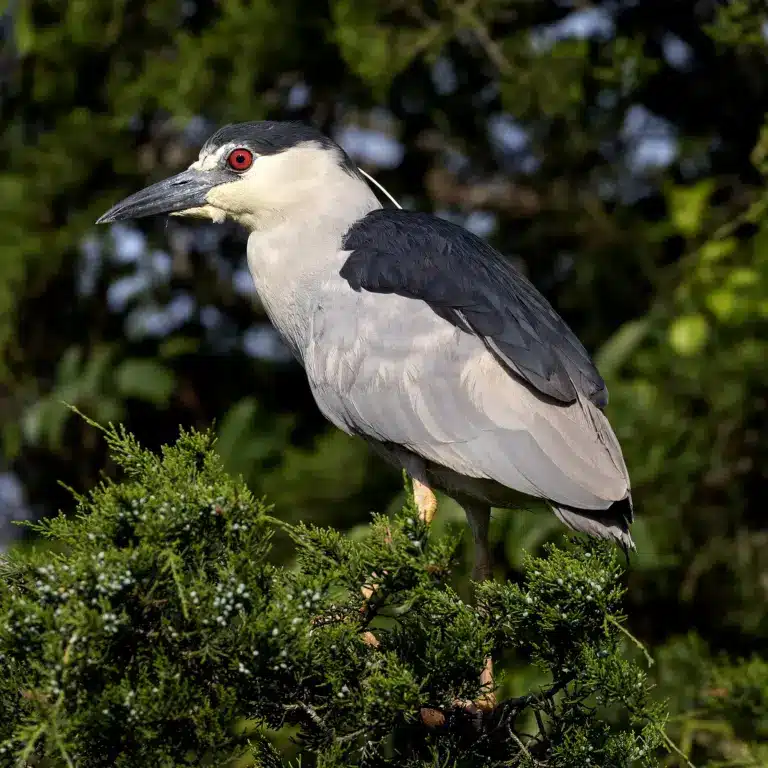
About Black-crowned Night Heron
- It is a medium-sized heron with a stocky build.
- Scientific Name: Nycticorax nycticorax
- Distribution: It is found across North America, as well as locally in Central America and the Caribbean.
- Habitat: Most colonies of black-crowned night herons are associated with large wetlands. They inhabit a variety of wetland habitats, such as swamps, streams, rivers, marshes, mud flats, and the edges of lakes.
- Features:
- It has a stocky body with a comparatively short neck and legs.
- It has a black crown, a gray body, and bright, red eyes.
- It weighs between 727 and 1014 grams, has a wingspan of 115 to 118 centimeters, and is 58 to 66 centimeters in length).
- Females and males look alike, but females are a little smaller.
- They are social at all times of the year, frequently associating with other species of herons.
- It is a migrating species.
- Diet: It is an opportunistic feeder. Its diet consists mainly of fish, though it is frequently rounded out by other items such as leeches, earthworms, aquatic and terrestrial insects.
- Conservation Status:
- IUCN Red List: Least Concern
Key Facts about Herons
- These are any of about 60 species of long-legged wading birds.
- These are classified in the family Ardeidae (order Ciconiiformes) and generally including several species usually called egrets.
- The Ardeidae also include the bitterns (subfamily Botaurinae).
- These are widely distributed over the world but are most common in the tropics.
- They usually feed while wading quietly in the shallow waters of pools, marshes, and swamps, catching frogs, fishes, and other aquatic animals.
- They nest in rough platforms of sticks constructed in bushes or trees near water; the nests usually are grouped in colonies called heronries.
Q1) What are wading birds?
Wading birds have physical and behavioral adaptations for living on or near water. While all animals need fresh drinking water, wading birds depend on water as a source of food, shelter, and nesting sites. The group includes cranes, herons, egrets, storks, spoonbills, and ibises.
Source: China Identifies Tagging Station Of Migratory Bird ‘Heron’ Found In Manipur






 Last updated on March, 2026
→ UPSC Final Result 2025 is now out.
→ UPSC has released UPSC Toppers List 2025 with the Civil Services final result on its official website.
→ Anuj Agnihotri secured AIR 1 in the UPSC Civil Services Examination 2025.
→ UPSC Marksheet 2025 is now out.
→ UPSC Notification 2026 & UPSC IFoS Notification 2026 is now out on the official website at upsconline.nic.in.
→ UPSC Calendar 2026 has been released.
→ Check out the latest UPSC Syllabus 2026 here.
→ UPSC Prelims 2026 will be conducted on 24th May, 2026 & UPSC Mains 2026 will be conducted on 21st August 2026.
→ The UPSC Selection Process is of 3 stages-Prelims, Mains and Interview.
→ Prepare effectively with Vajiram & Ravi’s UPSC Prelims Test Series 2026 featuring full-length mock tests, detailed solutions, and performance analysis.
→ Enroll in Vajiram & Ravi’s UPSC Mains Test Series 2026 for structured answer writing practice, expert evaluation, and exam-oriented feedback.
→ Join Vajiram & Ravi’s Best UPSC Mentorship Program for personalized guidance, strategy planning, and one-to-one support from experienced mentors.
→ Shakti Dubey secures AIR 1 in UPSC CSE Exam 2024.
→ Also check Best UPSC Coaching in India