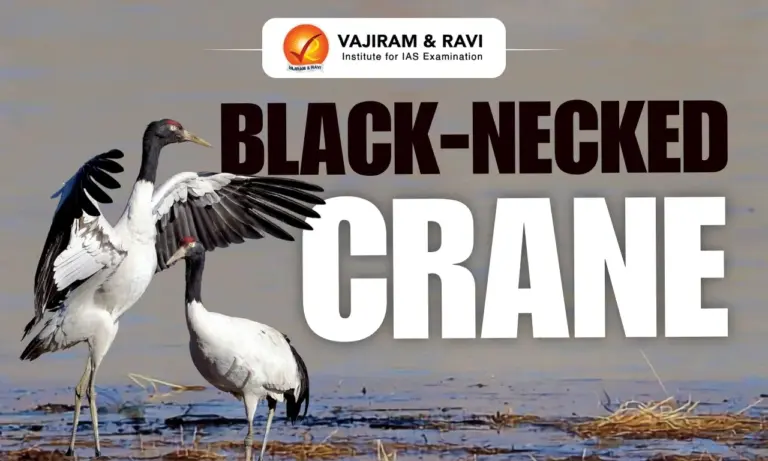
Black-Necked Crane Latest News
The Bombay Natural History Society (BNHS) has sterilised over 2,950 Free Ranging Dogs (FRD) to save Black-necked Cranes (Grus nigricollis) in Ladakh, whose chicks and nests were being attacked in alpine wetlands.
About Black-Necked Crane
- It is classed as a medium-sized member of the crane family.
- Other Names: It is locally known as “cha thung-thung” in Ladakh and “thungdung karma” in Arunachal Pradesh.
- Appearance: It has a largely whitish-grey body contrasted by a jet-black head and upper neck, splashes of red around the eye, and long, elegant legs built for wading through alpine bogs.
- Distribution: High altitude marshes and lakes of Tibetan Plateau (Tibet, Qinghai, Xinjiang, Gansu), Sichuan (China), and eastern Ladakh (India).
- A small wintering population is also found in Sangti and Zimithang valleys of Arunachal Pradesh in India.
- Diet: These are carnivores and herbivores. They feed on the tubers of sedges, plant roots, earthworms, insects and other invertebrates, frogs.
- Breeding: The cranes breed at elevations between 2,600 and 4,900 metres, choosing gently sloping wetlands where they build simple nests of grasses and sedges.
- The main breeding sites include the Changthang Cold Desert Wildlife Sanctuary, especially the wetlands of Hanle, Tso Kar, Nyoma, and nearby marshes.
- Cultural Significance: They hold a special place in Ladakh’s Buddhist culture. They are regarded as sacred birds and symbols of peace, purity and good fortune.
- Threats: Increasing human use of areas surrounding wetlands, expansion of linear infrastructure, growing tourism activities, habitat degradation, and the impacts of climate change.


Conservation Status of Black-Necked Crane
- IUCN: Near Threatened
- CITES: Appendices I
- Wild Life (Protection) Act, 1972: Schedule I
Source: DTE

 Last updated on Oct, 2026
→ UPSC 2027 Notification will be released on 13 January 2027 at upsconline.nic.in.
→ Asian Games 2026 are being held in Aichi-Nagoya, Japan, from 19 September to 4 October.
→ Check Nobel Prize 2026 Winners List here.
→ Download PIB PRiSM Monthly Magazine 2026 here.
→ Check UPSC Monthly Current Affairs Magazine The Recitals here.
→ Check out the latest UPSC Syllabus here.
→ Download UPSC Model Answers for Mains 2026
→ UPSC Mains Question Paper 2026 is out now for Essay & GS Paper 1, 2, 3 & 4.
→ UPSC Calendar 2027 has been released.
→ Enroll in Vajiram & Ravi’s UPSC Mains Test Series 2027 for structured answer writing practice, expert evaluation, and exam-oriented feedback.
→ Join Vajiram & Ravi’s UPSC Mentorship Program 2027 for personalized guidance, strategy planning, and one-to-one support from experienced mentors.
→ Go through the UPSC Mains Previous Year Papers to enhance your preparation.
→ UPSC has released UPSC Toppers List 2025 with the Civil Services final result on its official website.
→ Also check Best UPSC Coaching in India
Black-necked Crane FAQ's
Q1. What is the Scientific name of Black-necked Crane?+
Q2. What is the IUCN status of Black-necked Crane ?+
Tags: black-necked crane prelims pointers upsc current affairs upsc prelims current affairs