Black Plastic Latest News
Black Plastic made headlines as a recent study claimed that the material contained toxic flame retardants which could be leaching into food at hazardous levels.
About Black Plastic
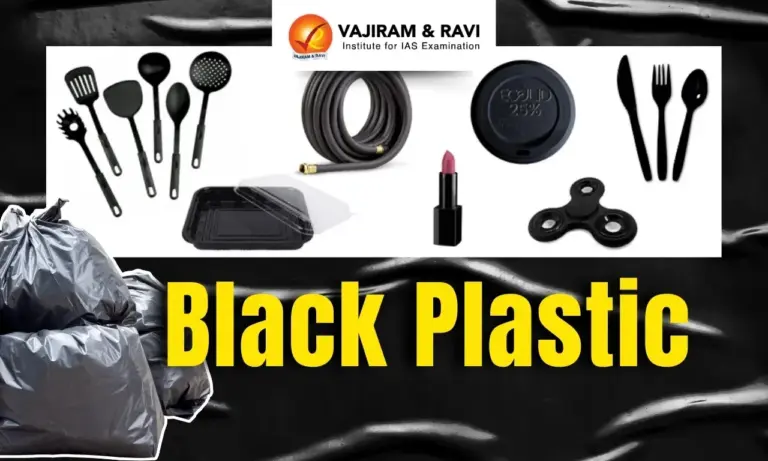
- It is a type of plastic used to make everyday items like food trays, containers, and utensils.
- It is often made from recycled electronic waste such as computers, TVs, and appliances.
- These are more likely to contain unregulated amounts of toxic chemicals including heavy metals and flame retardants.
- The issue is that these electronics typically contain substances such as the flame retardant bromine; antimony; and heavy metals such as lead, cadmium, and mercury.
- These electronics comprise flame retardants in a bid to prevent fire hazards.





Impact of Black Plastic on Human Health
- The aforementioned substances and heavy metals are known to be toxic to humans at high levels of exposure.
- Children are particularly vulnerable as they often come into prolonged contact with toys that could expose them to harmful chemicals through direct handling or ingestion.
- Toxic chemicals in black plastic kitchen utensils could leach into food during heating, compounding the risk of exposure for households using these products regularly.
- Studies have shown that chemicals in black plastic, such as BPA and phthalates, disrupt the endocrine system, leading to potential reproductive health issues, obesity, and diabetes.
- It is difficult to recycle and often ends up in landfills or incinerators, releasing toxic substances like dioxins and furans into the air.
Black Plastic FAQs
Q1: Why black plastic is not recyclable?
Ans: Black plastic is not easily recyclable because the carbon black pigment used to color it absorbs near-infrared (NIR) light.
Q2: What are the disadvantages of black plastic?
Ans: Black plastics can contain unregulated amounts of toxic chemicals such as phthalates and flame retardants, as well as heavy metals such as cadmium, lead, nickel, chromium, and mercury.
Q3: What are black plastics?
Ans: These are made from the plastics in recycled electronics such as televisions and computers.
Source: IE

 Last updated on March, 2026
→ UPSC Final Result 2025 is now out.
→ UPSC has released UPSC Toppers List 2025 with the Civil Services final result on its official website.
→ Anuj Agnihotri secured AIR 1 in the UPSC Civil Services Examination 2025.
→ UPSC Marksheet 2025 is now out.
→ UPSC Notification 2026 & UPSC IFoS Notification 2026 is now out on the official website at upsconline.nic.in.
→ UPSC Calendar 2026 has been released.
→ Check out the latest UPSC Syllabus 2026 here.
→ UPSC Prelims 2026 will be conducted on 24th May, 2026 & UPSC Mains 2026 will be conducted on 21st August 2026.
→ The UPSC Selection Process is of 3 stages-Prelims, Mains and Interview.
→ Prepare effectively with Vajiram & Ravi’s UPSC Prelims Test Series 2026 featuring full-length mock tests, detailed solutions, and performance analysis.
→ Enroll in Vajiram & Ravi’s UPSC Mains Test Series 2026 for structured answer writing practice, expert evaluation, and exam-oriented feedback.
→ Join Vajiram & Ravi’s Best UPSC Mentorship Program for personalized guidance, strategy planning, and one-to-one support from experienced mentors.
→ Shakti Dubey secures AIR 1 in UPSC CSE Exam 2024.
→ Also check Best UPSC Coaching in India