Blue Washing Latest News
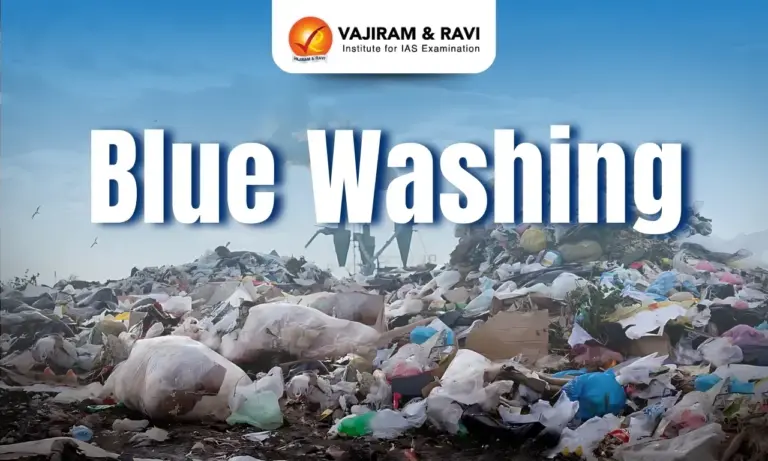
The Central Pollution Control Board (CPCB) has recently introduced a new category of industries called the ‘Blue Category’, which falls under Essential Environmental Services (EES).
What is Blue Washing?
- ‘Blue Washing’ refers to the practice of portraying polluting industries as environmentally friendly by categorising them under less polluting or cleaner industry labels.
- This term is now used to describe the reclassification of highly polluting Waste-to-Energy (WTE) incineration industries by the Central Pollution Control Board (CPCB) into the new ‘Blue Category’.
Blue Category
- The ‘Blue Category’ is introduced as part of a subset of EES activities like composting, biogas plants, sewage treatment, and material recovery facilities.
- Waste-to-Energy (WTE) incineration, previously under the ‘Red Category’ with a PI of 97.6, is now reclassified as a ‘Blue Category’ industry.





What is WTE Incineration?
- WTE incineration burns mixed municipal solid waste (MSW) to produce heat and electricity.
- It generates energy through turbine-driven steam, similar to coal plants, but emits more CO₂
About Pollution Index (PI)
- The Union Ministry of Environment, Forest and Climate Change (MoEFCC) introduced a Pollution Index (PI) to categorise industries based on pollution levels.
- PI is calculated on the basis of emissions (air pollutants), effluents (water pollutants), hazardous waste, and resource consumption.
- PIranges from 0 to 100, with industries classified as:
- White Category (0–20): Least polluting
- Green Category (21–40)
- Orange Category (41–59)
- Red Category (60–100): Most polluting
Blue Washing FAQs
Q1. What is blue washing?
Ans. A deceptive practice where companies overstate their commitment to ocean conservation or ethical water use for brand image.
Q2. How does it differ from greenwashing?
Ans. Focuses specifically on water-related sustainability claims, often linked to SDG 14 (Life Below Water).
Q3. Give an example of blue washing.
Ans. A 2022 case where a beverage firm advertised “plastic-neutral” products while remaining a top ocean plastic polluter.
Source: DTE

 Last updated on March, 2026
→ UPSC Final Result 2025 is now out.
→ UPSC has released UPSC Toppers List 2025 with the Civil Services final result on its official website.
→ Anuj Agnihotri secured AIR 1 in the UPSC Civil Services Examination 2025.
→ UPSC Marksheet 2025 is now out.
→ UPSC Notification 2026 & UPSC IFoS Notification 2026 is now out on the official website at upsconline.nic.in.
→ UPSC Calendar 2026 has been released.
→ Check out the latest UPSC Syllabus 2026 here.
→ UPSC Prelims 2026 will be conducted on 24th May, 2026 & UPSC Mains 2026 will be conducted on 21st August 2026.
→ The UPSC Selection Process is of 3 stages-Prelims, Mains and Interview.
→ Prepare effectively with Vajiram & Ravi’s UPSC Prelims Test Series 2026 featuring full-length mock tests, detailed solutions, and performance analysis.
→ Enroll in Vajiram & Ravi’s UPSC Mains Test Series 2026 for structured answer writing practice, expert evaluation, and exam-oriented feedback.
→ Join Vajiram & Ravi’s Best UPSC Mentorship Program for personalized guidance, strategy planning, and one-to-one support from experienced mentors.
→ Shakti Dubey secures AIR 1 in UPSC CSE Exam 2024.
→ Also check Best UPSC Coaching in India