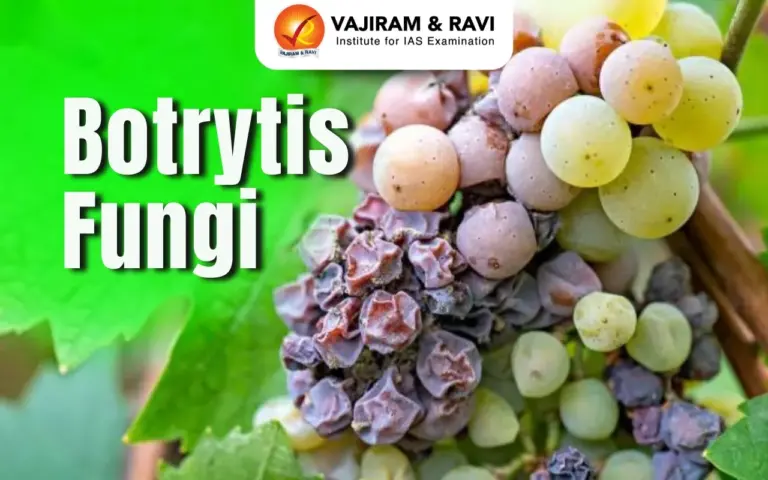
Botrytis Fungi Latest News
Recently, researchers from Sichuan University and the University of British Columbia have found that botrytis fungi (Botrytis cinerea) cannot be cloned.
About Botrytis Fungi
- It is a widespread necrotrophic fungal pathogen.
- Botrytis cinerea needs to obtain nutrients before it can penetrate a plant.
- Dead or damaged plant tissue, such as old flower petals, can provide nutrients that the fungus needs.
- Owing to this feeding source, the infection gains strength and spreads to healthy plant tissues. A brownish rot develops in newly infected tissues, which is how Botrytis cinerea deteriorates plants.
- These fungi usually attack blossoms and fruit, but they can also cause rot and blight on buds, stems, leaves, roots, bulbs, and tubers.
- The fungus typically targets fragile, wounded, aging, or dead plant parts.
- It infects grapes, penetrates the skin, causes the berries to lose water by evaporation and shrivel up, and thus concentrates the sugars and flavours in them.
- It was also found recently that this fungi exhibits an unusual idiosyncrasy.
- In these fungi, no single nucleus contains a complete set of chromosomes. Instead, the chromosome set is distributed across two or more nuclei, and any one nucleus contains only a subset.
- It requires warm temperatures, high humidity, and prolonged wetness which facilitate easy fungus inoculation.
- Additionally, it can release organic acids, such as oxalic acid, which acidify the surrounding environment.
Source: TH






 Last updated on March, 2026
→ UPSC Final Result 2025 is now out.
→ UPSC has released UPSC Toppers List 2025 with the Civil Services final result on its official website.
→ Anuj Agnihotri secured AIR 1 in the UPSC Civil Services Examination 2025.
→ UPSC Marksheet 2025 is now out.
→ UPSC Notification 2026 & UPSC IFoS Notification 2026 is now out on the official website at upsconline.nic.in.
→ UPSC Calendar 2026 has been released.
→ Check out the latest UPSC Syllabus 2026 here.
→ UPSC Prelims 2026 will be conducted on 24th May, 2026 & UPSC Mains 2026 will be conducted on 21st August 2026.
→ The UPSC Selection Process is of 3 stages-Prelims, Mains and Interview.
→ Prepare effectively with Vajiram & Ravi’s UPSC Prelims Test Series 2026 featuring full-length mock tests, detailed solutions, and performance analysis.
→ Enroll in Vajiram & Ravi’s UPSC Mains Test Series 2026 for structured answer writing practice, expert evaluation, and exam-oriented feedback.
→ Join Vajiram & Ravi’s Best UPSC Mentorship Program for personalized guidance, strategy planning, and one-to-one support from experienced mentors.
→ Shakti Dubey secures AIR 1 in UPSC CSE Exam 2024.
→ Also check Best UPSC Coaching in India
Botrytis Fungi FAQ's
Q1. What type of fungus is Botrytis?+
Q2. What temperature kills Botrytis?+
Tags: botrytis fungi prelims pointers upsc prelims current affairs