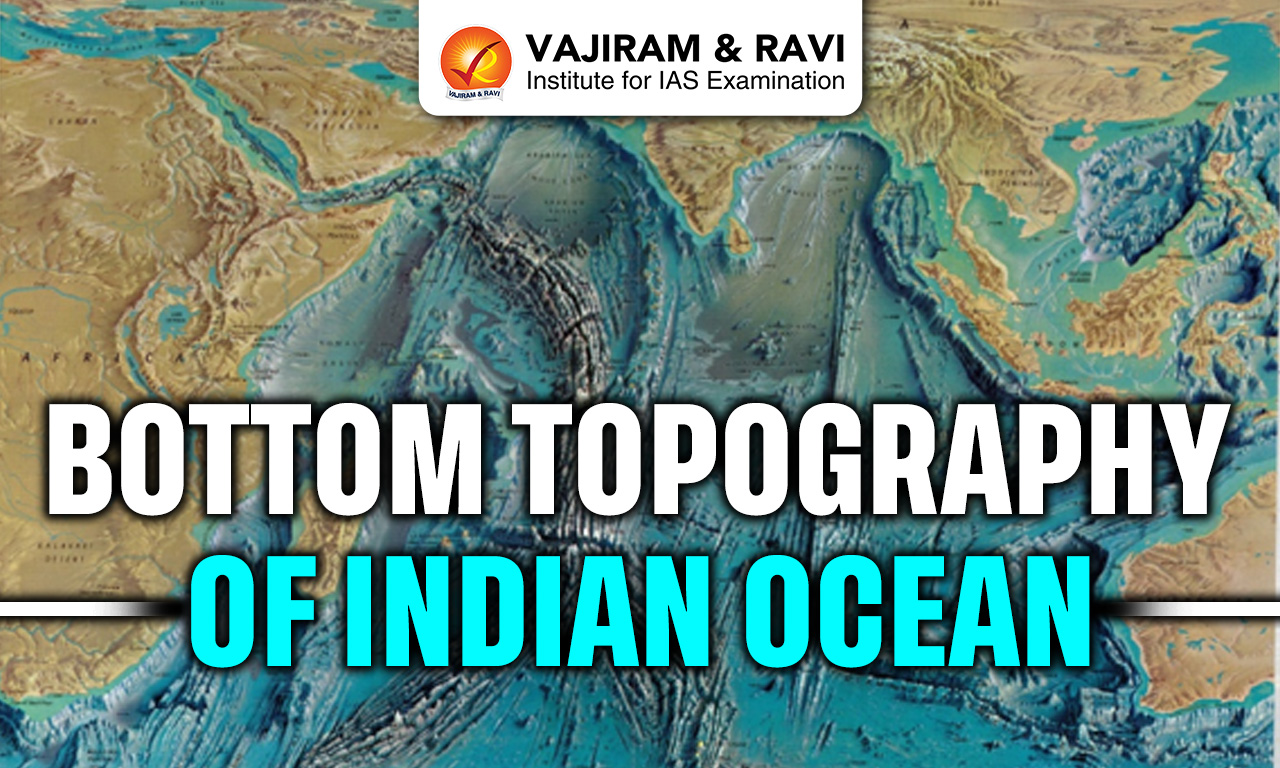
The Indian Ocean is often described as a “half ocean” because it is landlocked in the north by Asia, unlike the Atlantic and Pacific. It is bounded by Africa, Asia, Australia and Antarctica and plays a key role in monsoon circulation and global maritime trade. Bottom Topography of Indian Ocean is highly complex, shaped by tectonic activity, sedimentation and oceanic processes, making it crucial for understanding ocean dynamics and resource distribution.
Bottom Topography of Indian Ocean
The Bottom Topography of Indian Ocean floor is marked by diverse features such as mid oceanic ridges, deep basins, trenches and plateaus. It has an average depth of about 3741 m. Its structure is tectonically active due to interactions among the Indo-Australian, African, Eurasian and Antarctic plates. The ocean widens southward and is divided by ridges into multiple basins, while marginal seas and islands add to its structural complexity.
Indian Ocean Zones
The Indian Ocean is divided into distinct zones based on regional and oceanographic characteristics, reflecting variations in depth, structure and geological features within the Bottom Topography of Indian Ocean.
- Western Zone: Located between the African coast and Mid-Indian Oceanic Ridge, it has numerous islands and an average depth of about 3650 m, indicating relatively shallow and fragmented oceanic structure.
- Eastern Zone: This is the deepest zone with steep continental slopes and narrow shelves. It shows intense tectonic activity and significant depth variation, making it structurally complex and geologically active.
- Central Zone: This zone represents the mid oceanic ridge region where volcanic activity forms numerous small islands, reflecting ongoing seafloor spreading and tectonic divergence.


Indian Ocean Topographic Divisions
The Bottom Topography of Indian Ocean is divided into several major relief divisions formed by tectonic, volcanic and depositional processes.
- Continental Shelf: Shallow submerged margins surrounding continents, varying widely in width, supporting fisheries and sediment deposition, especially along the Arabian Sea and Bay of Bengal.
- Mid Ocean Ridge: A continuous underwater mountain chain running north-south, forming new oceanic crust through seafloor spreading and dividing the ocean into major basins.
- Ocean Basin: Deep, flat regions located between ridges and continental margins, containing thick sediment deposits and forming the largest part of the ocean floor.
- Ocean Deeps & Trenches: Narrow, elongated depressions formed at subduction zones, representing the deepest parts of the ocean and associated with earthquakes and volcanic activity.
- Abyssal Plains: Extensive flat areas covered with fine sediments, located at depths between 3600 m and 6000 m, forming the most widespread feature of the ocean floor.
Continental Shelf
The continental shelf shows significant variation in width and structure across the Indian Ocean margins.
- Western Shelves: Very wide shelves averaging about 640 km are found along the eastern coast of Africa and around Madagascar, supporting rich marine resources and sediment accumulation.
- Northern Shelves: Extensive shelves occur in the Arabian Sea and Bay of Bengal, influenced by large river systems like the Ganga and Indus that deposit massive sediments.
- Eastern Shelves: Narrow shelves averaging 160 km are found along Java and Sumatra, with steep slopes due to tectonic activity and proximity to subduction zones.
- Southern Shelves: Shelves become extremely narrow near Antarctica due to glacial and tectonic influences, limiting sediment deposition and marine productivity.
Mid Ocean Ridge
The Mid Indian Oceanic Ridge is the most prominent structural feature shaping the ocean floor.
- Central Ridge System: Extends from the southern tip of the Indian Peninsula to Antarctica, forming a continuous highland chain with an average width of about 320 km.
- Laccadive-Chagos Ridge: Northern segment of the ridge, also known as Maldive Ridge, connecting Lakshadweep and Maldives islands formed due to volcanic activity.
- Chagos-St. Paul Ridge: Extends between the equator and 30°S latitude, maintaining similar width and showing active tectonic processes and spreading centers.
- Amsterdam-St. Paul Plateau: Widens significantly up to 1600 km between 30°S and 50°S, representing an elevated plateau region of the ridge system.
- Ridge Bifurcation: South of 50°S, the ridge splits into Kerguelen-Gaussberg Ridge in the west and Indian-Antarctic Ridge in the east, indicating plate divergence zones.
- Carlsberg Ridge Branch: Extends northwest from 5°S towards the Gulf of Aden, linking with African plate boundaries and influencing regional tectonics.
- Ninety East Ridge: A major aseismic ridge running parallel to 90°E longitude from Myanmar to 40°S, formed due to hotspot volcanic activity.
Indian Ocean Basin
The Indian Ocean basins are extensive and formed by tectonic subsidence and sediment deposition processes.
- Arabian Basin: Circular basin between Laccadive-Chagos and Socotra-Chagos ridges, with depths ranging from 3600 m to 5486 m, important for marine circulation.
- Somali Basin: Located near East Africa, bounded by multiple ridges with average depth around 3600 m, reflecting tectonic stability and sediment deposition.
- Oman Basin: Lies near the Gulf of Oman with average depth of 3658 m, formed on continental shelf margins with thick sediment layers.
- Mauritius Basin: Extends from 20°S to 40°S with depths up to 6391 m, representing one of the deeper basins influenced by surrounding ridges.
- Mascarene Basin: Oval shaped basin between Madagascar and Seychelles-Mauritius Ridge, showing moderate depth and sediment accumulation.
- Agulhas-Natal Basin: Elongated basin near South Africa, bounded by ridges and continental margins, with average depth around 3600 m.
- West Australian Basin: Largest basin with rectangular shape and depths reaching 6459 m, bounded by Ninety East Ridge and Australian shelf.
- Mid Indian Basin: Located centrally with depths ranging from 3600 m to 6800 m, influenced by surrounding ridges and sediment influx.
Indian Ocean Deeps & Trenches
Trenches and deeps are limited but significant features of the Bottom Topography of Indian Ocean.
- Java (Sunda) Trench: Deepest trench with depth around 7450 m, formed due to subduction of Indo-Australian Plate beneath Eurasian Plate.
- Ob Trench: Located in the eastern Indian Ocean with depth about 6875 m, associated with tectonic activity and plate convergence.
- Mauritius Trench: A smaller trench located near the Mascarene Plateau, representing localized tectonic depression zones.
- Amirante Trench: Found near Seychelles region, formed due to crustal deformation and minor subduction processes.
- Deep Sea Plains: About 60 percent of the ocean consists of plains with depths between 3600 m and 5487 m, indicating relatively stable tectonic regions.
Abyssal Plains
Abyssal Plains form the largest and flattest Bottom Topography of Indian Ocean floor.
- Somali Abyssal Plain: Located near East Africa, formed by sediment accumulation and characterized by smooth surface and moderate depth.
- Ceylon Abyssal Plain: Found near Sri Lanka, shaped by riverine sediment deposits and ocean currents, supporting deep sea ecosystems.
- Indian Abyssal Plain: Extensive flat region with average depth around 4380 m, formed by long term deposition of fine sediments.
- Sediment Thickness: In regions like Bay of Bengal, sediment thickness exceeds 7 miles due to heavy river discharge, especially from Ganga-Brahmaputra system.
- Marine Ecology: Supports specialized deep sea organisms adapted to high pressure and low temperature, contributing to biodiversity.
Indian Ocean Surface Features
Surface and near surface features of the Bottom Topography of Indian Ocean complement its bottom relief and reflect geological and oceanographic processes.
- Marginal Seas: Important seas include Arabian Sea, Bay of Bengal, Andaman Sea, Red Sea, Persian Gulf and Mozambique Channel, showing limited marginal seas compared to other oceans.
- Islands: Major islands include Madagascar and Sri Lanka, while smaller islands like Maldives, Seychelles, Comoros and Andaman-Nicobar are mostly volcanic or coral in origin.
- Submarine Canyons: Large canyons such as Indus and Ganga canyons cut across continental slopes, transporting sediments and forming deep sea fans like the Bengal Fan.
- Coral Reefs and Atolls: Extensive coral formations are found around Maldives, Lakshadweep and Seychelles, indicating warm tropical conditions and biological activity.
- Coastal Features: The coasts include estuaries, deltas, mangroves and beaches, with notable formations like Sundarbans mangroves and Indus delta reflecting high sedimentation.
Bottom Topography of Indian Ocean Significance
The Bottom Topography of Indian Ocean holds immense importance for global systems, economic resources and environmental processes.
- Strategic Importance: The Indian Ocean hosts major global shipping routes connecting Asia, Africa and Europe, making its seabed structure vital for navigation, ports and geopolitical control.
- Climatic Influence: Ocean floor features influence currents and monsoon systems, especially the Indian Ocean Dipole, which affects rainfall patterns across Asia and Africa.
- Economic Resources: Continental shelves and deep sea beds contain oil, gas and polymetallic nodules rich in manganese, nickel, cobalt and copper, supporting marine based economies.
- Blue Economy: Fisheries, marine biodiversity, seabed mining and renewable energy depend on ocean topography, contributing to sustainable economic development in coastal regions.
- EEZ Significance: Coastal nations derive Exclusive Economic Zones from continental shelves, enabling control over marine resources and enhancing economic and strategic advantages.
- Scientific Research: The tectonic complexity, ridge systems and sediment deposits provide insights into plate tectonics, ocean evolution and climate history.
- Biodiversity Support: Features like seamounts, ridges and coral reefs create diverse habitats supporting marine ecosystems, including deep sea organisms and commercially important species.
- Hazard Assessment: Trenches and tectonic zones are associated with earthquakes and tsunamis, as seen in the Sunda Trench region, making topography crucial for disaster management.
- Sediment Dynamics: Large sediment deposits from rivers like Ganga and Indus form abyssal plains and fans, influencing nutrient cycles and ocean productivity.
- Global Connectivity: The Indian Ocean connects with Atlantic and Pacific near Antarctica and its topography influences global thermohaline circulation and energy exchange systems.

 Last updated on Oct, 2026
→ UPSC 2027 Notification will be released on 13 January 2027 at upsconline.nic.in.
→ Check Nobel Prize 2026 Winners List here.
→ Download PIB PRiSM Monthly Magazine 2026 here.
→ Check UPSC Monthly Current Affairs Magazine The Recitals here.
→ Check out the latest UPSC Syllabus here.
→ Download UPSC Model Answers for Mains 2026
→ UPSC Mains Question Paper 2026 is out now for Essay & GS Paper 1, 2, 3 & 4.
→ UPSC Calendar 2027 has been released.
→ Enroll in Vajiram & Ravi’s UPSC Mains Test Series 2027 for structured answer writing practice, expert evaluation, and exam-oriented feedback.
→ Join Vajiram & Ravi’s UPSC Mentorship Program 2027 for personalized guidance, strategy planning, and one-to-one support from experienced mentors.
→ Go through the UPSC Mains Previous Year Papers to enhance your preparation.
→ UPSC has released UPSC Toppers List 2025 with the Civil Services final result on its official website.
→ Also check Best UPSC Coaching in India
Bottom Topography of Indian Ocean FAQs
Q1. What is the average depth of the Indian Ocean?+
Q2. Why is the Indian Ocean called a half ocean?+
Q3. What is the most important feature of the Indian Ocean floor?+
Q4. Which is the deepest trench in the Indian Ocean?+
Q5. Why is the Bottom Topography of Indian Ocean important?+
Tags: bottom topography of indian ocean geography geography notes