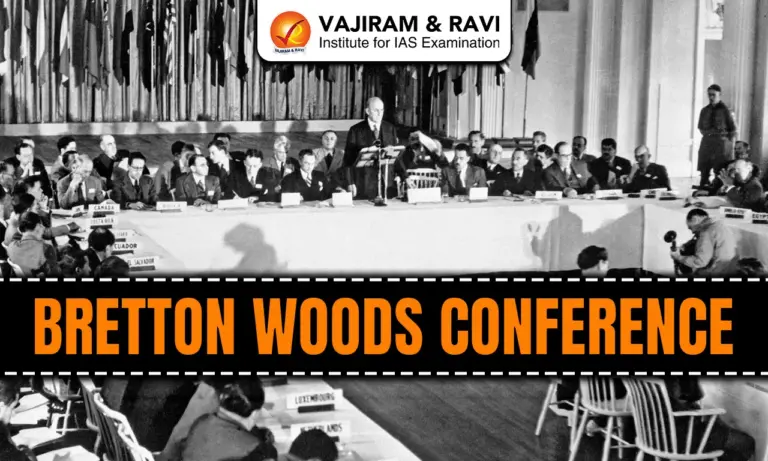
The Bretton Woods Conference was held in 1944 in New Hampshire, USA, to plan the Post-World War II global economy. It led to the creation of the International Monetary Fund (IMF) and the World Bank to promote financial stability, trade and economic development worldwide.
Bretton Woods Conference 1944
- The Bretton Woods Conference was organized in July 1944, with delegates from 44 countries to create a new international monetary system after World War II.
- It led to the establishment of the International Monetary Fund (IMF) to maintain exchange rate stability and provide financial assistance and the World Bank to support post-war reconstruction and economic development.
- The system fixed currencies to the U.S. dollar, which was pegged to gold. The conference laid the foundation for international economic cooperation, and both the IMF and World Bank continue to play a major role in global finance and development.
Bretton Woods Conference 1944 Objectives
- Monetary Stability: The Bretton Woods Conference established a fixed exchange rate system connected to the US dollar and gold to reduce unpredictable currency fluctuations and maintain global financial stability.
- Economic Reconstruction: It formed the International Bank for Reconstruction and Development (IBRD), now a part of the World Bank Group, to provide financial assistance for rebuilding countries damaged during war.
- Financial Cooperation: Created the International Monetary Fund (IMF) to support nations facing balance of payments problems and to prevent them from adopting strict protectionist policies.
- Trade Promotion: Promoted global trade by reducing exchange restrictions and encouraging smoother international financial transactions.





Bretton Woods Conference & World Bank Group Role
- The World Bank Group (WBG) is a group of five international organizations that provide loans, mainly to poor and developing countries (LDCs).
- It was created in 1945 after the Bretton Woods Conference and started operations in 1946.
- Initially, it focused on post-war reconstruction, but today it works to reduce poverty and promote development in all areas.
- The World Bank prepares the “World Development Report”, which gives information on global development issues.
- Its headquarters are in Washington, D.C., USA.
- It is an international organization owned by member countries. Profits are reinvested to support development projects.
- Governance:
- Each member country contributes capital and gets votes proportional to its contribution.
- All members have basic voting rights, plus additional votes based on financial contributions.
- Although connected to the United Nations system, the World Bank has its own governance structure independent of the UN.
- The World Bank Group consists of five main agencies:
- International Bank for Reconstruction and Development (IBRD)– Provides loans to middle-income and creditworthy countries for development projects.
- International Development Association (IDA)– Offers low-interest loans and grants to the poorest countries.
- International Finance Corporation (IFC)– Supports private sector development in developing countries.
- Multilateral Investment Guarantee Agency (MIGA)– Provides political risk insurance to encourage foreign investment.
- International Centre for Settlement of Investment Disputes (ICSID)– Helps resolve investment disputes between countries and foreign investors.
Bretton Woods Conference & IMF
The Bretton Woods Conference, held in 1944, aimed to create a stable international financial system after World War II. It led to the establishment of key global financial institutions, including the International Monetary Fund (IMF), to promote economic stability and cooperation.
- Established a fixed exchange rate system linked to the US dollar and gold to maintain global monetary stability.
- Created the International Monetary Fund (IMF) to assist countries facing balance of payments crises.
- Encouraged financial cooperation among nations to prevent economic instability and currency devaluation.
- Promoted international trade by reducing exchange restrictions and supporting smooth financial transactions.
- Helped maintain global economic stability through financial monitoring and policy guidance.
Bretton Woods Conference Outcomes
- International Monetary Fund (IMF): Created to maintain monetary stability and stable exchange rates globally.
- International Bank for Reconstruction and Development (IBRD/World Bank): Created to rebuild war-torn countries and promote economic development, especially in infrastructure.
- These two institutions are called the Bretton Woods twins.
Why did Bretton Woods Failed?
- In the 1960s, the Bretton Woods fixed exchange rate system came under pressure due to:
- Rising inflation in the United States
- Growing U.S. trade deficits
- Increasing demand for gold from foreign countries
- By 1971, the U.S. gold reserves could no longer cover all the dollars held abroad.
- President Richard Nixon suspended the dollar’s convertibility into gold, temporarily ending the gold standard.
- This action triggered the collapse of the Bretton Woods system by 1973.
- After the collapse, countries were free to choose how their currencies were valued:
- They could peg their currency to another currency or a basket of currencies.
- Or they could let their currency float freely, allowing market forces to determine its value.

 Last updated on April, 2026
→ UPSC Final Result 2025 is now out.
→ UPSC has released UPSC Toppers List 2025 with the Civil Services final result on its official website.
→ Anuj Agnihotri secured AIR 1 in the UPSC Civil Services Examination 2025.
→ UPSC Marksheet 2025 is now out.
→ UPSC Notification 2026 & UPSC IFoS Notification 2026 is now out on the official website at upsconline.nic.in.
→ UPSC Calendar 2026 has been released.
→ Check out the latest UPSC Syllabus 2026 here.
→ UPSC Prelims 2026 will be conducted on 24th May, 2026 & UPSC Mains 2026 will be conducted on 21st August 2026.
→ The UPSC Selection Process is of 3 stages-Prelims, Mains and Interview.
→ Prepare effectively with Vajiram & Ravi’s UPSC Prelims Test Series 2026 featuring full-length mock tests, detailed solutions, and performance analysis.
→ Enroll in Vajiram & Ravi’s UPSC Mains Test Series 2026 for structured answer writing practice, expert evaluation, and exam-oriented feedback.
→ Join Vajiram & Ravi’s Best UPSC Mentorship Program for personalized guidance, strategy planning, and one-to-one support from experienced mentors.
→ Shakti Dubey secures AIR 1 in UPSC CSE Exam 2024.
→ Also check Best UPSC Coaching in India
Bretton Woods Conference FAQs
Q1. What was the Bretton Woods Conference?+
Q2. What were the main objectives of the Bretton Woods Conference?+
Q3. Which major institutions were created at the Bretton Woods Conference?+
Q4. What was the role of the IMF?+
Q5. What are the main agencies of the World Bank Group?+
Tags: bretton woods conference economy economy notes