BRICS Summit Latest News
- India at the BRICS Summit 2025 called for fair and transparent economic practices, opposing the linkage of trade measures with non-trade issues amid rising US tariff disputes.
Introduction
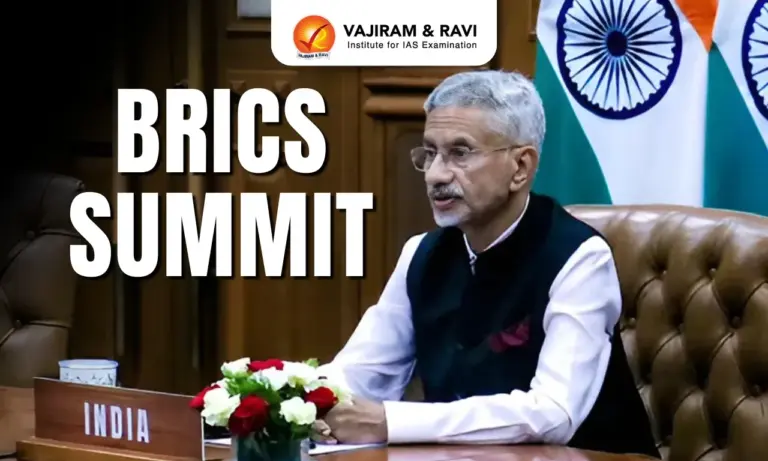
- The BRICS Summit 2025, convened virtually under the leadership of Brazil, has emerged as a key platform for discussions on global economic disruptions triggered by rising tariff wars and geopolitical tensions.
- Representing India, External Affairs Minister (EAM) S. Jaishankar underscored the urgent need for fair, transparent, and rules-based economic practices.
- He highlighted India’s concerns over linking trade measures with non-trade issues, a veiled reference to the United States’ recent tariff escalations.





Understanding BRICS
- BRICS, an acronym for Brazil, Russia, India, China, and South Africa, is an influential intergovernmental grouping that represents nearly 42% of the world’s population and about a quarter of global GDP.
- Historical Background
- The concept of BRICS was first introduced in 2001 by economist Jim O’Neill to describe emerging economies shaping the global order.
- The first BRIC Summit was held in 2009 in Russia, and South Africa joined in 2010, transforming it into BRICS.
- Objectives
- Reform of global financial and political institutions to reflect emerging economies.
- Enhanced trade, investment, and sustainable development among member states.
- Cooperation on security, technology, and climate change.
- Advocacy for a multipolar world order to counter Western dominance.
- Achievements
- Over the years, BRICS has launched initiatives like the New Development Bank (NDB), which finances infrastructure and sustainable projects, and the Contingent Reserve Arrangement (CRA) to stabilise economies during crises.
- It has also served as a forum for discussing counter-terrorism, energy security, digital innovation, and global governance reforms.
- Challenges
- Internal divisions – particularly between India and China due to border tensions.
- Economic asymmetry – China’s overwhelming dominance compared to other members.
- Geopolitical contradictions – diverging interests in Ukraine, West Asia, and trade policies.
- Limited integration – trade among BRICS members is often constrained by deficits and protectionist measures.
Summary of the 2025 BRICS Summit
- India’s Concerns on Tariff Wars
- At the 2025 BRICS Summit, EAM S. Jaishankar raised concerns over the United States’ imposition of 50% tariffs on Indian and Brazilian exports, citing penalties for oil trade with Russia.
- He strongly objected to linking trade measures with non-trade matters, arguing that such practices destabilise the global economic order.
- Call for Fair and Transparent Economic Practices
- S. Jaishankar emphasised that the international trading system must remain open, fair, transparent, non-discriminatory, and rules-based.
- He stressed that increasing barriers and protectionism would not help developing economies, especially when global food, energy, and fertiliser security is already strained.
- Need for Resilient Supply Chains
- Highlighting vulnerabilities exposed by the COVID-19 pandemic, geopolitical conflicts, and climate disruptions, S. Jaishankar called for resilient, redundant, and diversified supply chains.
- He advocated democratizing manufacturing across geographies to prevent overdependence on specific regions.
- Global South and Multilateralism
- The External Affairs Minister noted that the Global South has been disproportionately affected by conflicts in Ukraine and West Asia, experiencing shortages in food, fuel, and fertilisers.
- He pressed for a diplomatic resolution to conflicts and reformed multilateralism, particularly within the United Nations system.
- India’s Trade Deficits within BRICS
- S. Jaishankar pointed out that India faces some of its largest trade deficits with BRICS partners, especially China.
- He urged member states to review trade flows and adopt more cooperative mechanisms that can reduce imbalances and boost intra-BRICS trade.

 Last updated on March, 2026
→ UPSC Final Result 2025 is now out.
→ UPSC has released UPSC Toppers List 2025 with the Civil Services final result on its official website.
→ Anuj Agnihotri secured AIR 1 in the UPSC Civil Services Examination 2025.
→ UPSC Marksheet 2025 is now out.
→ UPSC Notification 2026 & UPSC IFoS Notification 2026 is now out on the official website at upsconline.nic.in.
→ UPSC Calendar 2026 has been released.
→ Check out the latest UPSC Syllabus 2026 here.
→ UPSC Prelims 2026 will be conducted on 24th May, 2026 & UPSC Mains 2026 will be conducted on 21st August 2026.
→ The UPSC Selection Process is of 3 stages-Prelims, Mains and Interview.
→ Prepare effectively with Vajiram & Ravi’s UPSC Prelims Test Series 2026 featuring full-length mock tests, detailed solutions, and performance analysis.
→ Enroll in Vajiram & Ravi’s UPSC Mains Test Series 2026 for structured answer writing practice, expert evaluation, and exam-oriented feedback.
→ Join Vajiram & Ravi’s Best UPSC Mentorship Program for personalized guidance, strategy planning, and one-to-one support from experienced mentors.
→ Shakti Dubey secures AIR 1 in UPSC CSE Exam 2024.
→ Also check Best UPSC Coaching in India
BRICS Summit FAQs
Q1. What is BRICS?+
Q2. What were India’s key concerns at the BRICS 2025 Summit?+
Q3. Why did the US tariffs figure prominently in the summit?+
Q4. What did Jaishankar say about supply chains?+
Q5. How does India view its trade relations within BRICS?+
Tags: brics summit mains articles upsc current affairs upsc mains current affairs