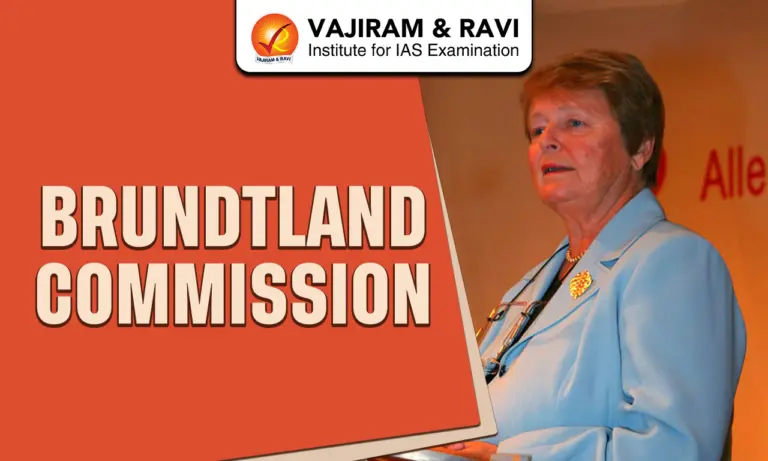
The Brundtland Commission is officially known as the World Commission on Environment and Development (WCED). It was established in 1983 by the United Nations to address growing global concerns over environmental degradation and development conflicts. It gained worldwide recognition through its 1987 report “Our Common Future”, which introduced the concept of Sustainable Development. The Commission played a crucial role in linking environmental protection with economic growth and social equity, shaping global policy discourse.
Brundtland Commission Background
The Brundtland Commission emerged amid rising environmental and developmental concerns globally during the late 20th century.
- Environmental crisis context: Rapid industrialisation in the 1970s and 1980s led to pollution, deforestation, biodiversity loss and resource depletion, raising serious global environmental concerns.
- Developmental tensions: Developing nations prioritised poverty alleviation and economic growth, while developed nations emphasised environmental protection, creating a conflict between growth and conservation goals.
- UNGA Resolution 38/161: On 19 December 1983, the United Nations General Assembly established WCED to propose long term strategies for sustainable development and global cooperation.
- Leadership and composition: Chaired by Gro Harlem Brundtland, the Commission included members from 21 countries, representing both developed and developing nations to ensure balanced global perspectives.
- Global challenges addressed: Issues such as climate change, ozone depletion, desertification and resource scarcity highlighted the need for coordinated international action beyond national policies.
Brundtland Commission Objectives
The Brundtland Commission was assigned a comprehensive mandate to integrate environment and development issues globally.
- Re-examining global issues: It aimed to analyse critical environmental and developmental challenges and propose realistic, long term solutions for sustainable growth.
- Promoting sustainable development: The Commission sought to integrate economic growth with environmental conservation and social equity through practical policy strategies.
- Strengthening cooperation: It focused on enhancing international collaboration between developed and developing countries for managing shared environmental concerns.
- Raising awareness: The Commission worked to increase global understanding of the interdependence between environment, development and human well being.
- Policy recommendations: It aimed to develop actionable policies ensuring long term sustainability while addressing poverty, inequality and environmental degradation.





Brundtland Commission Report
The Brundtland Commission released a report in 1987- “Our Common Future”, which became a landmark document in global environmental governance. The key highlights of the report are:
- Definition of sustainable development: It defined sustainable development as development meeting present needs without compromising future generations’ ability to meet their needs.
- Integration approach: The report emphasised that economic development and environmental protection are interconnected and must be pursued simultaneously.
- Global issues identified: It highlighted climate change, biodiversity loss, deforestation, population growth, food security and energy challenges as urgent global threats.
- Focus on poverty: The report identified poverty as both a cause and consequence of environmental degradation, stressing the need for equitable development strategies.
- Call for cooperation: It recommended stronger international institutions and agreements to manage global commons and ensure sustainable resource use.
Brundtland Commission Sustainable Development Goals
The ideas of the Brundtland Commission laid the conceptual foundation for later global development frameworks including SDGs.
- Three pillars concept: It introduced the integration of economic growth, environmental protection and social equity as core pillars of sustainable development.
- Influence on MDGs and SDGs: Its framework directly influenced the Millennium Development Goals (2000-2015) and Sustainable Development Goals (2015-2030).
- Holistic development vision: The Commission promoted a balanced approach addressing poverty, inequality, climate change and resource management simultaneously.
- Global action framework: The SDGs reflect its emphasis on international cooperation, shared responsibility and inclusive development strategies.
- Long term sustainability agenda: It provided a roadmap for achieving sustainable development through coordinated global efforts across sectors and nations.
Brundtland Commission Impacts
The Brundtland Commission had significant long term impacts on global environmental governance and policy frameworks.
- Policy transformation: Its recommendations shaped national and international environmental and development policies across multiple countries and institutions.
- Rio Earth Summit: It directly inspired the 1992 United Nations Conference on Environment and Development held in Rio de Janeiro.
- Climate change awareness: The report elevated global understanding of climate change, contributing to the creation of the UNFCCC framework.
- Academic influence: Sustainable development became a central concept in environmental studies, economics and public policy worldwide.
- Institutional strengthening: It promoted global governance mechanisms and encouraged collaboration between governments, NGOs and international organisations.
Brundtland Commission Significance
The Brundtland Commission represents a major milestone in redefining global development paradigms.
- Conceptual shift: It transformed the idea of development by integrating environmental sustainability with economic and social dimensions.
- Intergenerational equity: The report emphasised fairness between present and future generations in resource use and development planning.
- Global governance foundation: It laid the groundwork for international environmental agreements and sustainability frameworks.
- Bridging global divide: The Commission attempted to reconcile differences between developed and developing countries on growth and environmental priorities.
- Enduring relevance: Its principles continue to guide global debates on climate change, sustainability and equitable development in the 21st century.
Brundtland Commission Criticism
Despite its influence, the Brundtland Commission faced several criticisms regarding its approach and implementation.
- Vagueness of definition: Critics argue the concept of sustainable development is too broad and ambiguous, allowing multiple interpretations that often prioritise economic growth over environmental protection.
- Implementation challenges: Many countries struggled to convert recommendations into concrete policies, resulting in gaps between theoretical framework and practical execution.
- Growth centric approach: Some analysts believe the emphasis on continued economic growth undermines ecological limits and environmental sustainability concerns.
- North-South inequality: Developing nations argued the Commission did not adequately address structural inequalities in trade, finance and technology transfer between developed and developing countries.
- Lack of measurable targets: The absence of clear quantitative indicators made it difficult to assess progress and enforce accountability in sustainable development efforts.

 Last updated on March, 2026
→ UPSC Final Result 2025 is now out.
→ UPSC has released UPSC Toppers List 2025 with the Civil Services final result on its official website.
→ Anuj Agnihotri secured AIR 1 in the UPSC Civil Services Examination 2025.
→ UPSC Marksheet 2025 is now out.
→ UPSC Notification 2026 & UPSC IFoS Notification 2026 is now out on the official website at upsconline.nic.in.
→ UPSC Calendar 2026 has been released.
→ Check out the latest UPSC Syllabus 2026 here.
→ UPSC Prelims 2026 will be conducted on 24th May, 2026 & UPSC Mains 2026 will be conducted on 21st August 2026.
→ The UPSC Selection Process is of 3 stages-Prelims, Mains and Interview.
→ Prepare effectively with Vajiram & Ravi’s UPSC Prelims Test Series 2026 featuring full-length mock tests, detailed solutions, and performance analysis.
→ Enroll in Vajiram & Ravi’s UPSC Mains Test Series 2026 for structured answer writing practice, expert evaluation, and exam-oriented feedback.
→ Join Vajiram & Ravi’s Best UPSC Mentorship Program for personalized guidance, strategy planning, and one-to-one support from experienced mentors.
→ Shakti Dubey secures AIR 1 in UPSC CSE Exam 2024.
→ Also check Best UPSC Coaching in India
Brundtland Commission FAQs
Q1. What is the Brundtland Commission?+
Q2. What is the main contribution of the Brundtland Commission?+
Q3. What is the definition of sustainable development given by the Brundtland Commission?+
Q4. How did the Brundtland Commission influence global policies?+
Q5. What are the major criticisms of the Brundtland Commission?+
Tags: brundtland commission environmental geography international relations