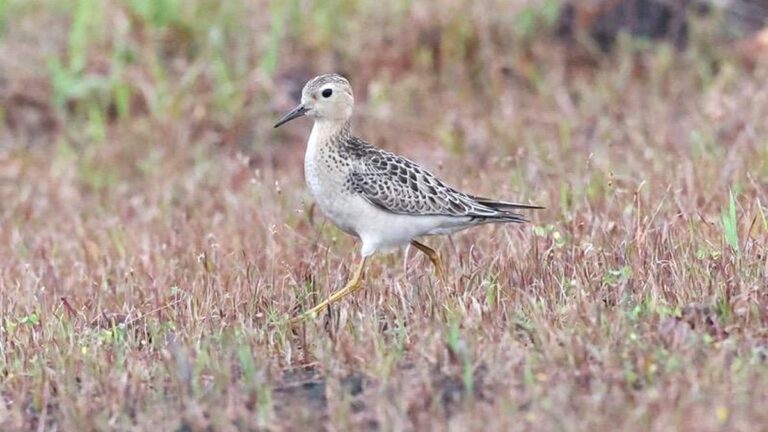
About Buff-breasted Sandpiper:
- It is one of the most delicately beautiful of the shorebirds.
- It breeds in the open arctic tundra of North America and winters usually in South America.
- Habitat: Shortgrass prairies; in summer, tundra ridges. Migrants in North America mostly on dry open ground, such as prairies, pastures,
- The male Buff-breasted Sandpipers gather in groups on display territories called leks, where they flash their eye-catching underwings to compete for females’ attention.
- It is a champion long-distance migrant, leaving high-Arctic dry tundra nesting grounds and migrating thousands of miles to winter on the grasslands of Brazil, Argentina, Uruguay, and Paraguay.
- Conservation status
- IUCN: Near Threatened
Key facts about Arctic tundra
- It is the northernmost biome which is a vast, dry, rocky place, with few trees.
- It covers the lands north of the Arctic Circle up to the polar ice cap.
- It reaches as far south as the Hudson Bay area of Canada and the northern part of Iceland.
- The word “tundra” comes from the Finnish word tunturi. This word means ‘treeless plain’.
- One important characteristic of the tundra is the permafrost. The word “permafrost” is short-form for the words “permanently frozen”.
- The ground in the arctic tundra tends to be rocky and the soil has few nutrients. This is because the organic matter there breaks down very slowly.
- Despite the lack of trees, this biome is still considered a major carbon sink.
- This is due to the large amounts of organic matter found in deposits of peat and humus.
- Temperature: Temperatures range from 15.5 °C in summer to -60 °C in winter. Mean temperatures are below 0°C for six to 10 months of the year.
- Annual precipitation: The annual precipitation is around 150 to 250mm. Most of this precipitation does not evaporate due to the low temperatures.
Q1) What are Sandpipers?
Sandpipers are a large and varied group, with over 90 different species found around the world. They are part of the wider order Charadriiformes, which includes plovers, curlews, and other diverse group of small to medium-sized shorebirds
Source: Rare bird from arctic tundra brings cheer to top birders






 Last updated on March, 2026
→ UPSC Final Result 2025 is now out.
→ UPSC has released UPSC Toppers List 2025 with the Civil Services final result on its official website.
→ Anuj Agnihotri secured AIR 1 in the UPSC Civil Services Examination 2025.
→ UPSC Marksheet 2025 is now out.
→ UPSC Notification 2026 & UPSC IFoS Notification 2026 is now out on the official website at upsconline.nic.in.
→ UPSC Calendar 2026 has been released.
→ Check out the latest UPSC Syllabus 2026 here.
→ UPSC Prelims 2026 will be conducted on 24th May, 2026 & UPSC Mains 2026 will be conducted on 21st August 2026.
→ The UPSC Selection Process is of 3 stages-Prelims, Mains and Interview.
→ Prepare effectively with Vajiram & Ravi’s UPSC Prelims Test Series 2026 featuring full-length mock tests, detailed solutions, and performance analysis.
→ Enroll in Vajiram & Ravi’s UPSC Mains Test Series 2026 for structured answer writing practice, expert evaluation, and exam-oriented feedback.
→ Join Vajiram & Ravi’s Best UPSC Mentorship Program for personalized guidance, strategy planning, and one-to-one support from experienced mentors.
→ Shakti Dubey secures AIR 1 in UPSC CSE Exam 2024.
→ Also check Best UPSC Coaching in India