About C. Subramania Bharati:
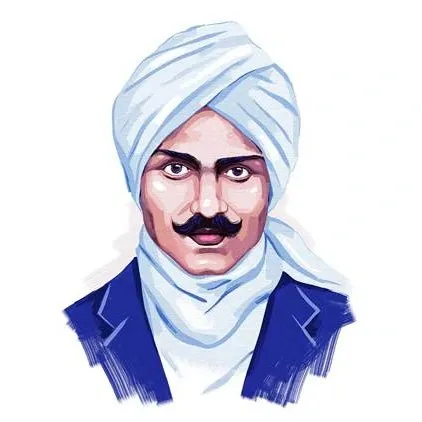
- He was a poet, freedom fighter, and social reformer from Tamil Nadu.
- He was known as Mahakavi Bharathiyar, and the laudatory epithet Mahakavi means a great poet.
- He was born in Ettayapuram, South India, in 1882, and died in Madras in 1921.
- He is considered one of India’s greatest poets. His songs on nationalism and freedom of India helped to rally the masses to support the Indian Independence Movement in Tamil Nadu.
- Bharathi joined as Assistant Editor of the Swadesamitran, a Tamil daily, in 1904.
- In 1907, he started editing the Tamil weekly India and the English newspaper Bala Bharatham with M.P.T. Acharya.
- He assisted Aurobindo in the Arya journal and later Karma Yogi in Pondicherry.
- Unfortunately, Bharati was persecuted for his convictions both by the British and by the orthodox elements of his own society, who treated him as an outcast.
- He was exiled from British India in 1908 and went to live in Pondicherry, a French colony in South India.
- He spent ten years in exile there and eventually returned to Madras, where he died.
- Most of his compositions are classifiable as short lyrical outpourings on patriotic, devotional, and mystic themes.
- Bharathi was essentially a lyrical poet. Bharati’s best-known works included Kaṇṇan pattu (1917; Songs to Krishna), Panchali sapatham (1912; Panchali’s Vow), and Kuyil pattu (1912; Kuyil’s Song).
- He also translated Vedic hymns, Patanjali’s Yoga Sutra and Bhagavat Gita into Tamil.
Q1: Who was Sri Aurobindo?
Sri Aurobindo (born August 15, 1872, Calcutta [now Kolkata], India—died December 5, 1950, Pondicherry [now Puducherry]) was a yogi, seer, philosopher, poet, and Indian nationalist who propounded a philosophy of divine life on earth through spiritual evolution. Aurobindo is one of the key leaders of the Indian nationalist movement at the beginning of the twentieth century. Most of his writings were published In Bande Mataram and Karmayogin newspapers and in this place and time, he expressed his desire for an independent India.
News: Compiled over decades, Subramania Bharati’s collected works to be released by PM Modi


 Last updated on Oct, 2026
→ UPSC 2027 Notification will be released on 13 January 2027 at upsconline.nic.in.
→ Check Nobel Prize 2026 Winners List here.
→ Download PIB PRiSM Monthly Magazine 2026 here.
→ Check UPSC Monthly Current Affairs Magazine The Recitals here.
→ Check out the latest UPSC Syllabus here.
→ Download UPSC Model Answers for Mains 2026
→ UPSC Mains Question Paper 2026 is out now for Essay & GS Paper 1, 2, 3 & 4.
→ UPSC Calendar 2027 has been released.
→ Enroll in Vajiram & Ravi’s UPSC Mains Test Series 2027 for structured answer writing practice, expert evaluation, and exam-oriented feedback.
→ Join Vajiram & Ravi’s UPSC Mentorship Program 2027 for personalized guidance, strategy planning, and one-to-one support from experienced mentors.
→ Go through the UPSC Mains Previous Year Papers to enhance your preparation.
→ UPSC has released UPSC Toppers List 2025 with the Civil Services final result on its official website.
→ Also check Best UPSC Coaching in India