CAG Report Latest News
- The CAG’s decadal analysis of States’ macro-fiscal health highlights uneven revenue sources, rising debt burdens, and the welfare paradox shaping fiscal sustainability across India.
Introduction
- India’s States collectively manage some of the largest public budgets in the world, often surpassing those of smaller countries in size.
- The recently released decadal analysis of States’ macro-fiscal health by the Comptroller and Auditor General (CAG) offers a crucial snapshot of how reforms, growth, and crises such as the pandemic have shaped their fiscal trajectories.
- While some States reported impressive revenue surpluses, others struggle under heavy debt burdens, revealing stark disparities in fiscal sustainability and policy choices.





States’ Macro-Fiscal Landscape in India
- In the early 2000s, Indian States were burdened with chronic deficits. Reforms in tax collection, GST implementation, and high growth during the 2010s improved finances, with some States recording surpluses.
- However, the pandemic reversed these gains, as shrinking revenues and soaring emergency expenditure pushed most States back into fiscal distress.
- States today present a mixed picture: while richer States like Maharashtra fund a large share of their expenditure internally, poorer States such as Arunachal Pradesh remain highly dependent on Union transfers.
- This vertical imbalance in fiscal capacity underscores the unevenness of India’s federal fiscal architecture.
Uneven Revenue Sources
- The CAG report shows that States rely on highly variable revenue streams. For example:
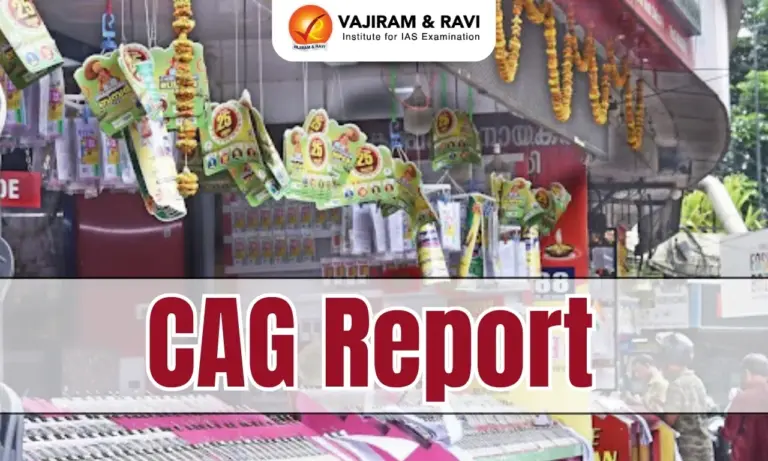
- Kerala’s lotteries contributed nearly Rs. 12,000 crore in 2022-23.
- Odisha’s mining royalties made up 90% of its non-tax income.
- Telangana raised nearly Rs. 9,800 crore through land sales.
- Such revenues are volatile and unsustainable: lotteries depend on sales, royalties on global commodity prices, and land cannot be sold repeatedly.
- Even surplus-earning States like Uttar Pradesh generated only 42% of their receipts internally, leaning heavily on central transfers.
Rising Borrowings and Debt Burden
- The fiscal health of States is also reflected in their borrowing patterns:
- Andhra Pradesh tripled its borrowings to Rs. 1.86 lakh crore by 2022-23, with debt reaching 35% of GSDP.
- Bihar doubled its borrowings, pushing debt close to 39% of GSDP.
- Kerala’s debt burden remained high at 37% of GSDP despite curbing borrowings post-pandemic.
- Punjab continued its fiscal stress with liabilities touching 45% of GSDP.
- In contrast, Odisha reduced borrowings, lowering debt to 15% of GSDP, the lowest in India.
- The pandemic was a turning point: while some States like Karnataka and Maharashtra cut back borrowings after 2021, others like Andhra Pradesh, Telangana, and Rajasthan kept expanding them, signalling divergent fiscal strategies.
The Welfare Paradox
- A striking theme of the CAG analysis is the welfare paradox.
- Despite reporting surpluses or stable debt, many States underfund key welfare sectors such as education, health, and rural infrastructure.
- Instead, reliance on off-budget loans, GST compensation arrears, and central transfers creates a façade of fiscal stability.
- Political populism adds another layer. Free power, farm waivers, and cash transfers defer costs into opaque mechanisms like guarantees and special-purpose vehicles.
Implications for Fiscal Federalism
- The CAG findings highlight deeper structural issues in India’s fiscal federalism:
- Dependence on volatile revenues limits the States’ capacity to plan long-term welfare.
- Rising borrowings pose risks of debt overhang, especially in poorer and smaller States.
- Vertical fiscal imbalance perpetuates reliance on the Centre, undermining financial autonomy.
- Populist welfare policies erode fiscal discipline while failing to deliver sustainable outcomes.
- The analysis suggests that India’s States must prioritise capital expenditure over routine subsidies, diversify revenue sources, and strengthen fiscal transparency.
- Without such reforms, India risks sustaining one of the largest welfare States in the world on one of the thinnest fiscal bases among middle-income economies.
Conclusion
- The CAG’s decadal review underscores the complexity of States’ macro-fiscal health.
- While some States like Odisha demonstrate prudent fiscal management, others, such as Punjab and Kerala, remain vulnerable to debt traps and volatile revenues.
- The welfare paradox, lavish spending amid weak revenues, reflects the tension between developmental needs and fiscal sustainability.
- For India’s federal system to remain resilient, States must pursue balanced fiscal strategies that combine growth, welfare, and sustainability.
Source: TH

 Last updated on March, 2026
→ UPSC Final Result 2025 is now out.
→ UPSC has released UPSC Toppers List 2025 with the Civil Services final result on its official website.
→ Anuj Agnihotri secured AIR 1 in the UPSC Civil Services Examination 2025.
→ UPSC Marksheet 2025 is now out.
→ UPSC Notification 2026 & UPSC IFoS Notification 2026 is now out on the official website at upsconline.nic.in.
→ UPSC Calendar 2026 has been released.
→ Check out the latest UPSC Syllabus 2026 here.
→ UPSC Prelims 2026 will be conducted on 24th May, 2026 & UPSC Mains 2026 will be conducted on 21st August 2026.
→ The UPSC Selection Process is of 3 stages-Prelims, Mains and Interview.
→ Prepare effectively with Vajiram & Ravi’s UPSC Prelims Test Series 2026 featuring full-length mock tests, detailed solutions, and performance analysis.
→ Enroll in Vajiram & Ravi’s UPSC Mains Test Series 2026 for structured answer writing practice, expert evaluation, and exam-oriented feedback.
→ Join Vajiram & Ravi’s Best UPSC Mentorship Program for personalized guidance, strategy planning, and one-to-one support from experienced mentors.
→ Shakti Dubey secures AIR 1 in UPSC CSE Exam 2024.
→ Also check Best UPSC Coaching in India
CAG Report FAQs
Q1. What does the CAG’s decadal report on States’ finances highlight?+
Q2. Which State has the lowest debt burden relative to GSDP?+
Q3. Why are States like Kerala and Telangana considered fiscally vulnerable?+
Q4. What is meant by the welfare paradox in States’ finances?+
Q5. How does the fiscal imbalance affect Centre-State relations?+
Tags: cag report mains articles upsc current affairs upsc mains current affairs