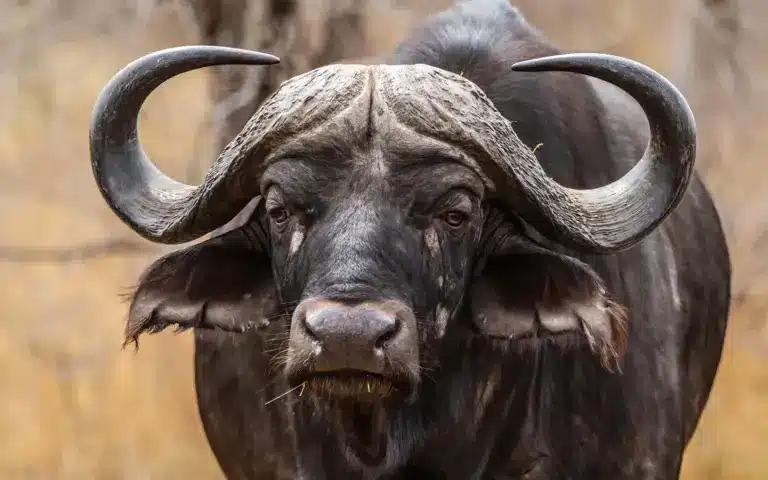
About Cape buffalo:
- The African or Cape buffalo (Syncerus caffer) is a formidable and aggressive species.
- It is one of the four subspecies of African Buffalo found south of the Sahara, the others being the forest buffalo, the West African Savanna Buffalo and the Central African Savanna Buffalo.
- Appearance
- Compared with other large bovids, African buffalo have long but stocky bodies and short but thickset legs, resulting in a relatively short standing height.
- The adult buffalo’s horns are its characteristic feature: they have fused bases, forming a continuous bone shield across the top of the head referred to as a “boss”.
- Habitat: They live in swamps and floodplains, as well as mopane grasslands, and the forests of the major mountains of Africa.
- They prefer a habitat with dense cover, such as reeds and thickets, but can also be found in open woodland, montane grasslands, and forest, savannas, and moist lowland rainforests.
- African buffalo may be active throughout the day and night. They are social and live in herds that consist of related females, and their offspring, in an almost linear dominance hierarchy.
- Distribution: The Cape Buffalo is found across the savannas of east and southern Africa.
- Diet: African buffalo have a strictly herbivorous (graminivorous, folivorous) diet. They feed on a wide variety of grasses, sedges, leaves, and other plants.
- These massive animals are also excellent swimmers and often cross rivers in search of better grazing.
- Conservation status
- IUCN: Near Threatened
Q1: What is Savannas?
It is a vegetation type that grows under hot, seasonally dry climatic conditions and is characterized by an open tree canopy above a continuous tall grass understory (the vegetation layer between the forest canopy and the ground).
News: Ngorongoro study offers insights into why humans & Cape buffalo are coming into conflict in Africa






 Last updated on March, 2026
→ UPSC Final Result 2025 is now out.
→ UPSC has released UPSC Toppers List 2025 with the Civil Services final result on its official website.
→ Anuj Agnihotri secured AIR 1 in the UPSC Civil Services Examination 2025.
→ UPSC Marksheet 2025 is now out.
→ UPSC Notification 2026 & UPSC IFoS Notification 2026 is now out on the official website at upsconline.nic.in.
→ UPSC Calendar 2026 has been released.
→ Check out the latest UPSC Syllabus 2026 here.
→ UPSC Prelims 2026 will be conducted on 24th May, 2026 & UPSC Mains 2026 will be conducted on 21st August 2026.
→ The UPSC Selection Process is of 3 stages-Prelims, Mains and Interview.
→ Prepare effectively with Vajiram & Ravi’s UPSC Prelims Test Series 2026 featuring full-length mock tests, detailed solutions, and performance analysis.
→ Enroll in Vajiram & Ravi’s UPSC Mains Test Series 2026 for structured answer writing practice, expert evaluation, and exam-oriented feedback.
→ Join Vajiram & Ravi’s Best UPSC Mentorship Program for personalized guidance, strategy planning, and one-to-one support from experienced mentors.
→ Shakti Dubey secures AIR 1 in UPSC CSE Exam 2024.
→ Also check Best UPSC Coaching in India