AWD Latest News
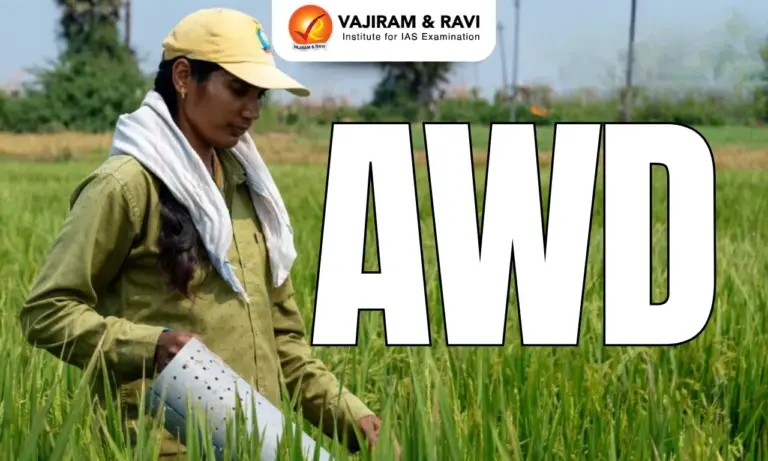
- Getting farmers to adopt climate-friendly practices is challenging, especially when it involves high upfront costs, new machinery, or risks of yield loss. The challenge is sharper in India, where over 86% of farmers are small or marginal, holding 2 hectares or less.
- In this context, low-effort, high-impact agricultural practices become crucial. One such practice in rice cultivation is Alternate Wetting and Drying (AWD), which offers climate benefits without heavy investment or productivity losses.
Traditional Rice Cultivation and Methane Emissions
- In traditional rice cultivation, paddy seeds are first raised in nurseries and transplanted after 25–30 days into the main field, which is about ten times larger than the nursery area.
- After transplantation, the crop typically grows for 90–100 days, extending to 120 days or more for some varieties.
- For nearly the first 65 days of the cropping period, fields are kept continuously flooded with 4–5 cm of standing water.
- This practice mainly helps suppress weeds by creating oxygen-deficient conditions that prevent weed seed germination.
- Flooding becomes less necessary after the vegetative growth and tillering stage, when panicle formation begins.
Methane Formation in Flooded Fields
- Continuous flooding creates an anaerobic soil environment, ideal for methanogenic microbes that decompose organic matter.
- During this process, carbon from plant residues reacts with hydrogen from water, producing methane.
- Methane is a highly potent greenhouse gas, with a global warming potential about 28 times greater than carbon dioxide over a 100-year period, making flooded rice cultivation a significant contributor to agricultural emissions.




Alternate Wetting and Drying (AWD): A Climate-Friendly Alternative
- Alternate Wetting and Drying (AWD) replaces continuous flooding with periodic drying and re-flooding of paddy fields.
- This breaks the anaerobic conditions that favour methane-producing microbes, thereby reducing emissions.
AWD Schedule in Practice
- Farmers are advised to:
- Keep fields flooded for the first 20 days after transplantation
- During days 21–65, allow the field to dry for two cycles of six days each, draining water to 10–15 cm below the soil surface before re-flooding
Field Evidence from Telangana
- A study by Mitti Labs Ltd during the 2024 kharif season covered 30 paddy fields across three villages in Warangal district.
- 15 fields followed AWD
- 15 fields followed continuous flooding (CF)
- Water use: AWD fields used 3.14 million litres per acre, compared to 4.96 million litres under CF
- Methane emissions: AWD emitted 3.5 tonnes CO₂-equivalent per hectare, versus 6 tonnes under CF
- Crucially, grain yields remained unchanged at about 2.5 tonnes per acre under both AWD and CF.
- This makes AWD a low-effort, high-impact practice that conserves water and cuts emissions without affecting productivity.
Carbon Credits: A New Income Stream for Rice Farmers
- Alternate Wetting and Drying (AWD) offers farmers more than resource efficiency.
- Experts highlight AWD’s potential to generate carbon credits, enabling farmers to monetise methane reductions.
- Carbon credits are built on direct methane measurements using field chambers, laboratory analysis, geo-tagging, boundary mapping, and satellite imagery—creating a rigorous monitoring, reporting, and verification (MRV) system suitable for domestic and international markets.
- Data centres, airlines, and other energy- and water-intensive industries purchase credits to offset emissions and meet net-zero targets, driving demand for verified agricultural abatement.
Farmer Earnings Potential
- Methane abatement credits trade at $15–25 per tonne CO₂e.
- With ~2.5 tCO₂e/ha reduced per crop, farmers can earn ~$37.5/ha—about ₹3,367 per hectare (₹1,363 per acre) per crop.
- With India the world’s largest rice producer and exporter, AWD-linked carbon markets present a scalable, farmer-friendly pathway to raise incomes while cutting emissions—an opportunity whose time has arrived.

 Last updated on March, 2026
→ UPSC Final Result 2025 is now out.
→ UPSC has released UPSC Toppers List 2025 with the Civil Services final result on its official website.
→ Anuj Agnihotri secured AIR 1 in the UPSC Civil Services Examination 2025.
→ UPSC Marksheet 2025 is now out.
→ UPSC Notification 2026 & UPSC IFoS Notification 2026 is now out on the official website at upsconline.nic.in.
→ UPSC Calendar 2026 has been released.
→ Check out the latest UPSC Syllabus 2026 here.
→ UPSC Prelims 2026 will be conducted on 24th May, 2026 & UPSC Mains 2026 will be conducted on 21st August 2026.
→ The UPSC Selection Process is of 3 stages-Prelims, Mains and Interview.
→ Prepare effectively with Vajiram & Ravi’s UPSC Prelims Test Series 2026 featuring full-length mock tests, detailed solutions, and performance analysis.
→ Enroll in Vajiram & Ravi’s UPSC Mains Test Series 2026 for structured answer writing practice, expert evaluation, and exam-oriented feedback.
→ Join Vajiram & Ravi’s Best UPSC Mentorship Program for personalized guidance, strategy planning, and one-to-one support from experienced mentors.
→ Shakti Dubey secures AIR 1 in UPSC CSE Exam 2024.
→ Also check Best UPSC Coaching in India
AWD FAQs
Q1. Why are carbon credits relevant for rice farmers in India?+
Q2. What is Alternate Wetting and Drying (AWD)?+
Q3. How does AWD reduce methane emissions?+
Q4. How much can farmers earn from methane reduction?+
Q5. Who buys carbon credits generated from rice farming?+
Tags: AWD mains articles upsc current affairs upsc mains current affairs