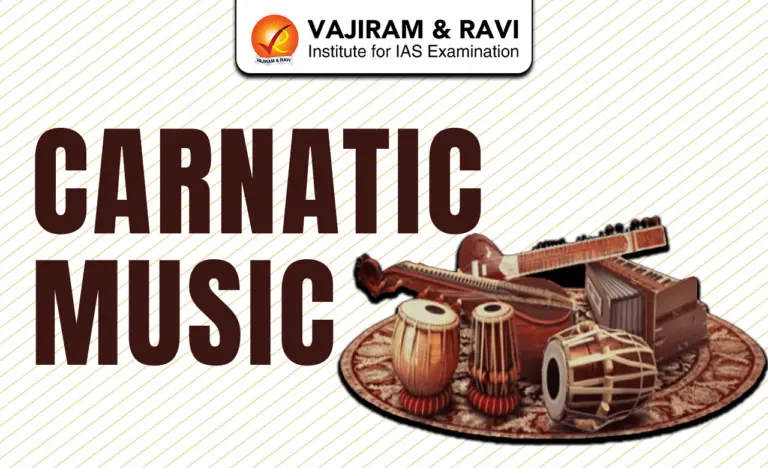
Carnatic music is a classical music tradition of South India, rooted in ancient Vedic chants and known for its structured system of raga (melody) and tala (rhythm). It developed in states like Tamil Nadu and Karnataka and was enriched by great composers such as Purandaradasa and the Carnatic Trinity. The music includes various forms like Varnam, Kriti, Kirtanam, and Pallavi, which emphasize both composition and improvisation.
Carnatic Music Origin
Carnatic music derives its name from the Sanskrit term Karnâtaka Sangîtam, which means “traditional” or “codified music.” This reflects its highly structured and classical nature.
The roots of Carnatic music can be traced back to the ancient Vedic period, especially the Samaveda, where chants and melodies laid the foundation for the development of ragas and musical patterns. Over time, this evolved into a refined system based on two main elements:
- Raga (Melody): Defines the musical framework and emotional expression
- Tala (Rhythm): Governs the timing and rhythmic cycles
Carnatic music developed mainly in the South Indian states of Tamil Nadu, Kerala, Andhra Pradesh, and Karnataka, which are known for preserving Dravidian culture and traditions.
Musical Forms of Carnatic Music
Carnatic music includes a variety of structured compositions, each with unique characteristics:
- Gitam: The simplest form with a smooth and melodious flow, ideal for beginners.
- Suladi: A composition that combines multiple talas (rhythmic patterns).
- Svarajati: Contains three parts—Pallavi, Anupallavi, and Charanam; themes are devotional, heroic, or romantic.
- Jatisvaram: Focuses on rhythm and musical patterns without lyrical content.
- Varnam: A complex and important form used for practice and performance; unique to Carnatic music.
- Kirtanam: Devotional songs emphasizing bhakti (devotion).
- Kriti: A refined and advanced form evolved from Kirtanam; central to Carnatic performances.
- Pallavi: The most creative form allowing improvisation and showcasing musical expertise.






Carnatic Music and the Bhakti Movement
Carnatic music flourished during the Bhakti Movement (7th–15th century CE). Devotion became the central theme, and music was used as a medium to connect with the divine. Saint-composers like Purandaradasa and the Carnatic Trinity composed songs dedicated to deities like Lord Rama, Krishna, and Shiva. These compositions are still widely performed today and form the backbone of Carnatic music.
Adaptation of Carnatic Music in Modern Times
Carnatic music has successfully adapted to modern times through the influence of technology and globalization, making it more accessible to a wider audience. While digital platforms have expanded its reach, they have also brought challenges to its traditional learning methods and originality.
- Technology has transformed learning through online classes, video tutorials, and virtual concerts.
- Platforms like YouTube and streaming apps have helped artists reach global audiences.
- Digital recordings and music apps have made preservation and sharing easier.
- Social media has increased popularity among younger generations.
- Traditional Guru-Shishya Parampara is gradually declining due to modern learning methods.
- Short-form content has reduced the depth and detailed understanding of compositions.
- Fusion music and collaborations have introduced Carnatic music to new genres.
- Global performances and festivals have increased international recognition.
- Accessibility has improved, allowing learners from any part of the world to study Carnatic music.
Also Read: Classical Music of India
Difference Between Carnatic and Hindustani Music
Carnatic and Hindustani music are the two main traditions of Indian classical music, each with its own style, history, and cultural influence. While Carnatic music is more structured and rooted in South Indian traditions, Hindustani music is more flexible and influenced by Persian and Islamic elements.
| Difference Between Carnatic and Hindustani Music | ||
|
Basis |
Carnatic Music |
Hindustani Music |
|
Region |
South India (Tamil Nadu, Karnataka, Kerala, Andhra Pradesh) |
North India |
|
Origin |
Ancient and preserved in original form |
Developed with Persian & Islamic influence after medieval period |
|
Nature |
More structured, disciplined, and intellectual |
More flexible, expressive, and imaginative |
|
Cultural Influence |
Purely Indian (Dravidian traditions) |
Mixed culture (Indian + Persian + Islamic) |
|
Main Elements |
Raga and Tala with strict rules |
Raga and Tala with more freedom |
|
Importance of Composition |
Fixed compositions (Kriti-based) are central |
Improvisation plays a bigger role |
|
Improvisation Style |
Alapana, Niraval, Kalpnaswaram, Ragam-Tanam-Pallavi |
Alap, Taan, Bol improvisation |
|
Famous Forms |
Varnam, Kriti, Kirtanam, Pallavi |
Dhrupad, Khayal, Thumri, Tarana, Ghazal |
|
Language Used |
Mainly Telugu, Sanskrit, Tamil, Kannada |
Mainly Hindi, Urdu, Persian |
|
Gharana System |
No gharana system |
Strong gharana tradition (Jaipur, Gwalior, Kirana, etc.) |
|
Performance Style |
Fast-paced and composition-oriented |
Slow, gradual development of raga |
|
Instruments Used |
Veena, Mridangam, Violin, Ghatam |
Sitar, Tabla, Sarod, Flute |
|
Focus |
Devotional (Bhakti-based) |
Both devotional and romantic/secular |
|
Uniformity |
More uniform across regions |
Varies across gharanas and regions |

 Last updated on April, 2026
→ UPSC Final Result 2025 is now out.
→ UPSC has released UPSC Toppers List 2025 with the Civil Services final result on its official website.
→ Anuj Agnihotri secured AIR 1 in the UPSC Civil Services Examination 2025.
→ UPSC Marksheet 2025 is now out.
→ UPSC Notification 2026 & UPSC IFoS Notification 2026 is now out on the official website at upsconline.nic.in.
→ UPSC Calendar 2026 has been released.
→ Check out the latest UPSC Syllabus 2026 here.
→ UPSC Prelims 2026 will be conducted on 24th May, 2026 & UPSC Mains 2026 will be conducted on 21st August 2026.
→ The UPSC Selection Process is of 3 stages-Prelims, Mains and Interview.
→ Prepare effectively with Vajiram & Ravi’s UPSC Prelims Test Series 2026 featuring full-length mock tests, detailed solutions, and performance analysis.
→ Enroll in Vajiram & Ravi’s UPSC Mains Test Series 2026 for structured answer writing practice, expert evaluation, and exam-oriented feedback.
→ Join Vajiram & Ravi’s Best UPSC Mentorship Program for personalized guidance, strategy planning, and one-to-one support from experienced mentors.
→ Shakti Dubey secures AIR 1 in UPSC CSE Exam 2024.
→ Also check Best UPSC Coaching in India
Carnatic Music FAQs
Q1. What is Carnatic music?+
Q2. Who is the father of Carnatic music?+
Q3. What are the main elements of Carnatic music?+
Q4. What is the Melakarta system?+
Q5. How is Carnatic music different from Hindustani music?+
Tags: carnatic music performing arts