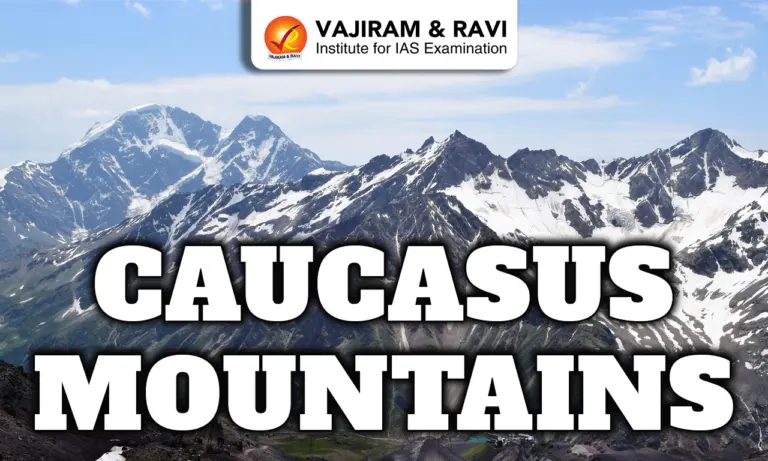
The Caucasus Mountains form a major mountain system located between the Black Sea and the Caspian Sea, acting as a natural boundary between Europe and Asia. The region lies across Russia, Georgia, Azerbaijan, and Armenia, and is known for its rugged terrain, high peaks, and exceptional ethnic diversity. Historically, it has served both as a barrier and a bridge for cultural interaction between Europe and Asia.
Caucasus Mountains Location and Extent
- The Caucasus Mountains stretch for about 1200 km from the Taman Peninsula near the Black Sea to the Abşeron Peninsula near the Caspian Sea.
- The region includes two main mountain ranges: the Greater Caucasus in the north and the Lesser Caucasus in the south.
- The area north of the Greater Caucasus is known as Ciscaucasia, while the area to the south is called Transcaucasia.
- The region extends from the Kuma-Manych Depression in the north to the borders of Turkey and Iran in the south.
- It covers an area of about 4,40,000 sq. km and forms an important geographical transition zone between Europe and Asia.
Caucasus Mountains Physiography and Geology
- The Greater Caucasus range forms the main axis of the system and contains the highest peak, Mount Elbrus, which rises to 5642 metres.
- The range consists of several high peaks such as Shkhara, Kazbek, and Dykhtau, many exceeding 4800 metres.
- The Lesser Caucasus lies to the south and is connected to the Armenian Highland, with peaks like Mount Aragats.
- Between the two ranges lies the Kura-Aras Lowland, an important depression with fertile plains.
- The Kolkhida Lowland near the Black Sea is another significant lowland region.
- Geologically, the Caucasus Mountains were formed as part of the Alpine orogeny about 25 million years ago and consist of folded rocks, volcanic deposits, and sedimentary layers.
- The region remains tectonically active, with frequent earthquakes and volcanic features.





Caucasus Mountains Drainage System
- The Caucasus has a well-developed drainage system, with rivers flowing into different seas.
- Rivers such as the Kura and Aras flow into the Caspian Sea, while the Rioni and Inguri drain into the Black Sea.
- The Kuban River flows into the Sea of Azov.
- Snowmelt plays an important role in river flow, causing floods in spring.
- Many rivers in limestone regions show underground flow due to karst topography.
- The region also contains important lakes such as Lake Sevan.
- Glaciers are found in the Greater Caucasus, especially on the northern slopes, contributing to river systems.
Caucasus Mountains Climate
- The Caucasus Mountains act as a climatic barrier, influencing the movement of air masses between north and south.
- The northern region (Ciscaucasia) has a more continental climate, while the southern region (Transcaucasia) has milder conditions.
- The western part near the Black Sea has a humid subtropical climate with heavy rainfall.
- The eastern part is drier and more continental, especially around the Kura-Aras Lowland.
- Temperature varies with altitude, with cold alpine conditions at higher elevations.
- Precipitation is highest on the southern slopes facing the Black Sea and decreases toward the east.
Caucasus Mountains Soils
- Soil types vary widely due to differences in climate and relief.
- Fertile black soils are found in parts of the northern plains and are suitable for agriculture.
- Mountain soils are thin and less developed due to steep slopes and erosion.
- In arid regions, soils are often saline and less productive.
- Soil fertility generally decreases with increasing altitude.
Caucasus Mountains Natural Vegetation
- Vegetation in the Caucasus shows clear regional variation.
- The western region has dense forests with oak, beech, and chestnut due to high rainfall.
- The eastern region has steppe and semi-desert vegetation due to lower rainfall.
- Subtropical vegetation is found in lowlands near the Black Sea.
- At higher altitudes, forests give way to alpine meadows and eventually to snow-covered zones.
- The region supports a wide variety of plant species due to climatic diversity.
Caucasus Mountains Fauna
- The Caucasus is rich in biodiversity and includes several endemic species.
- Mammals such as bears, deer, lynx, and mountain goats are commonly found.
- Unique species like the Caucasian tur and mountain turkey are adapted to high altitudes.
- The region also supports birds, reptiles, and small mammals suited to different environments.
- Faunal diversity reflects the varied climatic and ecological conditions of the region.
Caucasus Mountains Human Geography
- The Caucasus is one of the most ethnically diverse regions in the world, with more than 50 ethnic groups.
- Major communities include Russians, Georgians, Armenians, and Azerbaijanis.
- The population is concentrated in fertile valleys, lowlands, and coastal areas.
- Mountain regions are sparsely populated due to harsh conditions.
- The region has historically served as a cultural link between Europe and Asia.
Caucasus Mountains Economic Activities
- Agriculture is well developed in fertile lowlands, with crops such as wheat, fruits, tea, and grapes.
- Pastoralism is practiced in mountainous areas, mainly involving sheep and cattle.
- The region is rich in natural resources such as oil, natural gas, coal, and metallic minerals.
- Hydroelectric power generation is significant due to numerous rivers.
- Tourism is important, especially in areas with scenic landscapes and favourable climate.

 Last updated on March, 2026
→ UPSC Final Result 2025 is now out.
→ UPSC has released UPSC Toppers List 2025 with the Civil Services final result on its official website.
→ Anuj Agnihotri secured AIR 1 in the UPSC Civil Services Examination 2025.
→ UPSC Marksheet 2025 is now out.
→ UPSC Notification 2026 & UPSC IFoS Notification 2026 is now out on the official website at upsconline.nic.in.
→ UPSC Calendar 2026 has been released.
→ Check out the latest UPSC Syllabus 2026 here.
→ UPSC Prelims 2026 will be conducted on 24th May, 2026 & UPSC Mains 2026 will be conducted on 21st August 2026.
→ The UPSC Selection Process is of 3 stages-Prelims, Mains and Interview.
→ Prepare effectively with Vajiram & Ravi’s UPSC Prelims Test Series 2026 featuring full-length mock tests, detailed solutions, and performance analysis.
→ Enroll in Vajiram & Ravi’s UPSC Mains Test Series 2026 for structured answer writing practice, expert evaluation, and exam-oriented feedback.
→ Join Vajiram & Ravi’s Best UPSC Mentorship Program for personalized guidance, strategy planning, and one-to-one support from experienced mentors.
→ Shakti Dubey secures AIR 1 in UPSC CSE Exam 2024.
→ Also check Best UPSC Coaching in India
Caucasus Mountains FAQs
Q1. Where are the Caucasus Mountains located?+
Q2. What is the highest peak in the Caucasus Mountains?+
Q3. How do the Caucasus Mountains affect climate?+
Q4. What type of climate is found in the Caucasus Mountains?+
Q5. What is the drainage pattern of the Caucasus Mountains?+
Q6. What kind of vegetation is found in the Caucasus Mountains?+
Tags: caucasus mountains